1
Introduction
Introduction
This manual covers the operation and basic maintenance of Head and Torso Simulator Type
4128-C and its accessories; Right Ear Simulator Type 4158-C, Left Ear Simulator Type 4159-C
and Handset Positioner for HATS Type 4606. The manual is divided into two parts with the first
part covering Types 4128-C, Type 4158-C and Type 4159-C, and the second part covering the
Handset Positioner for HATS Type 4606.
Head and Torso Simulator Type 4128-C
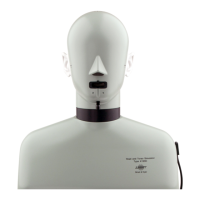
Head and Torso Simulator (HATS) Type 4128-C consists of a head mounted on a torso, both of
which represent the international average dimensions of a human adult. In airborne acoustic
measurements it provides correct simulation of the acoustic field around a human head and torso as
specified in ITU-T Rec. P58 and IEC60318–7. You can use HATS free-standing, or fitted on a
tripod or turntable using the tripod mounting adaptor.
The Mouth Simulator
The mouth simulator in HATS has a high-compliance loudspeaker that gives powerful low-
frequency response and low distortion. The acoustic transmission path from the loudspeaker to the
mouth opening ensures an easily equalisable frequency response of the sound pressure level in
front of the mouth. The equivalent lip plane containing the ITU-T Center of Lip (CL) is 6 mm in
front of the mouth opening. The usual calibration position is at the ITU-T Mouth Reference Point
(MRP), 25mm in front of this plane. A chin clip is supplied with Type 4128-C that will hold a 1/4
reference microphone at precisely the correct distance for calibration at the MRP.
This chin clip can also hold a microphone at the opening of the mouth if you want to monitor or
equalise the sound pressure at this point. Type 4128-C comes with an additional chin clip
(Reference Microphone Holder UA-2127) for replacement.
The mouth simulator produces a sound-pressure distribution around the opening of the mouth that
simulates that of a median adult human mouth, correlating with the figures given in ITU-T Rec. P.58.
The position of the acoustic center of the mouth simulator also follows that of humans over the
speech frequency range.


 To Next Page
 Loading...