EasyManua.ls Logo

Bryant 394HAD - User Manual

Bryant 394HAD
8 pages
Print Icon
To Next Page IconTo Next Page
Loading...
NOTE: Read the entire instruction manual before starting the
installation.
These procedures are for sizes 65,000 through 150,000 Btuh units.
Index Page
SAFETY CONSIDERATIONS.....................................................1
CARE AND MAINTENANCE..................................................1-5
Air Filter Arrangement..........................................................2-3
Blower Motor and Wheel......................................................3-4
Cleaning Heat Exchanger......................................................4-5
Electrical Controls and Wiring.................................................5
Pilot ...........................................................................................5
Troubleshooting ........................................................................5
Unit Wiring Diagram ............................................................6-7
Troubleshooting Chart ..............................................................8
SAFETY CONSIDERATIONS
Installing and servicing heating equipment can be hazardous due to
gas and electrical components. Only trained and qualified person-
nel should install, repair, or service heating equipment.
Untrained personnel can perform basic maintenance functions
such as cleaning and replacing air filters. All other operations must
be performed by trained service personnel. When working on
heating equipment, observe precautions in the literature, on tags,
and on labels attached to or shipped with the unit and other safety
precautions that may apply.
Follow all safety codes. In the United States, follow all safety
codes including the National Fuel Gas Code NFPA No. 54-
1992/ANSI Z223.1-1992 (NFGC). In Canada, refer to the current
edition of the National Standard of Canada CAN/CGA-B149.1-
and .2-M91 Natural Gas and Propane Gas Installation Codes
(NSCNGPIC). Wear safety glasses and work gloves. Have fire
extinguisher available during start-up and adjustment procedures
and service calls.
Recognize safety information. This is the safety-alert symbol
.
When you see this symbol on the furnace and in instructions or
manuals, be alert to the potential for personal injury.
Understand the signal word DANGER, WARNING, or CAU-
TION. These words are used with the safety-alert symbol. DAN-
GER identifies the most serious hazards which will result in severe
personal injury or death. WARNING signifies a hazard that could
result in personal injury or death. CAUTION is used to identify
unsafe practices which would result in minor personal injury or
product and property damage. NOTE is used to highlight sugges-
tions that will result in enhanced installation, reliability, or
operation.
WARNING: The ability to properly perform mainte-
nance on this equipment requires certain expertise, me-
chanical skills, tools, and equipment. If you do not
possess these, do not attempt to perform any maintenance
on this equipment other than those procedures recom-
mended in the User’s Manual. FAILURE TO FOLLOW
THIS WARNING COULD RESULT IN POSSIBLE
DAMAGE TO THIS EQUIPMENT, SERIOUS PER-
SONAL INJURY, OR DEATH.
CARE AND MAINTENANCE
For continuing high performance and to minimize possible equip-
ment failure, it is essential that periodic maintenance be performed
on this equipment. Consult your local dealer as to the proper
frequency of maintenance and the availability of a maintenance
contract.
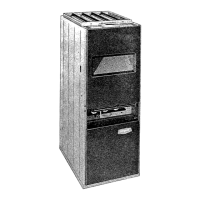
Fig. 2—Model 394HAD Upflow
A92057
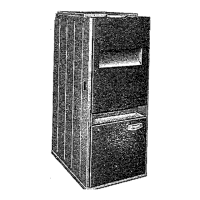
Fig. 1—Model 396HAD
Downflow
A92058
®
ama
CANADIAN GAS ASSOCIATION
A PPR O V ED
R
service and
maintenance procedures
GAS-FIRED
INDUCED-COMBUSTION FURNACES
Cancels: SP04-13 SP04-19
11-1-93
394HAD
396HAD
Series C
—1—

Other manuals for Bryant 394HAD

Questions and Answers

Summary

Safety Considerations

General Safety Precautions

Discusses hazards, qualifications, safety codes, symbols, and signal words for safe operation.

Operational Safety Warnings

Emphasizes safety during operation, including power, filter presence, and storage of items near the furnace.

Care and Maintenance

Air Filter Arrangement and Maintenance

Details air filter arrangements, cleaning procedures, and replacement guidelines for furnace filters.

Blower Motor and Wheel Service

Provides instructions for cleaning and lubricating the blower motor and wheel, including disassembly steps.

Heat Exchanger Cleaning Procedure

Outlines the procedure for cleaning the heat exchanger, including soot and carbon deposit removal.

Electrical Controls and Wiring Checks

Details checks for electrical connection tightness, fuses, and proper operation of controls and wiring.

Pilot Inspection and Cleaning

Provides guidance on checking and cleaning the pilot at the start of the heating season for proper operation.

Troubleshooting Guide

Directs users to a troubleshooting chart for isolating furnace operation problems and verifying component function.

Summary

Safety Considerations

General Safety Precautions

Discusses hazards, qualifications, safety codes, symbols, and signal words for safe operation.

Operational Safety Warnings

Emphasizes safety during operation, including power, filter presence, and storage of items near the furnace.

Care and Maintenance

Air Filter Arrangement and Maintenance

Details air filter arrangements, cleaning procedures, and replacement guidelines for furnace filters.

Blower Motor and Wheel Service

Provides instructions for cleaning and lubricating the blower motor and wheel, including disassembly steps.

Heat Exchanger Cleaning Procedure

Outlines the procedure for cleaning the heat exchanger, including soot and carbon deposit removal.

Electrical Controls and Wiring Checks

Details checks for electrical connection tightness, fuses, and proper operation of controls and wiring.

Pilot Inspection and Cleaning

Provides guidance on checking and cleaning the pilot at the start of the heating season for proper operation.

Troubleshooting Guide

Directs users to a troubleshooting chart for isolating furnace operation problems and verifying component function.

Overview

This document describes the service and maintenance procedures for Bryant Day & Night and Payne gas-fired induced-combustion furnaces, specifically models 394HAD and 396HAD Series C. These procedures are applicable to units ranging from 65,000 to 150,000 Btuh.

Function Description

The furnaces are designed for residential heating applications, utilizing induced combustion to efficiently burn natural gas or propane. The induced draft motor pulls combustion air through the heat exchanger and expels flue gases, ensuring proper combustion and preventing the escape of harmful gases into the living space. A blower motor circulates heated air throughout the building's ductwork. The units incorporate various safety features, including a draft safeguard switch, limit switches, and a pressure switch, to monitor and control operation, ensuring safe and reliable performance. The control board manages the sequence of operation, including ignition, fan operation, and safety shutdowns.

Usage Features

The furnaces are designed for either upflow (394HAD) or downflow (396HAD) installations, accommodating different ductwork configurations. They are equipped with permanent, washable air filters, which are crucial for maintaining indoor air quality and protecting internal components from dust and debris. The filter arrangement varies by model and installation type, with upflow models typically having filters in the blower compartment and downflow models having them in the return-air duct. The units are designed for use with a thermostat to control heating cycles. The blower speed selector allows for adjustment of airflow, which can be optimized for heating and cooling demands. The control board includes a 3-amp automotive-type fuse for protection against electrical shorts in the 24-volt circuit.

Maintenance Features

Regular maintenance is essential for the longevity, efficiency, and safety of these furnaces. The manual emphasizes that only trained and qualified personnel should perform most service and repair tasks due to the inherent hazards of gas and electrical components. However, basic maintenance, such as cleaning and replacing air filters, can be performed by untrained personnel.

Air Filter Maintenance:

Filters should be checked monthly and cleaned or replaced more frequently if needed. The permanent, washable filters can be cleaned with tap water, spraying in the opposite direction of airflow, then rinsed and allowed to dry. Oiling or coating of these filters is not recommended. Access to filters involves removing the blower access door, which is secured by screws. For downflow models, filters are tilted towards the center of the return-air plenum for removal. For upflow models, a filter retainer clip is released.

Blower Motor and Wheel Maintenance:

The blower motor and wheel should be cleaned annually to remove accumulated dirt and grease, which can impair performance and efficiency. Lubrication of the blower motor is required for models with oil ports, with a frequency of every 5 years for intermittent operation (thermostat FAN switch in AUTO) or every 2 years for continuous operation (thermostat FAN switch in ON). Motors without oil ports have prelubricated sealed bearings and do not require lubrication. Disconnecting electrical power is mandatory before accessing the blower compartment. The procedure involves removing access doors, the vent pipe enclosure (for downflow models), the control box, and electrical leads. The blower assembly is then removed from the furnace, and the wheel and motor are disassembled for cleaning. Care must be taken not to disturb balance weights on the blower wheel. Reassembly requires proper alignment and secure connections, especially for ground wires and polarized electrical leads.

Heat Exchanger Cleaning:

Cleaning the heat exchanger is a task for qualified service technicians, as it involves significant disassembly and specialized tools. Soot and carbon deposits indicate a problem that needs correction. The process requires turning off gas and electrical power, removing access doors, the vent pipe enclosure, and the relief box. Wires to various components (draft safeguard switch, inducer motor, pressure switch, limit overtemperature switch, gas valve, and control box connector) must be disconnected. The flue collector box and inducer assembly are removed to expose the flue openings and heat exchanger cells. Cleaning is performed using a field-provided small wire brush and steel spring cable, attached to a variable-speed, reversible drill. The cable is slowly inserted into the cell openings and rotated to dislodge deposits, then removed gradually. Both upper and lower passes of the cells are cleaned. Residue is removed with a vacuum cleaner. The burner assembly is also cleaned with a soft brush attachment. After cleaning, the sealant on the flue collector is checked, and all components are reinstalled, ensuring proper alignment and secure connections.

Electrical Controls and Wiring Maintenance:

Electrical connections should be checked for tightness at the beginning of each heating season. Any smoky or burned connections require disassembly, cleaning, and secure reassembly. The 24-volt circuit is protected by a 3-amp fuse on the main control board, and only a fuse of identical size should be used for replacement. Proper electrical grounding for 115-volt wiring must be maintained.

Pilot Maintenance:

The pilot should be checked and cleaned at the beginning of each heating season. The pilot flame must be high enough to properly impinge on the flame sensing element (thermocouple) and light the main burners. Soot and carbon accumulation on the flame sensing element should be removed.

Troubleshooting:

A troubleshooting chart is provided to help isolate furnace operation problems. It guides technicians through a series of questions, starting with "Start," to identify the failed component. After replacing any component, the correct operating sequence should be verified.

The manual strongly advises against using matches or open flames to check for gas leaks, recommending a soap-and-water solution instead. It also warns against storing flammable materials or cleaning compounds near the furnace, as this can lead to corrosion, fire, personal injury, or death. The safety-alert symbol (a triangle with an exclamation mark) is used throughout the document to highlight potential hazards, with signal words like DANGER, WARNING, and CAUTION indicating the severity of the risk.

Bryant 394HAD Specifications

General IconGeneral
Model394HAD
TypeGas Furnace
Heating Capacity40, 000-120, 000 BTU/h
Blower TypeVariable Speed
Ignition TypeHot Surface Ignition
Fuel TypeNatural Gas

Related product manuals