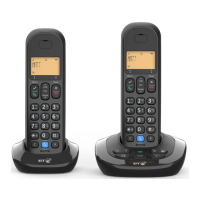
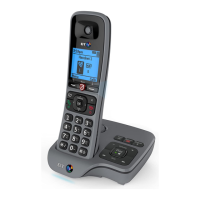
Need help?
Do you have a question about the BT BT7610 and is the answer not in the manual?
Lists all the items included in the BT7610 phone package.
Step-by-step guide for connecting the base station and charging the handset.
Instructions for setting up extra handsets in multipack purchases.
Details on safety, cleaning, and technical info, directing to the full user guide.
Explains the 12-month guarantee period and its conditions.
Guidance on recycling electrical equipment and environmental commitment.
Important warning regarding 999 calls during power outages.
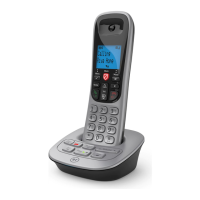
Description of handset buttons, base station lights, and controls.
Instructions for making, answering, and muting calls.
How to store, dial contacts, and manage call lists.
Details on managing messages and setting the answer delay.
Methods to block calls by type or specific numbers.
Addresses common issues like no dial tone, poor quality, or battery problems.
Guidance on using the phone with broadband and ADSL microfilters.
Information on finding FAQs, full user guides, and contacting support.
This document describes the BT7610 Digital Cordless Phone with Answering Machine, designed for easy setup and use, with a focus on managing nuisance calls.
The primary function of the BT7610 is to provide a cordless telephone system with an integrated answering machine. It allows users to make and receive phone calls, store contacts, and manage incoming messages. A key feature of this device is its ability to block nuisance calls, offering two methods: blocking by call type (e.g., withheld, international) and blocking specific numbers chosen by the user.
To begin using the BT7610, the first step is to plug in the mains power adaptor into the base unit and a wall socket. Next, the telephone line cord should be plugged into the base and a telephone wall socket. The handset batteries need to be inserted, ensuring correct polarity. The handset should then be placed on the base or charger to charge for 24 hours. Once charged, the date and time can be set. The handset display will guide the user through the setup process. For optimal battery performance, it's crucial to allow the initial 24-hour charge.
To make a call, simply press the green call button and dial the desired phone number, then press the red end call button to hang up. To answer an incoming call, lift the handset from the base or charger, or press the green call button if the handset is not on the base or charger. The device supports Caller Display, showing the caller's details before answering, provided the user has subscribed to this service from their network provider.
The BT7610 can store up to 200 contacts. To store a new contact, navigate to the "Options" menu from the home screen, select "Add contact," and then enter the name using the keypad. The phone number (home, mobile, and work) can also be entered. Once saved, contacts can be dialed by scrolling through the contact list or by searching alphabetically using the keypad.
For Caller Display and the Calls list features to work, a subscription to a Caller Display service from the network provider is required. The phone keeps a list of up to 50 incoming calls and 30 outgoing calls. New missed calls are indicated on the home screen. Users can view these lists, differentiate between call types (missed, outgoing, incoming), and dial an entry directly from the list. Entries from the calls list can also be saved as new contacts or added to existing contacts.
The integrated answering machine is ready to record messages by default. Users can record their own outgoing message by accessing the "Answer Phone" menu, selecting "Outgoing msg," and following the voice prompts. The answer delay can be adjusted in the settings to ensure compatibility with other voicemail services like BT 1571. The handset and base both have controls for playing, skipping, deleting, and managing messages.
This is a significant feature of the BT7610. It offers two ways to block unwanted calls:
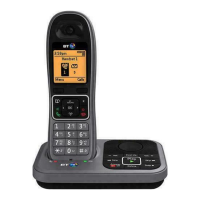
The handset features a left option button for menu access and confirmation, and a right option button for confirming options, deleting, or going back. Volume controls adjust speech volume and navigate menus. A dedicated "OK" button accesses highlighted events. The green button initiates/answers calls, and the red button ends calls or turns the handset on/off. A keypad with alphanumeric characters is used for dialing and text entry. Special keys include a recall button (R), a pound key (#) for keypad lock/unlock and case toggling, and an asterisk key (*) for ringer on/off. Speed dial buttons (2-9) allow for quick dialing of stored numbers.
The base unit has several indicator lights and control buttons. A green "In use" light indicates power and flashes during calls or registration. A red "charging" light indicates when the handset is charging. Buttons on the base allow for:
For optimal performance, only the supplied cables and batteries should be used. Ensure the mains power adaptor and telephone line cord are correctly plugged in. If using broadband on the same phone line, the phone should be plugged into the wall socket via an ADSL microfilter (not supplied), unless using BT Infinity. Poor speech quality can be improved by ensuring the product is not too close to other electrical appliances. If the battery icon is flashing or "Battery low" is displayed, the batteries need to be recharged for 24 hours to ensure maximum performance. For further assistance, a comprehensive user guide is available online, and a free helpline is provided.
 General
| Number of Handsets | 1 |
|---|---|
| Caller ID | Yes |
| Phonebook Capacity | 50 entries |
| Answering Machine | Yes |
| Range (Outdoors) | 300 meters |
| Range (Indoors) | 50m |

 To Next Page