Page 6
NOTE: Kingsley Enterprises Pty. Ltd. recommend that prior to using this
recovery equipment, users should undertake formal training from an
accredited industry body in winch use and vehicle recovery.
Calculating Fleet Angle
To obtain the best rope service, the direction of pull should be on a horizontal
plane within ±15 degrees and perpendicular to the centreline of the winch drum
within ±15 degrees. If the fleet angle is larger than the recommended angles,
incorrect spooling may occur, resulting in the rope loading onto one side of the
rope drum and possible damage to the rope or winch.
Load Rating
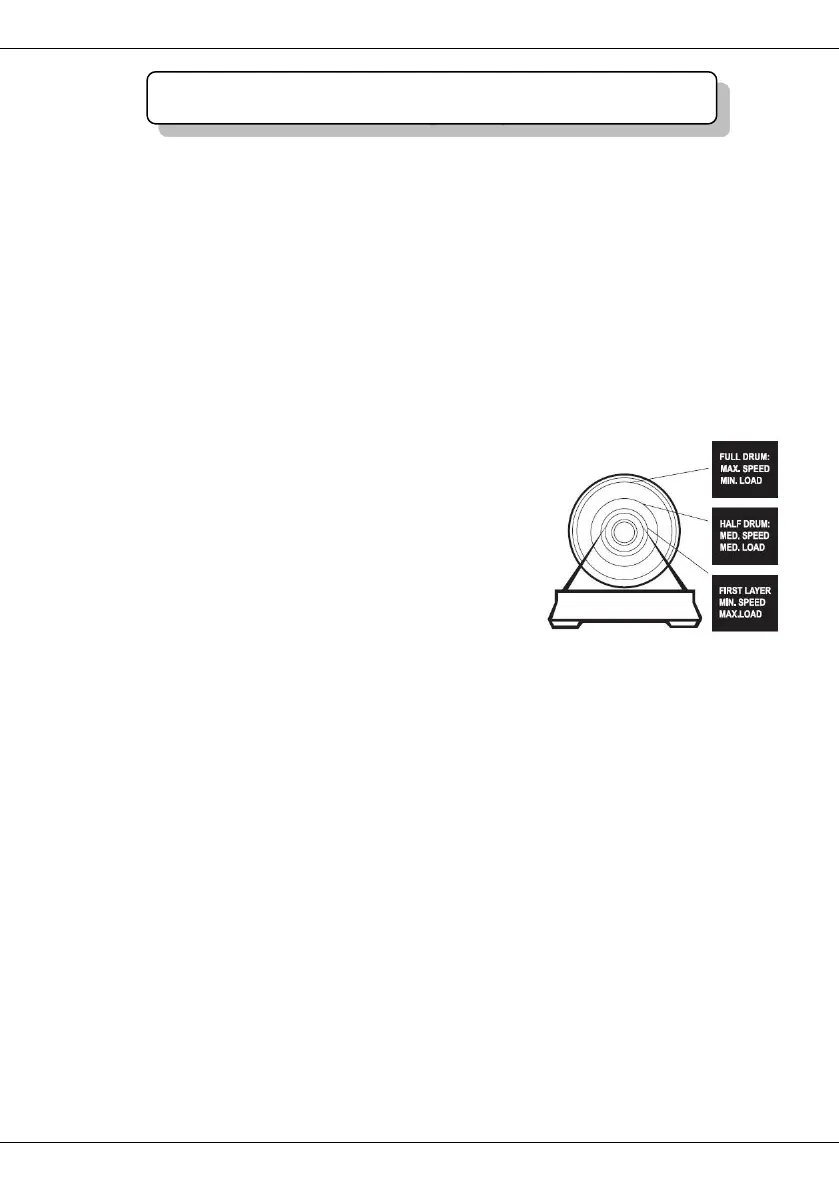
Load and speed varies according to how much rope is
on the drum. The first layer of rope on the drum
delivers the slowest speed and the maximum load. A
full drum delivers the maximum speed and the
minimum load. (Refer to winch specifications Pages 28 – 30).
For this reason, automotive winches are rated at their
first layer capacities.
Duty Cycle Ratings
Duty cycle ratings usually specify continuous, intermittent, or special duty (typically
expressed in minutes). The IEC (International Electrotechnical Commission) lists the
following ratings:
S1 - Continuous duty
The motor works at a constant load for enough time to reach temperature
equilibrium.
S2 - Short-time duty
The motor works at a constant load, but not long enough to reach temperature
equilibrium, and the rest periods are long enough for the motor to reach ambient
temperature.
S3 - Intermittent periodic duty
Sequential, identical run and rest cycles with constant load. Temperature
equilibrium is never reached. Starting current has little effect on temperature rise.
All automotive winches are rated at S3 intermittent periodic duty.


 To Next Page
 Loading...