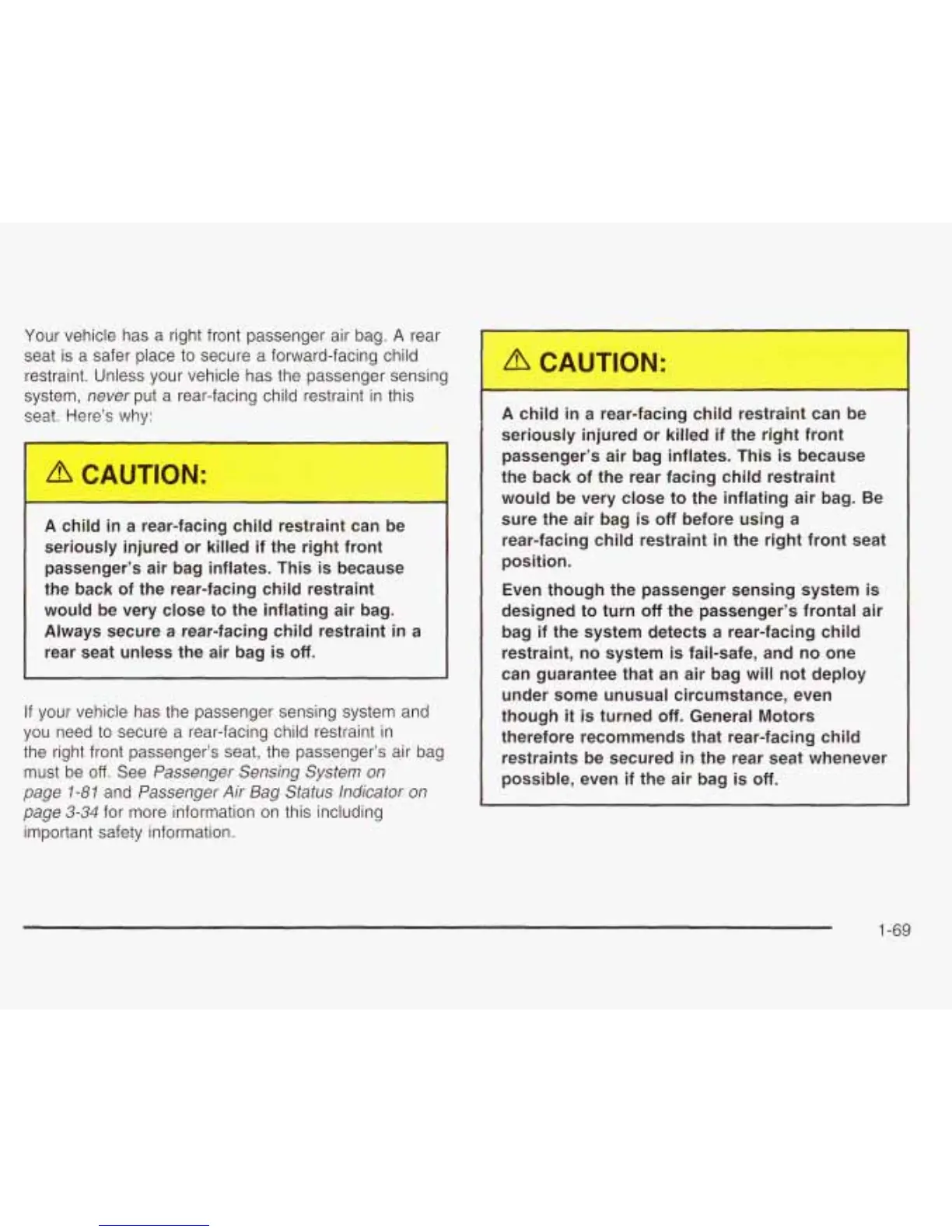
Your vehicle has a right front passenger air bag.
A
rear
seat is a safer place
to
secure a forward-facing child
restraint. Unless your vehicle has the passenger sensing
system, never put a rear-facing child restraint in this
seat. Here’s why:
A
chilu in a rear-facing child restraint can be
seriously injured or killed
if
the right front
passenger’s air bag inflates. This
is
because
the back of the rear-facing child restraint
would be very close to the inflating air bag.
Always secure a rear-facing child restraint
in
a
rear seat unless the air bag
is
off.
~~~~~ ~ ~ ~~ ~~
If
your vehicle has the passenger sensing system and
you need
to
secure a rear-facing child restraint in
the right front passenger’s seat, the passenger’s air bag
must be
off.
See Passenger Sensing System on
page
1-81
and Passenger Air Bag Status Indicator on
page
3-34
for more information on this including
important safety information.
A
-..ild
in
a rear-facing child restraint can be
seriously injured or killed if the
right
front
passenger’s air bag inflates. This is because
the back
of
the rear facing child restraint
would be very close to the inflating air bag. Be
sure the air bag
is
off
before using a
rear-facing child restraint
in
the right front seat
position.
Even though the passenger sensing system
is
designed to turn
off
the passenger’s frontal air
bag
if
the system detects a rear-facing child
restraint, no system
is
fail-safe, and no one
can guarantee that an air bag will not deploy
under some unusual circumstance, even
though it
is
turned
off.
General Motors
therefore recommends that rear-facing child
restraints be secured
in
the rear seat whenever
possible, even
if
the air bag
is
off.
1-69



 To Next Page