
 Need help?
Do you have a question about the Cafelat Robot and is the answer not in the manual?
Essential safety precautions and warnings for operating the coffee machine.
Details the capabilities and primary functions of the Robot espresso maker.
Outlines the features and functions the espresso machine does not possess.
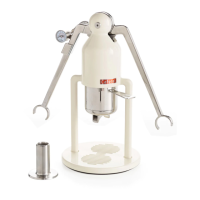
Identifies key components of the Robot espresso maker and their basic functions.
Description of the lever arms, portafilter, spouts, and basket functions.
Information regarding the professional and pressurized filter baskets.
Explains the function of the screen and tamper in the brewing process.
Step-by-step visual guide on how to operate the espresso maker.
Instructions on how to assemble the portafilter, including bottomless options.
Details the advantages of using a Bottomless Portafilter (BPF) for feedback.
Guidance on attaching and using spouts with the portafilter assembly.
Correct procedures for inserting and removing the portafilter from the main body.
Explains the design and function of the filter screen for water distribution.
Guidance on using paper filters as an alternative to the metal screen.
Advice on handling the metal screen and its fragility.
Instructions for adding coffee, tamping, adding the screen, and hot water.
Steps for locking the portafilter and initiating the espresso extraction process.
Guidance on recommended extraction times for optimal espresso.
How to stop the espresso extraction and prevent drips.
Instructions for cleaning the machine after use, focusing on puck removal.
Provides tips for using fresh coffee, grinders, and doses with the professional basket.
Discusses the concept of '9 bar' pressure and its relevance to TLCMs.
Explains how to use bathroom scales to estimate extraction pressure.
Details the pre-infusion stage for consistent and even espresso extraction.
Discusses methods to manage water temperature for better coffee quality.
Explains why spent coffee puck analysis is not meaningful for the Robot machine.
Guidance on using the pressurized basket, including dose and spout requirements.
Details the components and assembly of the optional pressure gauge kit.
Instructions for cleaning the machine parts and the main body.
Advice on lubricating the silicone seal for optimal performance.
Highlights observations that are normal and not indicative of a problem.
Diagnoses and solutions for water leaks occurring from the portafilter.
Addresses issues causing weak or watery coffee shots and provides solutions.
Troubleshooting steps for low coffee output, including grind, dose, and pressure.
Diagnoses problems related to the pressure gauge readings and potential leaks.
Addresses issues with a dented or damaged dispersion screen and potential causes.
Solutions for coffee appearing cold, focusing on water temperature and pre-heating.
Troubleshooting for overly frothy coffee when using the pressurized basket.
Solutions for difficulties in installing the portafilter into the main body.
Advice on dealing with scratches on the machine's aluminium or powder-coated finish.
Provides a table to convert scale readings to extraction bar pressure.
Lists and identifies all parts of the Robot espresso maker with their materials.
Identifies the specific parts included in the pressure gauge kit.
Details the components of the pressure gauge kit with labels and descriptions.
Guides on identifying fasteners and the metric tools required for them.
Recommendations for lubricating seals using specific silicone grease.
Details the terms and conditions of the manufacturer's warranty.
Information regarding the registration of the Robot design and patents.
 General
| Portafilter Size | 58 mm |
|---|---|
| Pressure Gauge | Optional |
| Type | Manual Lever Espresso Machine |
| Material | Stainless Steel, Aluminum |
| Width | 180mm |
| Depth | 180mm |
| Heat Source | External (requires pre-heating) |
| Pressure | User Controlled, Up to 9 Bar |
| Brewing Pressure | Manually controlled, up to 8-10 bars |
| Height | 300mm |

 To Next Page