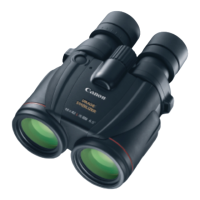
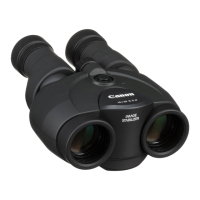
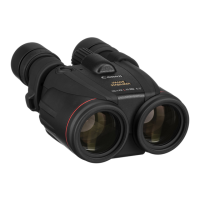
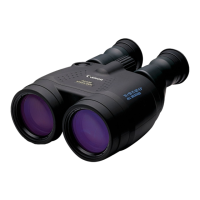
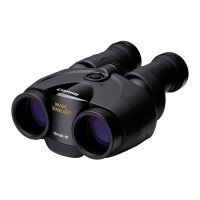
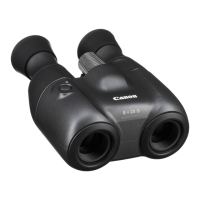
The Canon Binoculars, available in 10x30 IS II and 12x36 IS III models, are high-performance optical instruments designed for a variety of uses, including bird watching, spectator sports, theater events, and general everyday observation. These binoculars are equipped with an advanced Image Stabilizer system that utilizes a vari-angle prism, providing a steady and clear image even when handheld. The 10x30 IS II model offers a 10x magnification, while the 12x36 IS III model provides a 12x magnification, allowing users to choose the level of zoom best suited for their needs.
One of the primary functions of these binoculars is to enhance visual clarity and stability, especially in situations where minor hand movements might otherwise blur the image. The Image Stabilizer is a key feature, designed to compensate for severe shaking, ensuring a more comfortable and effective viewing experience. This stabilization system is activated by pressing and holding the Image Stabilizer button, which can be conveniently operated with either the left or right finger, catering to both left-handed and right-handed users. A lamp lights up to indicate when the Image Stabilizer is active, providing clear feedback to the user. The stabilization function ceases operation as soon as the button is released, conserving battery life. It's important to note that while the Image Stabilizer is highly effective, it may not be able to compensate for extremely severe shaking. In some rare instances, during rapid panning or similar movements, images might appear to move irregularly, which is a characteristic of the stabilization system.
Beyond image stabilization, the binoculars offer several user-friendly features for optimal viewing. Before use, the binoculars require the insertion of two AA-size alkaline batteries into the battery chamber. The battery chamber cover needs to be opened, and the batteries must be inserted with the correct positive (+) and negative (-) orientation as indicated inside the chamber. After inserting the batteries, users should press the Image Stabilizer button to confirm that the lamp lights up, indicating proper battery installation and sufficient power. The binoculars can also be powered by AA-size nickel metal hydride rechargeable batteries (Ni-MH), offering an alternative for users who prefer rechargeable options. It is crucial to always replace both batteries simultaneously with new ones of the same brand to prevent issues like leakage, ignitions, or explosions. If the binoculars are not going to be used for an extended period, or if the batteries are depleted, they should be removed to prevent potential damage from leakage or corrosion. Even without batteries, the binoculars can still be used as conventional optical instruments, albeit without the image stabilization feature.
Adjusting the binoculars for individual vision is a straightforward process. First, users need to adjust the width of the binoculars to match the distance between their eyes. This is done by looking through the eyepieces and adjusting the width until the left and right images converge into a single, clear image. This step is crucial for minimizing eye fatigue during prolonged viewing. When making this adjustment, it is recommended to look at a distant object. For individuals who wear eyeglasses, the rubber eyecups can be folded back to allow for comfortable viewing without removing their glasses.
Once the width is set, the diopter needs to be adjusted. This involves two steps: initially, the user looks through the left eyepiece only and turns the focusing knob until the object appears sharp. Subsequently, the user looks through the right eyepiece only, focusing on the same object, and turns the dioptric correction ring until the object also appears sharp through the right eye. Finally, the main focus is adjusted using the focusing knob, ensuring that the object looks sharp through both eyepieces. This comprehensive adjustment process ensures that the binoculars are perfectly tailored to the user's vision, providing a crisp and clear image.
The ergonomic design of the binoculars contributes to their ease of operation and portability. They are designed to be comfortable to hold and use for extended periods. A strap can be attached to the binoculars for convenient carrying, ensuring they are always within reach. When attaching the strap, it's important to ensure there is no slack at the clasp and that the strap does not loosen when pulled, preventing accidental drops.
Maintenance of the Canon Binoculars is essential to ensure their longevity and optimal performance. The binoculars are precision instruments and should be handled with care. They are not waterproof, so exposure to rain or water spray should be avoided. Dropping them or subjecting them to shock can cause damage, and users should never attempt to disassemble them. High temperatures can also cause malfunctions, so storing them near heaters or in direct sunlight, such as inside a car, should be avoided. Similarly, storage in environments with chemicals, such as laboratories, should be prevented to avoid rust or corrosion.
Cleaning the lenses requires a gentle approach. If the lens surface is dirty, a blower brush should first be used to remove any dust or loose particles. After that, a soft, dry cloth can be used to gently wipe the lens without scratching it. It is crucial not to use any organic solvents on the body or lenses, as these can cause damage. To prevent fungus formation or clouding of the lenses, especially if the binoculars are not used for an extended period, they should be thoroughly cleaned and stored in a well-ventilated, dry place.
When moving the binoculars from a cold environment to a warm one, condensation can form on the surfaces and internal parts due to sudden temperature changes. To prevent this, it is recommended to place the binoculars in an airtight plastic bag before transitioning them to a warmer environment. This allows them to gradually adjust to the new temperature before being taken out of the bag. The same procedure should be followed when moving them from a warm to a cold environment.
Safety precautions are paramount when using the binoculars. Users should never look directly at the sun with the binoculars, as this can cause permanent loss of vision. Placing the binoculars under direct sunlight should also be avoided, as the lenses can concentrate the sun's rays and potentially cause a fire. For households with small children, plastic bags used for packaging should be kept out of reach to prevent choking hazards. Additionally, care should be taken to ensure the strap does not accidentally wrap around the neck, which could lead to suffocation. When adjusting the width of the binoculars, especially when children are using them, users should be aware that fingers can be pinched. Prolonged use of the rubber eyecups may irritate the skin around the eyes; if this occurs, consulting a physician is advised. The binoculars should always be placed on a stable surface to prevent them from falling and causing personal injury. It is also advised not to use the binoculars while walking, as this could lead to collisions or falls and subsequent injuries.
The Canon Binoculars are constructed with "Environment Friendly Lead-Free Optical Glass," reflecting Canon's commitment to environmental care. This detail underscores the company's policy to integrate sustainable practices into its product design.



 To Next Page
 General
 Weight and Dimensions