"A"
mark.
This
is
because the aperture value
is
stored in the AEcircuit as
a
result of stopp-
ingdown the lens, and you will end up getting
incorrect automatic exposure for the next
shot, if
you fail to do that.
Generally, the depth-of-field will become
deeper as the aperture becomes smaller, and
shallower as the aperture becomes larger. A
shorter focal length as well as a greater subject
distance will also deepen the depth-of-field.
Comparing an interchangeable
28mm lens
with a standard
50mm lens set
at
the same
50
flstop, the 28mm lens's depth-of-field will be
greater. And when the photographic distance
changes, the depth-of-field changes, too. For
example, if the same subject
is
photographed
from three and then from seven meters away,
the foreground and background of the subject
will be deeper at the greater distance.
2
Depth-of-Field Scale on the Lens
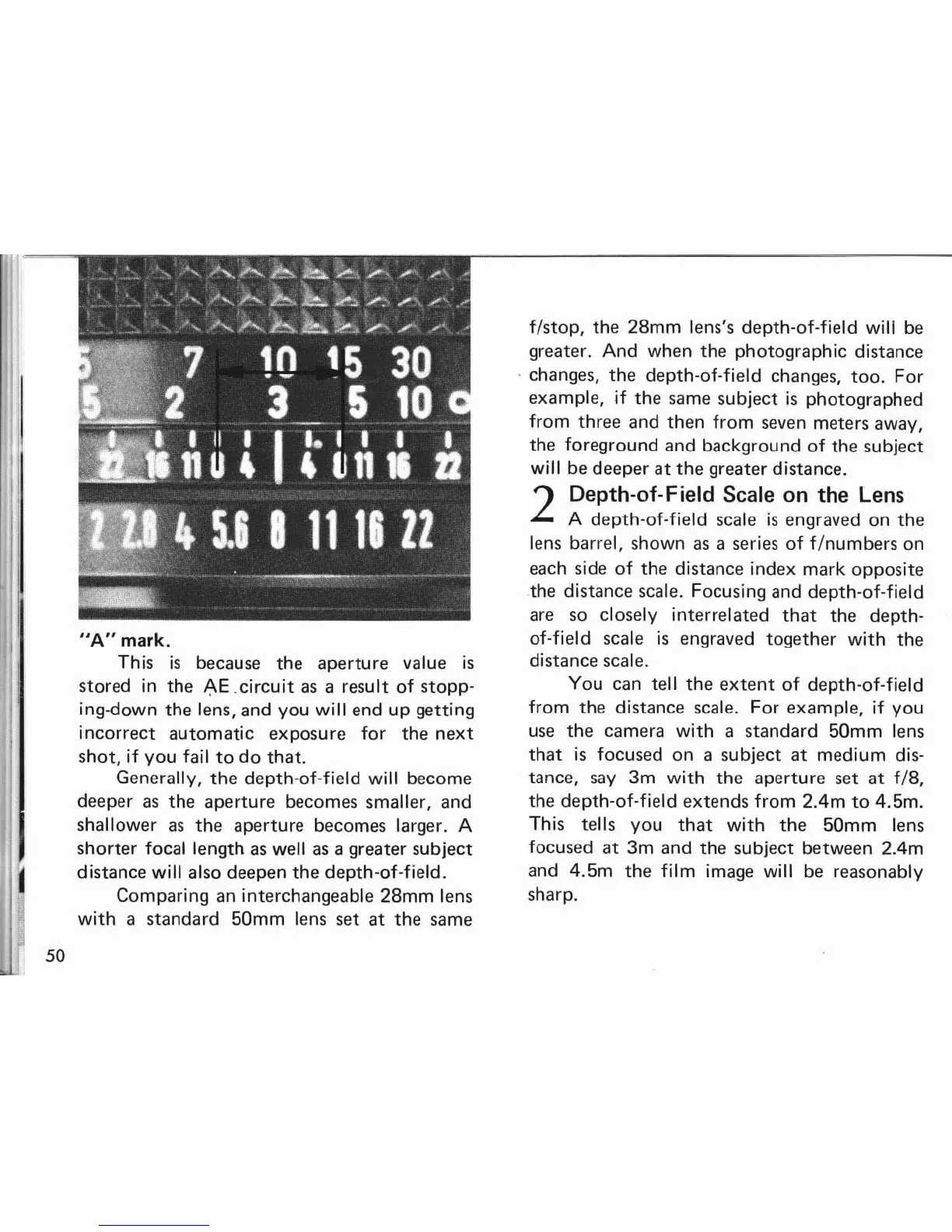
A depth-of-field scale
is
engraved on the
lens barrel, shown as
a
series of flnumbers on
each side of the distance index mark opposite
the distance scale. Focusing and depth-of-field
are so closely interrelated that the
depth-
of-field scale
is
engraved together with the
distance scale.
You can tell the extent of depth-of-field
from the distance scale. For example, if you
use the camera with a standard 50mm lens
that
is
focused on a subiect at medium dis-
tance, say
3m with the aperture set at f18,
the depth-of-field extends from 2.4m to 4.5m.
This tells you that with the 50mm lens
focused at
3m and the subject between 2.4m
and 4.5m the film image will be reasonably
sharp.


 To Next Page