Need help?
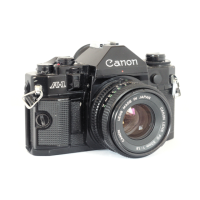
Do you have a question about the Canon AE-1 and is the answer not in the manual?
Setting aperture, loading battery, and film speed.
Framing shots and achieving sharp focus.
Camera type, size, lens mount, and viewfinder.
AE mechanism, metering system, and coupling ranges.
Shutter speeds, dial operation, release button, self-timer, and power source.
Film winding, rewinding, and flash synchronization details.
Safety devices, camera dimensions, and weight.
Securing the neckstrap and attaching the semi-hard case.
Proper use of lens protection caps.
Mounting FD lenses, with and without chrome breech-lock rings.
Mounting and dismounting lenses with chrome breech-lock rings.
Attaching a lens hood to prevent optical flare.
Key checks before mounting any lens onto the camera.
Detaching standard and breech-lock mount lenses.
List of compatible battery types for the camera.
Method to verify battery power status via viewfinder.
Procedures for opening and securing the camera's back cover.
Step-by-step guide for film insertion into the camera.
Verifying correct film loading by checking rewind knob rotation.
Adjusting the film speed setting on the camera.
How to use the shutter speed dial for exposure.
Guidance on choosing appropriate shutter speeds based on conditions.
Explanation of viewfinder focusing screens and aids.
Proper technique for pressing the shutter button to avoid shake.
Steps to rewind exposed film before removing it.
Verifying aperture and film speed settings.
Confirming correct film loading and advance.
Details on information displayed within the viewfinder.
Meter sensitivity patterns and operational range.
Table showing shutter speed and AE coupling compatibility.
Identifying and correcting overexposure using warning marks.
Using the backlight control switch for proper exposure.
How to manually control exposure settings.
Adjusting exposure by altering the film speed setting.
Operation and benefits of the built-in self-timer.
Covering the eyepiece to improve meter readings.
List of lenses incompatible with the camera's meter.
Mark indicating the exact film plane position.
How the aperture scale indicates light control.
Scale for measuring subject distance.
Scale on lens for estimating depth of field.
Available flash connection terminals and sync speeds.
The AE-1's design centered around electronic automation.
Use of advanced electronics like LSI and CPU.
High reliability and component sealing against elements.
Explanation of the shutter-speed priority system.
Key electronic components for performance.
Design for efficient energy consumption and battery life.
Benefits of Canon's FD lenses for image quality.
Imprinting date and information onto negatives.
Cleaning procedures for lenses, viewfinders, and interior.
Recommended maintenance practices and storage tips.
 General
| Film Format | 35mm |
|---|---|
| Lens Mount | Canon FD |
| Metering | Center-weighted average |
| Shutter Speed | 1/1000 sec to 2 sec, Bulb |
| ISO Range | 25-3200 |
| Exposure Modes | Manual |
| Flash Sync Speed | 1/60 second |
| Camera Type | SLR |

 To Next Page