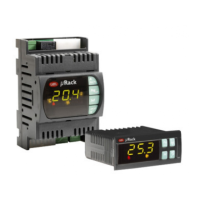
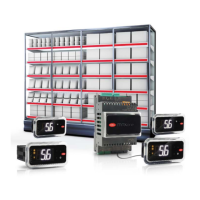
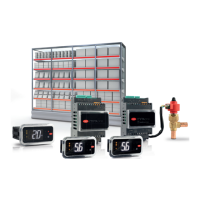
The MPXone is an electronic controller designed for centralized commercial refrigeration applications, specifically for groups of showcases requiring coordinated operation. It is available in three versions: Basic, Medium, and Advanced, which differ in the number of inputs/outputs and the type of expansion valve they can control.
Function Description
The MPXone controller offers a wide range of functionalities for refrigeration unit management. It supports various analogue inputs for controlling refrigeration unit temperature (outlet, intake, and defrost probes), superheat, saturated evaporation temperature, defrost on a second evaporator, ambient temperature, humidity, and glass temperature. Up to four virtual probes can be configured, physically connected to other devices, and shared via a supervisor for specific functions.
The Medium and Advanced versions feature two 0-10 V modulating outputs for managing anti-sweat heaters and evaporator fans. The Medium version can control an electronic expansion valve via an external driver (Fieldbus serial port), while the Advanced version integrates electronic expansion valve management (Carel unipolar).
Digital inputs can be configured for functions such as day/night switching, defrost calls, door or curtain switches, and alarm activation. The four digital outputs (relays) can control the solenoid valve/compressor, evaporator fans, defrost, lights, and/or alarms.
Key features include:
- Compact Structure: Available in both panel and DIN rail versions.
- Power Supply: 24 Vac/dc for panel-mounted models (Basic and Medium), and 115-230 Vac for DIN rail models (Medium and Advanced).
- Wireless Connectivity: NFC is standard on all versions, with optional Bluetooth (BLE) on Medium/Advanced versions.
- Commissioning Tool: The CAREL "APPLICA" app (available on Android and iOS) simplifies parameter configuration and unit commissioning.
- Network Management: Supports main/secondary network configurations (up to 9 secondary devices for Medium/Advanced, 5 for Basic).
- Serial Port: Integrated RS485 serial port for connection to supervisors and remote service systems (CAREL or Modbus protocol).
- Defrost Management: Defrost can be activated via keypad, digital input, network signal from the main controller, supervisor, or scheduled with the built-in RTC. It supports various defrost types (heater, natural/compressor off) on one or two evaporators, and includes smart defrost functions and coordination of network defrosts.
- Cabinet Management: Manages cabinet lights and curtains.
- Digital Input Broadcast: Digital inputs can be broadcast from main to secondary devices.
- Secondary Alarms: Displays secondary alarms on the main controller.
- Network Probes: Allows sharing of one or more network probes.
- Main Gateway: Acts as a main gateway to the supervisor for all secondary devices.
- HACCP Alarm Management: Includes specific alarms for Hazard Analysis and Critical Control Point procedures.
For versions using an external valve driver (EVDmini/ice) or the MPXone Advanced version, additional features include:
- Smooth Lines Function: Modulates evaporator capacity based on cooling demand.
- Advanced Superheat Control: Features low superheat (LowSH), low/high evaporation temperature (LOP/MOP), and low suction temperature (LSA) protection.
Important Technical Specifications
Physical Specifications:
- Dimensions: Refer to figures for specific measurements.
- Case: Polycarbonate.
- Assembly: Panel or DIN rail.
- Ball Pressure Test Temperature: 125°C.
- Ingress Protection: IP20 rear, IP65 front (panel), IP00 (DIN rail).
- Front Cleaning: Use a soft, non-abrasive cloth with neutral detergents or water.
Environmental Conditions:
- Storage Conditions: -40 to 85°C, <90% RH non-condensing.
- Operating Conditions: -20 to 60°C, <90% RH non-condensing.
Electrical Specifications:
- Rated Power Supply: 24 Vac/dc (SELV or PELV, Class 2) for panel models; 110/230 Vac (SELV or PELV, Class 2) for DIN rail models.
- Operating Power Supply Voltage: 24 Vac/dc (+10% -15%); 110/230 Vac (+10% -15%).
- Input Frequency (AC): 50/60 Hz.
- Maximum Current Draw: 600 mA rms (panel); 150 mA rms (DIN rail).
- Min Power Consumption: 400 mW.
- Clock Precision: ±50 ppm; date/time retention after shutdown (72h for Basic, 6 months for Medium).
- Rated Impulse Voltage: 4kV (115-230V input/relay outputs); 0.5kV (24V input).
- Surge Immunity Category: III (115-230V input/relay outputs); II (24V input).
- Terminal Block: Plug-in male-female.
User Interface:
- Buzzer: Built-in (panel models); not included on controller, built-in on user terminal (DIN rail models).
- Display: Built-in, 3 digits, decimal point, multi-function icons.
Connectivity:
- NFC: Max distance 10 mm, variable.
- Bluetooth Low Energy: Max distance 10 mm, variable.
- BMS Serial Interface: Modbus RS485, not opto-isolated.
- FieldBUS Serial Interface: Modbus RS485, not opto-isolated, max 20 devices.
- HMI Interface: Not featured (panel models); Modbus over RS485, not opto-isolated (DIN rail models).
- S1, S2, S3 (NTC/PT1000): NTC: 0.1°C resolution, 10kΩ @ 25°C, ±1°C (-50T50°C), ±3°C (50T90°C). PT1000: 0.1°C resolution, 1kΩ @ 0°C, ±1°C (-60+120°C).
- S4, S5 (0-5 Vrat / 4-20 mA / NTC): 0-5 Vrat: 2% fs, typical 1%; 4-20mA: 5% fs, typical 1%.
- S6 (NTC / PT1000 / 0-5 Vrat / 0-10 V / 4-20 mA): Same as S1-S3 for NTC/PT1000, plus 0-10V: 2% fs, typical 1%.
- S7 (NTC): Same as S1-S3 for NTC.
- S8 (NTC / 0-5 Vrat): Same as S1-S3 for NTC, plus 0-5 Vrat.
Digital Inputs (ID1-ID5): Voltage-free contact, not optically-isolated, 6 mA closing current, 13 V open contact voltage, max 50 Ω contact resistance.
Analogue Outputs (Y1, Y2): 0-10V, 10 mA max, frequency modulation 8-170 Hz, max amplitude 10 V.
Digital Outputs (NO1-NO4):
- NO1 (16A): EN60730: 15A resistive, 250V, 100k cycles; UL60730: 15A resistive, 240Vac, 100k cycles; Pilot duty B300, 6k cycles.
- NO2 (8A): EN60730: 5A resistive, 250Vac, 100k cycles; UL60730: 10A resistive, 250Vac, 100k cycles; 2FLA, 12LRA, 250Vac, 30k cycles.
- NO3, NO4 (5A): EN60730: 5A resistive, 250Vac, 50k cycles; UL60730: 5A resistive, 250Vac, 30k cycles.
Usage Features
The MPXone is designed for ease of use and flexibility. The user terminal, available on panel models or as a separate accessory for DIN rail models, features a display and four buttons for programming and monitoring. NFC and optional Bluetooth connectivity allow interaction with mobile devices using the CAREL "APPLICA" app, simplifying commissioning and parameter configuration.
The controller supports a "Wizard" procedure for initial setup, guiding users through critical parameters like probe types, network communication, and electronic valve management. This ensures the unit operates optimally with minimal manual adjustments.
The "APPLICA" app also includes a "Clone" feature, allowing users to quickly copy configurations from one unit to others, streamlining multi-cabinet installations. Date, time, and time bands can be set via the app, enabling scheduled operations.
Direct commands for functions like cabinet light, continuous cycle, defrost, network defrost, clean cabinet, unit ON, and anti-sweat heater can be activated directly from the keypad or via the app.
The programming mode, accessed with a password, allows users to configure basic parameters. More advanced settings are available through the "APPLICA" app or SPARK software, offering different access levels (User, Service, Manufacturer) with varying parameter visibility.
The device also supports shared control status in multi-evaporator applications, where a main controller manages the cooling request for secondary devices, simplifying control logic and reducing wiring.
Maintenance Features
The MPXone includes several features to aid in maintenance and ensure system reliability:
- Calibration: Probes and internal variables can be calibrated using parameters /cA to /co, allowing for adjustments to measured values. However, users are cautioned to verify authorization and record changes, as this alters measured values and may not be allowed by HACCP procedures.
- Analogue Probe Measurement Stability: Parameter /2 defines a coefficient to stabilize temperature measurements, balancing prompt response to variations with immunity to disturbance.
- Unit Periodic Maintenance Counter: The controller can signal when scheduled maintenance is due based on operating hours or days, displaying a "SrC" message. This helps in proactive maintenance scheduling.
- Alarm Log: The alarm log can be displayed via the supervisor, the APPLICA app, or the user terminal, providing details on alarm codes, dates, times, and durations. This helps in diagnosing and troubleshooting issues.
- Alarm Reset: Alarms can be muted and reset, with automatic reset for many types. The alarm log can be deleted via the APPLICA app (Service level access required).
- Troubleshooting Guide: The manual provides a comprehensive troubleshooting section, listing display codes, descriptions, and possible causes for various errors and alarms, facilitating quick diagnosis and resolution of problems.
The MPXone is designed for robustness, with warnings provided for installation environments (temperature, humidity, vibrations, corrosive atmospheres, electromagnetic interference, direct sunlight, dust) and electrical installation practices (separation of power and control wiring, proper cable termination, avoiding electrostatic discharge). These guidelines help ensure the longevity and reliable operation of the controller.

 Need help?
 General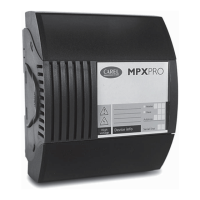



 To Next Page