EasyManua.ls Logo

Carrier 40VMW005 - User Manual

Carrier 40VMW005
18 pages
Print Icon
To Next Page IconTo Next Page
Loading...
Manufacturer reserves the right to discontinue, or change at any time, specifications or designs without notice and without incurring obligations.
Catalog No.20-40VMW005-030-01 Printed in U.S.A. Form 40VMW-6SI Pg 1 2-20 Replaces: 40VMW-5SI
Installation and Maintenance Instructions
CONTENTS
Page
SAFETY CONSIDERATIONS . . . . . . . . . . . . . . . . . . . 1
GENERAL . . . . . . . . . . . . . . . . . . . . . . . . . . . . . . . . . . . 2
INSTALLATION . . . . . . . . . . . . . . . . . . . . . . . . . . . . . . . 5
Step 1 — Unpack and Inspect Units . . . . . . . . . . . . 5
Step 2 — Position the Unit . . . . . . . . . . . . . . . . . . . . 5
Step 3 — Mount the Unit . . . . . . . . . . . . . . . . . . . . . . 5
Step 4 — Connect Piping . . . . . . . . . . . . . . . . . . . . . . 6
Step 5 — Complete Electrical Connections . . . . . . 7
Step 6 — Position and Connect Controller . . . . . . 9
ACB (Auxiliary Control Board) Interface . . . . . . . 13
START-UP . . . . . . . . . . . . . . . . . . . . . . . . . . . . . . . . 13
Pre-Start Check . . . . . . . . . . . . . . . . . . . . . . . . . . . . . 13
System Operation Check . . . . . . . . . . . . . . . . . . . . 13
MAINTENANCE. . . . . . . . . . . . . . . . . . . . . . . . . . . . . . 13
INDOOR UNIT ADDRESSING. . . . . . . . . . . . . . . . . 13
Wireless Remote Controller (40VM900001) . . . . . 13
Non-Programmable Controller (40VM900002). . . 14
Programmable Controller (40VM900003). . . . . . . 14
TROUBLESHOOTING . . . . . . . . . . . . . . . . . . . . . . 16
Replacement Parts . . . . . . . . . . . . . . . . . . . . . . . . . . 17
APPENDIX A — DIP SWITCH SETTINGS . . . . . . . . . 18
SAFETY CONSIDERATIONS
Improper installation, adjustment, alteration, service,
maintenance, or use can cause explosion, fire, electrical shock,
or other conditions that may cause death, personal injury or
property damage. The qualified installer or agency must use
factory-authorized kits or accessories when modifying this
product.
Follow all safety codes. Wear safety glasses, protective
clothing, and work gloves. Use quenching cloth for brazing
operations. Have fire extinguisher available. Read these
instructions thoroughly and follow all warnings or cautions
included in literature and attached to the unit. Consult local
building codes and the current editions of the National
Electrical Code (NEC) ANSI/NFPA (American National
Standards Institute/National Fire Protection Association) 70. In
Canada, refer to the current editions of the Canadian Electrical
Code CSA (Canadian Standards Association) C22.1.
Understand the signal words —
DANGER, WARNING, and
CAUTION. DANGER identifies the most serious hazards,
which will result in severe personal injury or death.
WARNING signifies hazards that could result in personal injury
or death. CAUTION is used to identify unsafe practices, which
would result in minor personal injury or product and property
damage.
Recognize safety information. This is the safety-alert
symbol ( ). When this symbol is displayed on the unit and in
instructions or manuals, be alert to the potential for personal
injury.
WARNING
Electrical shock can cause personal injury and death. Shut
off all power to this equipment during installation. There
may be more than one disconnect switch. Tag all
disconnect locations to alert others not to restore power
until work is completed.
WARNING
When installing the equipment in a small space, provide
adequate measures to avoid refrigerant concentration
exceeding safety limits due to refrigerant leak. In case of
refrigerant leak during installation, ventilate the space
immediately. Failure to follow this procedure may lead to
personal injury.
WARNING
DO NOT USE TORCH to remove any component. System
contains oil and refrigerant under pressure.
To remove a component, wear protective gloves and
goggles and proceed as follows:
a. Shut off electrical power to unit.
b. Recover refrigerant to relieve all pressure from
system using both high-pressure and low-pressure
ports.
c. Traces of vapor should be displaced with nitrogen
and the work area should be well ventilated.
Refrigerant in contact with an open flame produces
toxic gases.
d. Cut component connection tubing with tubing cutter
and remove component from unit. Use a pan to catch
any oil that may come out of the lines and as a gage
for how much oil to add to the system.
e. Carefully unsweat remaining tubing stubs when
necessary. Oil can ignite when exposed to torch
flame.
Failure to follow these procedures may result in personal
injury or death.
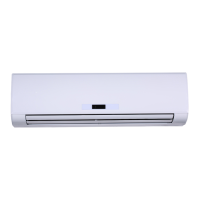
40VMW005-030
High Wall Indoor Unit for
Variable Refrigerant Flow (VRF) Systems

Questions and Answers

  • P
    Patrick OlsonAug 15, 2025
    What to do if Carrier Network Hardware has a communication error between indoor and outdoor unit?
    • M
      Michael RogersAug 15, 2025
      If your Carrier Network Hardware system is experiencing a communication error between the indoor and outdoor units, the issue might stem from several causes. First, check the signal wires to ensure they are properly connected and not short-circuited; reconnect them if necessary. If the wires are near an electromagnetic source, distance them from it. Finally, a PC board fault could be the cause, in which case you should replace the PC board.
  • M
    megan25Aug 18, 2025
    What to do if Carrier 40VMW005 has a communication error between indoor unit and controller?
    • S
      susan47Aug 18, 2025
      If your Carrier Network Hardware shows a communication error between the indoor unit and the controller, start by checking the signal wires. Ensure they are properly connected and not short-circuited; reconnect them if needed. Also, make sure the signal wires are not too close to any electromagnetic sources; if they are, move them away. If the problem persists, it might be due to a faulty PC board, which would need to be replaced.
  • B
    Brandon ShawAug 22, 2025
    What to do if Carrier Network Hardware displays an EEV Error?
    • C
      Cameron CooperAug 22, 2025
      If your Carrier Network Hardware system displays an EEV error, begin by inspecting the EEV wires to ensure they are properly connected and not short-circuited; reconnect them if necessary. If the wiring is not the issue, the EEV itself might have stopped working and needs replacement. As a last resort, the problem might be a PC board fault, which would require replacing the PC board.
  • W
    William PowellAug 25, 2025
    Why does my Carrier Network Hardware have a heating/cooling mode conflict?
    • E
      Elizabeth WashingtonAug 26, 2025
      If your Carrier Network Hardware system is experiencing a heating/cooling mode conflict, it means there's a disagreement in the operation modes of the units. This can happen if the system is set to cooling or fan mode, but a unit is sending a heating signal, or vice versa. To resolve this, ensure all units are set to the same mode. Specifically, all units should be in cooling mode for the system to stay in cooling mode, or all units should be in heating mode.
  • A
    Anthony HicksAug 28, 2025
    What to do if Carrier 40VMW005 displays 'Check Temperature Sensor'?
    • J
      Jamie LindseyAug 28, 2025
      If your Carrier Network Hardware displays an error related to the temperature sensor, there are a few things you can check. First, make sure the connection at the port on the PC board is secure; tighten it if it's loose. If the connection is good, the sensor itself might be short-circuited. Use a multi-meter to measure the resistance of the sensor; if it's ? 100 ohms, replace the sensor. If neither of these steps resolves the issue, the PC board might be faulty and need replacement.
  • B
    Bridget MoonAug 31, 2025
    What to do if Carrier 40VMW005 Network Hardware displays 'Check DC Fan Motor'?
    • Z
      zsmithAug 31, 2025
      If your Carrier Network Hardware is showing a DC fan motor error, it could be due to a few reasons. First, check the external static pressure on the unit and correct it if it's operating beyond limits. If the pressure is within the correct range, the DC motor itself might be faulty and require replacement. If neither of those steps solves the problem, the PC board might be at fault and need to be replaced.
  • C
    Christine Rodriguez MDSep 4, 2025
    What causes condensate overflow in Carrier Network Hardware?
    • R
      Richard ReyesSep 4, 2025
      If your Carrier Network Hardware is experiencing condensate overflow, there are several potential causes to investigate. Begin by checking the connection at the port on the PC board to ensure it is secure; tighten or reconnect it if it’s loose or disconnected. Next, inspect the condensate switch float to see if it is stuck. Also, verify that the trap slope is not too steep and adjust it if necessary. Check the length of the drain pipe and adjust if it's too long. Finally, if none of these steps resolve the issue, the drain pump may be faulty and require replacement.
  • C
    Christine ShafferSep 7, 2025
    What does EEPROM Error (Data Storage) mean on Carrier 40VMW005 Network Hardware?
    • P
      pmillerSep 7, 2025
      If your Carrier Network Hardware displays an EEPROM error (related to data storage), it suggests a problem with either the chip or the PC board. The suggested solution is to replace the PC board.
  • K
    kdunnSep 12, 2025
    How to fix 'No Address When Powered ON For First Time' on Carrier Network Hardware?
    • D
      Danielle FigueroaSep 12, 2025
      If your Carrier Network Hardware shows no address when powered on for the first time, it could be due to the indoor unit lacking an address. Try running the automatic addressing option at the outdoor unit. Alternatively, use a remote wireless or wired controller to readdress the indoor unit.

Overview

The 40VMW005-030 is a high-wall indoor unit designed for Variable Refrigerant Flow (VRF) systems, offering an efficient and aesthetically pleasing solution for heating and cooling spaces. This manual provides comprehensive instructions for its installation, maintenance, and operation.

Function Description

The 40VMW unit serves as an indoor component of a VRF system, responsible for delivering conditioned air into a room. It integrates with an outdoor unit and can be controlled via wireless, non-programmable, or programmable wired controllers. The unit features an electronic expansion valve (EEV) for precise refrigerant flow control, an indoor fan motor for air circulation, and an auxiliary control board (ACB) interface for connecting external devices like auxiliary heat, damper exhaust, humidifiers, or economizers. It supports various operational modes, including cooling, heating, fan-only, and defrost.

Important Technical Specifications

The 40VMW series offers a range of capacities, from 5,000 Btuh to 30,000 Btuh for total cooling, 4,060 Btuh to 18,950 Btuh for sensible cooling, and 6,000 Btuh to 34,000 Btuh for heating. All units operate on a 208/230V, 1-phase, 60Hz power supply.

Key specifications include:

  • Indoor Fan Motor: DC motor, with input ranging from 11W (005 model) to 85W (030 model).
  • Indoor Coil: Features 2 rows, 17 or 20 fins per inch, hydrophilic aluminum fin type, and a 0.276-inch OD inner groove tube type. Number of circuits varies from 3 to 5 depending on the model.
  • Indoor Airflow (cfm): Ranges from 245 cfm (low) to 770 cfm (high) for the largest model.
  • Indoor Noise Level (dBA): Varies from 31.2 dBA (low) to 48.3 dBA (high) depending on the model and fan speed.
  • Unit Dimensions (W x H x D):
    • 005-012 models: 36 x 11-3/8 x 9 inches.
    • 015-018 models: 42-1/4 x 12-3/8 x 9 inches.
    • 024-030 models: 47 x 13-1/2 x 10-1/8 inches.
  • Net/Gross Weight: Ranges from 28/35 lb to 38/50.5 lb.
  • Refrigerant Type: R-410A.
  • Expansion Device: EEV.
  • Design Pressure (H/L): 580/320 psig.
  • Refrigerant Piping (OD): Liquid side 1/4 inch (005-018) or 3/8 inch (024-030); Suction side 1/2 inch (005-018) or 5/8 inch (024-030).
  • Connecting Wiring: Power wiring sized per NEC and local codes; Signal wiring is 2-core stranded shielded cable 18 AWG.
  • Drainage Water Pipe Diameter: 3/4 NPT.
  • ACB Interface: Max 1A, 24V AC/DC output for auxiliary devices.

Usage Features

The 40VMW unit is designed for ease of installation and flexible control.

  • Installation: Units should be mounted on strong wall studs, at least eight feet from the floor, and centrally located. Proper clearances (6 inches minimum above, 5 inches minimum on sides) are required. Condensate piping must have a downward slope and avoid U-bends or sumps filled with water. Refrigerant piping requires careful handling, proper cutting and flaring tools, and torque wrenches for flare nuts. Electrical connections must adhere to wiring diagrams and local codes, with power and control wiring kept separate to prevent interference.
  • Control: The unit supports various controllers:
    • Wireless Remote Controller (40VM900001): Allows users to set addresses, select modes, adjust fan speed, and control air direction. Requires line of sight with the indoor unit's receiver.
    • Non-Programmable Controller (40VM900002): Used for setting indoor unit addresses by pressing specific buttons simultaneously.
    • Programmable Controller (40VM900003): Offers advanced parameter settings, including IDU addressing, accessible via a menu interface.
  • Addressing: Each indoor unit requires a unique address (0-63) for proper system operation. In heat pump systems, auto-addressing can be enabled via DIP switch S6 on the outdoor unit's main PCB, taking approximately six minutes. Heat recovery systems do not support auto-addressing.
  • Troubleshooting: The unit's display panel provides digital indicators for operational status and error codes (e.g., E1 for communication error, E7 for EEPROM error, FE for no address). A comprehensive troubleshooting table helps identify possible causes and solutions for various issues.

Maintenance Features

Regular maintenance is crucial for optimal performance and longevity of the 40VMW unit.

  • Every 3 Months:
    • Check and clean or replace the air filter.
  • Every 6 Months:
    • Follow the 3-month schedule.
    • Clean the condensate tray with a suitable cleaning agent.
    • Clean the grille and panel.
  • Every 12 Months:
    • Follow the 6-month schedule.
    • Ensure all electrical connections are secure.
    • Check condensate pump operation (if applicable).
    • Verify proper heating and cooling action.
  • Pre-Start Check: Before initial operation, ensure all units are properly installed, piping and insulation are complete, electrical connections are terminated correctly, condensate drains are installed, power supply voltage and frequency are correct, units are grounded, and service valves are open.
  • System Operation Check: After pre-start checks, verify system operation using a remote controller, checking for normal indicator lights, proper air louver swing, drain pump operation, and absence of abnormal vibration or noise.
  • Replacement Parts: When ordering replacement parts, it is essential to quote the unit model number and serial number, which can be found on the serial plate.
  • Safety: Always disconnect power before servicing. Use factory-approved replacement parts to maintain warranty and prevent equipment damage. Do not reuse wet mechanical or electrical controllers.

Carrier 40VMW005 Specifications

General IconGeneral
BrandCarrier
Model40VMW005
CategoryNetwork Hardware
LanguageEnglish

Related product manuals