
 Need help?
Do you have a question about the Carrier 48FC M20 Series and is the answer not in the manual?
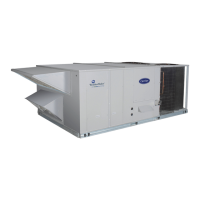
The provided document is a service and maintenance manual for Carrier 48FC**20-30 Single Package Rooftop Gas Heat/Electric Cooling Units, which use Puron® (R-410A) refrigerant and have a nominal capacity of 17.5-27.5 tons. This document outlines various aspects of the unit's operation, maintenance, and troubleshooting.
The manual details the general arrangement of the unit and the location of various access panels, including the control box, filter and indoor coil, indoor blower, gas heat, compressor, and condenser coil access panels. This information is crucial for technicians performing maintenance or repairs.
A routine maintenance program is recommended, with quarterly and seasonal checks. Quarterly inspections (and 30 days after initial start) include return air filter replacement, cleaning of outdoor hood inlet filters, checking condenser coil cleanliness, and checking the condensate drain. Seasonal maintenance involves checking outdoor fan motor mounting bolts, compressor mounting bolts, outdoor fan blade positioning, control box cleanliness and wiring condition, wire terminal tightness, refrigerant charge level, indoor coil cleanliness, supply blower motor amperage, heat exchanger flue passageway cleanliness, gas burner condition, gas manifold pressure, heating temperature rise, and economizer/outside air damper inlet filter condition, damper travel, and gear/damper cleanliness.
The unit is equipped with disposable fiberglass return air filters, accessed via a lift-out panel on the rear side. Economizer-equipped units also have an outside air screen, and manual outside air dampers include an inlet air screen. These filters and screens require periodic replacement or cleaning. High-velocity water or air jets should not be used to clean coils as they can bend fin edges and increase airside pressure drop. The unit should not be operated without return air filters in place to prevent dirt and debris accumulation on heat exchangers and coils, which can lead to fire hazards, excessive current draw, and motor failure.
The 48FC units feature an EcoBlue™ direct drive vane axial fan system, driven by an ECM motor. Fan speeds are user-configurable via the Unit Control Board (UCB) from 40% to 100% of the motor's maximum speed. The manual provides detailed instructions for evaluating and selecting fan speed, including using a VDC calculator chart for electro-mechanical controls and SystemVu™ interface for units with SystemVu™ controls. Troubleshooting for the ECM motor involves checking line voltage, motor control voltage signals, and engaging motor operation. If the motor fails to start, the fan assembly and motor may need replacement.
The cooling system includes a condenser coil and an evaporator coil. The condenser coil is made with round tube copper hairpins and plate fins, which may have various materials and coatings. Routine cleaning of coil surfaces is essential for maintaining proper operation and extending coil life. This involves removing surface-loaded fibers with a vacuum cleaner or soft brush, followed by a low-velocity clean water rinse. Totaline® environmentally balanced coil cleaner is recommended for periodic cleaning. Harsh chemicals, household bleach, or acid/basic cleaners should be avoided. The evaporator coil cleaning procedure involves turning off power, removing access panels, and cleaning the coil with a commercial coil cleaner or dishwasher detergent.
48FC 20-30 units use a TXV-distributor system. The TXV is a bi-flow, bleed port expansion valve with an external equalizer, specifically designed for Puron® (R-410A) refrigerant. Its operation involves sensing superheat temperature at the evaporator coil outlet, converting it to pressure to open the valve, and balancing it against suction and spring pressures. This stabilizes refrigerant flow according to load demand. Replacing a TXV involves recovering refrigerant, removing the old valve and bulb, installing a new TXV, attaching the equalizer tube and bulb, and sweating the inlet to the liquid line while avoiding excessive heat.
The system has two access ports: on the suction tube near the compressor and on the discharge tube near the compressor. These are brass fittings with black plastic caps and standard 1/4-inch SAE male flare couplings. The fittings are two-piece high-flow valves with integral spring-closed check valve cores. If necessary, the entire core body must be replaced. Special service tools are available for core replacement without recovering the entire system charge.
The unit is designed exclusively for Puron® (R-410A) refrigerant. R-410A systems operate at higher pressures than R-22 systems, requiring specific service equipment. Non-certified refrigerants should not be used due to potential contamination. R-410A refrigerant cylinders are pink and may have dip tubes. Liquid refrigerant should always be removed from the cylinder as a liquid. Charging procedures involve evacuating the system and weighing in the specified amount of refrigerant. Low-charge cooling requires using cooling charging charts, an accurate pressure gauge, and a temperature sensing device on the liquid line to determine the correct sub-cooling.
The compressor is factory-charged with the correct amount of oil. Only factory-trained service technicians should replace compressor units. Scroll compressors must rotate in the correct direction; incorrect rotation can cause internal damage and noise. To check rotation, connect service gauges, energize the compressor, and observe suction/discharge pressures. If pressures are abnormal, reverse two of the three unit power leads. The filter drier should be replaced whenever the refrigerant system is exposed to the atmosphere, using only factory-specified liquid-line filter driers with working pressures no less than 650 psig.
Condenser-fan adjustment involves shutting off power, removing the fan assembly, loosening hub setscrews, adjusting fan height until it stops on the shaft, tightening setscrews to 84 in.-lb (9.5 Nm) ± 12 in.-lb (1.5 Nm), and replacing the assembly.
A troubleshooting table is provided for various cooling system symptoms, causes, and solutions, including power failure, tripped fuses/circuit breakers, defective thermostats/contactors, insufficient line voltage, tripped pressure switches, faulty wiring, compressor motor issues, refrigerant over/undercharge, dirty coils/filters, and air in the system.
48FC models offer non-powered and unit-powered 125 VAC GFCI duplex receptacles rated at 15A, located behind a hinged waterproof access cover. The weatherproof cover kit must be installed at unit installation. Non-powered types require field installation of a general-purpose 125-v 15-A circuit. Unit-powered types include a factory-installed transformer to step down main power to 115-v. The unit-powered outlet has a duty cycle limitation, intended for intermittent use for service tools, not continuous high-load applications. Periodic testing of the GFCI receptacle is recommended.
Smoke detectors are available as factory-installed options for supply air, return air, or both. The system consists of a four-wire controller and one or two sensors, designed to shut down the rooftop unit to prevent smoke circulation. The controller has LEDs for Power, Trouble, and Alarm, and a manual test/reset button. The sensor includes a plastic housing, printed circuit board, clear plastic cover, sampling tube inlet, and exhaust tube, with LEDs for Power, Trouble, Alarm, and Dirty, and a manual test/reset button. Smoke detector locations are specified for supply air (right of indoor fan) and return air (across the unit basepan). FIOP smoke detectors automatically shut down unit operations upon smoke detection.
The manual provides procedures for sensor alarm tests (using a test magnet), controller alarm tests (using the test/reset switch), dirty controller tests, and dirty sensor tests. These tests help verify the functionality of the smoke detection system and identify issues like dirty sensors or wiring faults.
The unit includes several protective devices:
The gas heating system consists of a gas valve, multi-in-shot burners, primary and secondary heat exchanger tubes, and an induced draft fan. Safety switches include a Rollout Switch and limit switches. The unit is factory-equipped for natural gas (NG) but can be converted to liquid propane (LP) using accessory packages. Gas line and manifold pressures must be within specified ranges. The manual provides detailed instructions for inspecting flue gas passageways, combustion-air blower, burners, and igniters, as well as orifice replacement and troubleshooting the heating system.
The SystemVu™ control is a comprehensive unit-management system that is fully communicating and cable-ready for connection to Carrier Comfort Network® (CCN), Carrier i-Vu®, and Third Party BACnet building management systems. It features an integrated display module with an LCD and keypad for easy access to control information, sensor values, operating parameters, and a built-in test routine. Additional installation, wiring, and troubleshooting information is available in a separate manual.
Units may be equipped with factory-installed or accessory (field-installed) economizer systems (EconoMi$er®X, EconoMi$er IV, EconoMi$er2). These systems use direct-drive damper actuators. The manual details component locations, input/output logic, and various sensors (Outdoor Air Temperature (OAT), Supply Air Temperature (SAT), Indoor Air Quality (IAQ), and S-Bus enthalpy sensors). It also describes different control modes like outdoor dry bulb changeover, outdoor enthalpy changeover, and differential enthalpy control, along with procedures for exhaust set point adjustment, minimum position control, and demand controlled ventilation (DCV). Troubleshooting procedures for the EconoMi$er IV are also provided.
This section emphasizes safety considerations, including lockout/tag-out procedures, wearing PPE, and proper handling of refrigerant. It outlines general unit preparation steps, such as removing packaging, inspecting for damages, checking wiring, verifying fan blade positioning, air filter installation, and condensate drain trap filling. Additional installation/inspection steps for field-installed accessories and DDC alarms are also mentioned.
The manual includes notes on fan performance, such as interpolation permissibility, external static pressure considerations, tabular data accounting for pressure loss, effects of factory options and accessories, and recommendations for motor/drive combinations. It also references electrical information and EPACT regulations for indoor fan motors.
A table provides specific torque values for various fasteners, including stator motor mounting screws, fan rotor mounting screws, fan deck bracket screws, fan casing screws, heat shield screws, condenser motor mounting screws, condenser hub set screw, compressor mounting bolts, tandem rail mounting bolts, and crankcase heater.
This appendix provides a detailed breakdown of the model number nomenclature, explaining the codes for model series, unit heat type, cooling tons, heat options, refrig. systems options, sensor options, indoor fan options, coil options, voltage, design revision, packaging compliance, electrical options, service options, and intake/exhaust options.
This appendix contains tables of physical data for 48FC*(M/N) 20 to 30 units, including nominal capacity, base unit operating weight, refrigeration system details (number of circuits/compressors, Puron® charge, metering devices, high/low pressure trip/reset settings), evaporator coil specifications (material, type, rows/FPI, face area, drain connection size), condenser coil specifications, Humidi-MiZer coil specifications, evaporator fan and motor details (vertical standard/high static, horizontal high static), condenser fan and motor details, and filter quantities/sizes.
This appendix provides gas heat data for 48FC 20 to 30 units, including nominal capacity, number of gas valves, natural gas and liquid propane supply line pressures, heat anticipator settings, and natural gas/liquid propane heat specifications (number of stages/burners, connection size, rollout switch open/close temperatures, and temperature rise) for low, medium, and high heat settings.
This appendix contains extensive tables detailing fan performance for 48FCFM20, 48FCFM24, 48FCFM28, and 48FCFM30 units, covering 17.5, 20, 25, and 27.5 tons respectively. These tables provide rpm and bhp (brake horsepower) or vdc (volts DC) values across various external static pressures (in. wg) for both vertical and horizontal supply configurations, and for standard/medium static and high static motors.
This appendix includes a series of wiring diagrams for 48FC*20-30 units, covering both standard and high SCCR (Short-Circuit Current Rating) configurations, and for electro-mechanical systems with W7220 controllers or SystemVu™ controllers. These diagrams illustrate control wiring and power wiring for different voltage options (208/230-3-60, 460-3-60, 575-3-60).
This appendix provides diagrams illustrating the sensor position for low ambient control on outdoor circuiting for 17.5 Ton to 20.0 Ton and 25.0 Ton to 27.5 Ton units. It notes that conductive grease should be applied with the coil sensor on the specified leg before attaching it with a wire tie.
 General
| Brand | Carrier |
|---|---|
| Model | 48FC M20 Series |
| Category | Air Handlers |
| Language | English |


 To Next Page