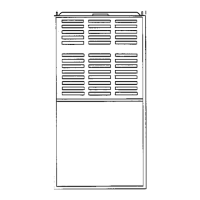
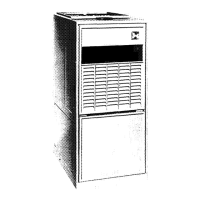
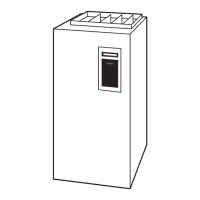
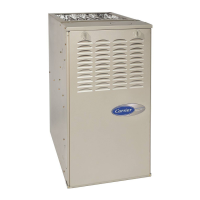
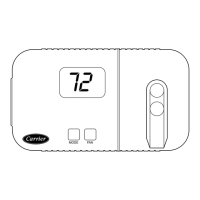
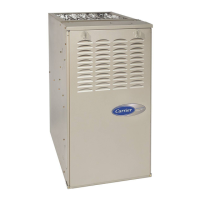
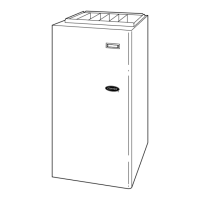
This document is a user's information manual for Carrier natural-draft gas furnaces, specifically models 58GP, GS, GSC, 58DP, DR, and DRC. It provides detailed instructions for operation, maintenance, and safety considerations.
Function Description:
The Carrier gas furnaces described in this manual are designed for home heating, utilizing natural gas as fuel. They are natural-draft furnaces, meaning they rely on the natural buoyancy of hot combustion gases to vent them. The manual covers both upflow and downflow furnace configurations, each with specific component layouts and access procedures. The furnaces incorporate either a manual ignition system with a continuously burning pilot flame or an automatic intermittent ignition system where the pilot is lit by an electric sparking device when heat is called for. Safety devices, such as a blocked vent shutoff system switch and a manual-reset auxiliary limit switch (for downflow models), are integrated to ensure safe operation.
Important Technical Specifications:
The manual does not list specific technical specifications like BTU output, efficiency ratings (AFUE), or dimensions. However, it does provide a "Furnace Filter Table" which details filter sizes and types (cleanable or disposable) based on the furnace casing width for both upflow and downflow models. For upflow furnaces, casing widths are 14-3/16, 17-1/2, 21, 24-1/2, and 31-1/2 inches, all using 15-7/8 x 27-3/4 inch or 19-3/8 x 27-3/4 inch, 22-7/8 x 27-3/4 inch, 29-7/8 x 27-3/4 inch filters. For downflow furnaces, casing widths are 14-3/16 & 17-1/2 and 21 & 24-1/2 inches, both using two 16 x 20 inch filters.
Usage Features:
The manual emphasizes safe and efficient operation. Key usage features include:
- Starting the Furnace: Detailed procedures are provided for both manual ignition (continuous pilot) and automatic intermittent ignition systems. Users are instructed to set the thermostat to its lowest setting, close the external manual gas valve, turn off the electrical supply, remove access doors, turn the internal gas valve control knob to OFF, wait 5 minutes, open the external manual gas valve, turn the internal gas valve to PILOT (for manual ignition) or ON (for automatic ignition), light the pilot (manual ignition only), and then turn the internal gas valve to ON. For automatic ignition, the system sparks to light the pilot, followed by a timed delay before the main burners ignite and the blower switches on.
- Thermostat Adjustment: After verifying burner ignition, users can adjust the room thermostat to their personal comfort setting.
- Vent Damper (Optional): If equipped, the automatic vent damper should be in the open position when the thermostat calls for heat. If not, the furnace should be shut down and serviced.
- Shutdown Procedures: Instructions are given for shutting down the furnace at the end of the heating season or if a malfunction is suspected. This involves setting the thermostat to the lowest temperature, turning off the electrical supply, closing the external manual gas valve, and turning the internal gas valve control knob to OFF. For manual ignition, there's an option to keep the pilot light burning by turning the control knob to PILOT.
- Safety Precautions: The manual highlights critical safety rules, such as keeping the area around the furnace free of combustible materials, ensuring adequate and clean combustion air supply, and never operating a furnace that has been submerged in water. It also warns against manually lighting an intermittent ignition pilot.
- Troubleshooting: A "Before You Request a 'Service Call'" section provides a checklist for common, easily solved problems, including checking airflow, thermostat settings, electrical supply, gas valve positions, pilot flame (if applicable), and safety switches (blocked vent shutoff system, manual-reset auxiliary limit switch).
Maintenance Features:
Routine maintenance is crucial for economical and dependable operation. The manual outlines the following:
- Air Filter Check and Replacement/Cleaning: Users are advised to check filters every 3 to 4 weeks. Dirty disposable filters should be replaced with the correct size and type (refer to the "Furnace Filter Table"). Reusable filters should be washed with cold water and mild liquid detergent, flushed from the side opposite accumulated dirt, air-dried, and reinstalled with the cross-mesh binding side facing the blower. Specific instructions are provided for accessing filters in both upflow and downflow furnaces. A caution warns against operating the furnace without a filter.
- Combustion Area and Vent System Inspection: Before each heating season, users should inspect the burner and pilot areas for dirt, rust, or scale, and the vent connection area and vent pipe for rust, sags, holes, obstructions, or disconnections. Horizontal vent pipes must slope upward at least 1/4 inch per linear foot away from the furnace. Any discrepancies or damage require immediate professional service.
- Professional Dealer Maintenance: The manual strongly recommends regular inspections by a qualified service agency, preferably annually or at least every other year. These inspections should include:
- Inspection of all flue product passages (burners, pilot, heat exchanger, draft diverter, vent pipe).
- Inspection of combustion and ventilation air passages and openings.
- Inspection of all gas pipes for leaks/deterioration.
- Inspection, cleaning, and lubrication (if oil ports are provided) of the blower, blower motor, and wheel.
- Routine inspection and cleaning/replacement of the air filter.
- Inspection of all supply-air and return-air ducts for air leaks, obstructions, and insulation.
- Check for loose fasteners and electrical wiring connections.
- Operational check of the furnace to determine working condition and make necessary repairs/adjustments.
- Access Door Removal: Detailed instructions are given for removing and reinstalling access doors for both upflow and downflow furnaces, which is necessary for maintenance and troubleshooting.
- Safety During Maintenance: Users are reminded to turn off the electrical power supply before removing access doors for service or maintenance and to be careful when handling parts due to sharp edges.
The manual also includes warranty information for both "Uncoated Heat Exchanger" and "Coated Heat Exchanger" models, outlining one-year and extended nine-year or nineteen-year warranties, respectively, along with limitations and responsibilities. It advises users to contact the installer, nearest Carrier distributor, or Carrier Corporation for service or parts, providing contact information.

 Need help?

 To Next Page


 General