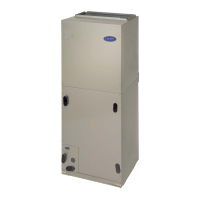
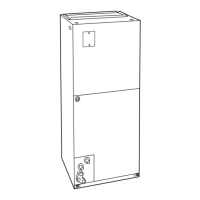
F55: Installation Instructions
Manufacturer reserves the right to change, at any time, specifications and designs without notice and without obligations.
9
To change motor speeds disconnect the BLUE and/or WHITE fan lead
from motor connector terminal #2 and/or #4 (factory default position)
and move to desired speed-tap, based on application.
Speed-taps 1, 2, and 3 have a 90 second blower off time delay
pre-programmed into the motor. Speed-taps 4 and 5 are used for high
static applications, but have a 0-second blower time delay
pre-programmed into the motor. See Airflow Performance tables for
actual CFM. Se Fig. 14 for motor speed selection location.
NOTE: In low static applications, lower motor speed tap should be used
to reduce possibility of water being blown off coil.
Refrigerant Tubing Connection and
Evacuation
Use accessory tubing package or field-supplied tubing of refrigerant
grade. Suction tube must be insulated. Do not use damaged, dirty, or
contaminated tubing because it may plug refrigerant flow-control
device. ALWAYS evacuate the coil and field-supplied tubing to 500
microns before opening outdoor unit service valves.
Units have sweat suction and liquid tube connections. Make suction tube
connection first.
IMPORTANT: Federal regulations require that you do not vent
refrigerant to the atmosphere. Recover during system repair or final unit
disposal.
– Run refrigerant tubes as directly as possible by avoiding
unnecessary turns and bends.
– Make provision for expansion and contraction of long piping runs.
– Protect piping and fittings as much as possible against adverse
environmental effects; for example, the danger of water collecting
and freezing in relief pipes or the accumulation of dirt and debris.
– Install piping to reduce the likelihood of hydraulic shock damaging
the system.
– Always use certified steel piping and components to protect against
corrosion.
– Protect flexible pipe elements against mechanical damage and
excessive stress by torsion or other forces. Check flexible pipes for
mechanical damage annually.
1. Cut tubing to correct length.
2. Insert tube into sweat connection on unit until it bottoms.
3. All fittings need to withstand 700 PSIG (Mechanical Fittings or
Brazing). When brazing, use silver bearing or non-silver bearing
brazing material. Do not use solder (materials which melt below
800° F / 427° C). Consult local code requirements.
4. Perform a pressure check of the unit with a nitrogen charge of about
200psi. The Nitrogen holding charge must not decrease in pressure
for 1 hour.
5. Perform leak check on the unit. Vacuum unit to 500 microns. When
isolating the unit from the pump, the pressure shall not rise above
1500 microns in 10 minutes.
Mechanical Line Set Connections
If using mechanical or crimp-type line set connections, follow crimp tool
manufacturer's instructions.
NOTE: Should the use of mechanical fittings cause failure of the fittings
or failure of the equipment, such would not be covered under the
standard warranty.
Refrigerant Flow-Control Device
The 18-60 size units come equipped with an R-454B refrigerant
mechanical TXV. When tightening nuts on a TXV, do not exceed
20 ft-lbs.
Always use outdoor units designed to match indoor fan coil applications.
Disassembly
NOTE: For Item #1 (Fig. 15): Use an adjustable wrench with a backup
adjustable wrench to loosen the brass nut (TXV outlet). Then use both
wrenches to loosen Item # 2 (TXV inlet).
1. Use an adjustable wrench with a backup adjustable wrench to
loosen Item # 3 (TXV equalizer line).
2. For Item #4 - Cut the wire tie and remove the black insulation.
Remove the band from around the TXV bulb.
3. Cut the wire tie that holds the TXV equalizer line and bulb from the
aluminum vapor header tube.
4. Remove 2 screws from the TXV bracket. Remove the TXV from
the coil unit.
Assembly
1. Mount the TXV bracket and TXV with the 2 screws removed
during disassembly.
2. Connect Items #1 and #2 (TXV outlet and inlet respectively) and
use an adjustable wrench with a backup wrench to tighten each nut.
Tighten to between 10 and 20 ft-lbs.
3. Connect Item #3 and use an adjustable wrench with a backup
adjustable wrench to tighten the flare nut. Tighten to approximately
12 ft-lbs.
4. Item # 4 - Reconnect the TXV bulb with a clamp and reinstall
insulation around the TXV bulb and vapor tube.
CAUTION
!
PRODUCT DAMAGE HAZARD
Failure to follow this caution may result in product or property damage.
A brazing shield MUST be used when tubing sets are being brazed to
the unit connections to prevent damage to the unit surface and
condensate pan fitting caps.
CAUTION
!
PRODUCT DAMAGE HAZARD
Failure to follow this caution may result in product or property damage.
Wrap a wet cloth around rear of fitting to prevent damage to TXV and
factory-made joints.
CAUTION
!
PRODUCT OPERATION HAZARD
Failure to follow this caution may result in improper product operation.
If using a TXV in conjunction with a single-phase reciprocating
compressor, a compressor start capacitor and relay are required.
Consult outdoor unit pre-sale literature for start assist kit part number.
WARNING
!
PERSONAL INJURY HAZARD
Failure to follow this warning could result in personal injury.
Remove refrigerant charge from system and ensure there is no pressure
before servicing the TXV.



 To Next Page