1
50VT---A
Performancet 14 SEER Single ---Packaged Heat Pump
System with Puron® (R---410A) Refrigerant
Single and Three Phase
2 --- 5 N o m i n a l To n s ( S i z e s 2 4 --- 6 0 )
Installation Instructions
NOTE: Read the entire instruction manual before starting the
installation.
NOTE: Installer: Make sure the Owner’s Manual and Service
Instructions are left with the unit after installation.
TABLE OF CONTENTS
PAGE
SAFETY CONSIDERATIONS 1.........................
INTRODUCTION 2...................................
RECEIVING AND INSTALLATION 2--9..................
Check Equipment 2..................................
Identify Unit 2....................................
Inspect Shipment 2.................................
Provide Unit Support 2...............................
Roof Curb 2......................................
Slab Mount 2.....................................
Provide Clearances 2.................................
Rig and Place Unit 6.................................
Inspection 6......................................
Rigging/Lifting of Unit 6............................
Select and Install Ductwork 7...........................
Converting Horizontal Discharge Units to Downflow
(Vertical) Discharge Units 7..........................
Provide for Condensate Disposal 8......................
Install Electrical Connections 8.........................
High--Voltage Connections 8.........................
Special Procedures for 208--V Operation 9...............
Control Voltage Connections 9........................
Standard Connections 9.............................
Transformer Protection 9............................
Accessory Electric heaters Installation 9.................
Sequence of Operation 9............................
PRE--START --UP 17...................................
START--UP 17--20.....................................
Checking Cooling & Heating Control Operation 17........
Check for Refrigerant Leaks 17.........................
Start--Up Adjustments 17.............................
Checking & Adjusting Refrigerant Charge 18............
Indoor Airflow & Airflow Adjustments 18..............
Continuous Fan Operation 19........................
Defrost Control 20...................................
Quiet Shift 20.....................................
Defrost 20.......................................
MAINTENANCE 23--28................................
Air Filter 23........................................
Indoor Blower and Motor 23...........................
Outdoor Coil, Indoor Coil, & Condensate Drain Pan 26......
Outdoor Fan 26.....................................
Electrical Controls and Wiring 26.......................
Refrigerant Circuit 26.................................
Indoor Airflow 26...................................
Metering Devices-- TXV & Piston 26....................
Pressure Switches 27.................................
Loss of Charge Switch 27.............................
High Pressure Switch 27..............................
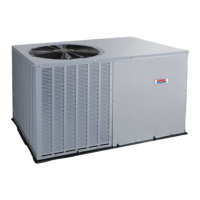
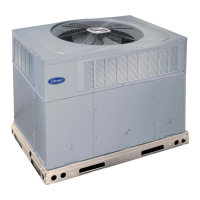
A09033
Fig. 1 -- Unit 50VT -- A
Copeland Scroll compressor (Puron Refrigerant) 27.........
Refrigerant System 27................................
Refrigerant 27....................................
Compressor Oil 27.................................
Servicing Systems on Roofs with Synthetic Materials 27....
Liquid Line Filter Drier 27...........................
PuronR (R--410A) Refrigerant Charging 28.............
System Information 28................................
Loss of Charge Switch 28............................
Check Defrost Thermostat 28.........................
TROUBLESHOOTING 28..............................
START --UP CHECKLIST 28............................
SAFETY CONSIDERATIONS
Installation and servicing of this equipment can be hazardous due
to mechanical and electrical components. Only trained and
qualified personnel should install, repair, or service this equipment.
Untrained personnel can perform basic maintenance functions such
as cleaning and replacing air filters. All other operations must be
performed by trained service personnel. When working on this
equipment, observe precautions in the literature, on tags, and on
labels attached to or shipped with the unit and other safety
precautions that may apply.
Follow all safety codes. Wear safety glasses, protective clothing,
and work gloves. Use quenching cloth for brazing operations.
Have a fire extinguisher available. Read these instructions
thoroughly and follow all warnings or cautions included in
literature and attached to the unit. Consult local building codes, the
current editions of the National Electrical Code (NEC) NFPA 70.
In Canada refer to the current editions of the Canadian Electrical
Code CSA C22.1.

 Need help?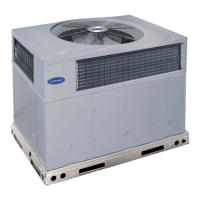


 To Next Page
 General