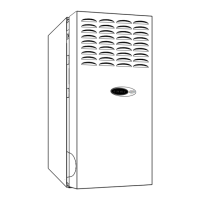
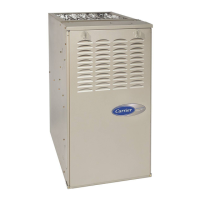
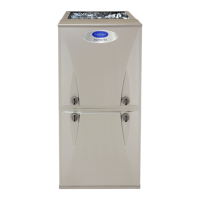
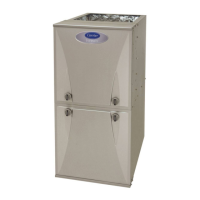
The Carrier Multipoise, Condensing Gas Furnace, models 58MCA, 58MVP, and 58MXA, represents a new generation of home comfort, designed for efficiency, safety, and dependability. This furnace is a significant investment for homeowners, especially in light of rising energy costs, as it incorporates advanced technology to maximize heat output from consumed fuel.
Function Description:
The primary function of the Carrier Gas Furnace is to provide efficient and dependable heating for your home. It utilizes a revolutionary design with two heat exchangers to extract the maximum amount of heat from the combustion process. Over 90% of the heat generated during combustion is captured and delivered into your home, representing more than a 33% increase in heating efficiency compared to conventional furnaces. This high efficiency makes it one of the most energy-efficient furnaces available.
The furnace operates using an automatic, hot surface ignition system, eliminating the need for a continuously burning pilot flame, which saves energy. When the thermostat calls for heat, the hot surface ignitor at the main burners is automatically heated. Once the microprocessor control verifies sufficient heat for ignition, the gas valve opens, allowing gas to flow to the main burners and ignite. After ignition and a brief time delay, the blower starts at a low speed and then adjusts to the necessary low- or high-fire speed to circulate warm air throughout your home.
The furnace draws combustion air from outside the home, ensuring contaminant-free operation, and vents exhaust gases through PVC pipes. A heavy-duty blower circulates air across the heat exchangers, transferring heat into the home. The system includes a secondary condensing heat exchanger, which wrings out additional heat through condensation, further enhancing efficiency. Condensate is collected and disposed of into the home's drain system.
Usage Features:
The Carrier Gas Furnace is designed for user-friendly operation, primarily controlled by your room thermostat.
- Thermostat Control: You set your desired room temperature on the thermostat. When the room temperature drops below this setting, the furnace automatically switches on. Once the desired temperature is reached, the furnace switches off. Some thermostats also feature a FAN switch with "AUTO" and "ON" selections. In "AUTO" mode, the furnace blower cycles on and off as controlled by the thermostat. In "ON" mode, the blower runs continuously, which helps maintain a more evenly balanced temperature throughout your home and continuously filters the indoor air.
- Safety Features: The furnace is equipped with several safety devices to ensure safe operation. These include a redundant gas valve with two internal shut-off valves, a pressure switch to ensure adequate flue product flow, and a rollout switch (manual reset) to prevent overtemperature conditions. An LED on the control center provides diagnostic codes to help identify operational issues or service requirements.
- Starting the Furnace: The starting procedure involves setting the thermostat to its lowest setting, closing the external manual gas valve, turning off the electrical supply, removing the access door, turning the gas valve control knob to "OFF" (and waiting 5 minutes to clear any gas), then turning it to "ON," replacing the access door, turning on the electrical supply, opening the external manual gas valve, and finally setting the thermostat to the desired temperature.
- Shutting Down the Furnace: For service or maintenance, the furnace can be shut down by setting the thermostat to its lowest temperature, closing the external manual gas valve, turning off the electrical supply, removing the access door, and turning the gas valve control knob to "OFF."
Maintenance Features:
Routine maintenance is crucial for the economical and dependable operation of your Carrier Gas Furnace. While some basic tasks can be performed by the homeowner, more complex service should be handled by a qualified installer or service agency.
- Air Filter Maintenance: A dirty air filter can significantly reduce airflow, leading to a loss of efficiency and potentially causing the furnace to cycle on safety controls or even lock out. It is recommended to check the furnace filter every 3 to 4 weeks and clean or replace it as necessary. The manual provides detailed instructions for accessing and cleaning/replacing filters, including different locations (bottom or side) and types (washable). If a washable filter is replaced by an electronic air cleaner (EAC), refer to the EAC Owner's Manual for maintenance.
- Combustion Area and Vent System Inspection: Before each heating season, it is important to visually inspect the combustion area and vent system. Check all PVC pipes for cracks, sags, or blockages, both inside and outside the home. Accumulations of dirt, soot, scale, or rust can impair efficiency and cause delayed ignition, resulting in loud noises. If such accumulations or pipe damage are found, a qualified dealer should be contacted.
- Annual Professional Check-up: To ensure proper performance and prevent future problems, an annual professional check-up by a trained service specialist is highly recommended. This check-up typically includes:
- Inspecting flue gas passages, burners, heat exchangers, coupling boxes, and inducer assembly.
- Inspecting all combustion-air and vent piping, including terminations outside the structure.
- Checking gas pipes for leaks.
- Inspecting and cleaning the blower motor and wheel (note: inducer and blower motors are pre-lubricated and do not require additional lubrication).
- Inspecting and changing or cleaning air filter(s).
- Inspecting all supply- and return-air ducts for obstructions, air leaks, and insulation damage.
- Inspecting return-air duct connections for physical soundness and sealing.
- Inspecting electrical wiring, connections, and components for loose connections.
- Performing an operational checkout.
- Inspecting condensate drain tubes and condensate trap assembly for leaks, and cleaning the condensate removal system.
- Examining the physical support of the furnace for cracks, sagging, or gaps.
- Checking for any obvious signs of deterioration.
- Winterizing Procedures: If the furnace is installed in an unconditioned space where temperatures may drop to 32°F or lower, freeze protection measures must be taken. Since the furnace uses a condensing heat exchanger and accumulates water, it cannot be turned off and left off for extended periods in freezing temperatures without winterization. This involves obtaining propylene glycol (RV/swimming pool antifreeze or equivalent) and pouring it through the inducer housing drain connection to prevent freezing in the condensate trap and drain system.
- Diagnostic Chart: The furnace features an LED operation and fault code display to assist with troubleshooting. The manual provides a diagnostic chart for models 58MCA and 58MXA (and a separate one for 58MVP) that lists fault codes and corresponding checklists for troubleshooting common issues, such as limit switch lockout, ignition lockout, furnace fuse open, and pressure switch not closed. This allows homeowners or technicians to quickly identify potential problems.
The Carrier Gas Furnace is designed to provide years of money-saving home comfort and enjoyment with minimal care, provided routine maintenance and safety guidelines are followed.

 Need help?
 General



 To Next Page