Appendix
SECTION
1
FM
Stereo Signals
and the
Asymmetrical
Charge Coupled
FM
Detector™*
FM
radio stations started
life
broadcasting
a
carrier frequency
modulated
by
music. When
you
listen
to "FM
108",
what your tuner
is
receiving
is
that frequency
—108
MHz
(megahertz,
or
millions
of
cycles
per
second)
—
modulated
by a
music spectrum from
30 Hz to
15
kHz
(KiloHertz,
or
thousands
of
cycles
per
second).
The
Federal
Communication
Commission ensures
(by law and
threat
of
fine)
that
the
rock
music
on one
station
won't
interfere with classics
on the
next.
When
radio stations came under pressure
to
deliver stereo sound,
some system
of
broadcasting
two
signals,
short
of
setting
up
another
station, became
necessary.
Early experiments were actually
tried
with
one
channel
on FM, the
other
on AM.
Needless
to
say, some other
solution
had to be
found.
One
constraint
of the
stereo broadcast
system
required that table radios
get a
usable mono signal
— not
just
the
left,
or
just
the
right channel. What
was
finally adopted
and
approved
by the FCC was a
broadcasting system where both
channels
(L+R)
were available
as
usual.
To
supply
stereo,
a
difference signal
(L-
R) was
developed
and
used
to
modulate
another carrier
at 38
kHz.
Now
for the
first
complication.
It
turns
out
that broadcasting that
signal
in
stereo required
too
much frequency deviation (the difference
between
the
necessary signal
and the
carrier),
so the 38 kHz L- R
carrier
is
suppressed
and a
much smaller amplitude
19
kHz
pilot
is
added.
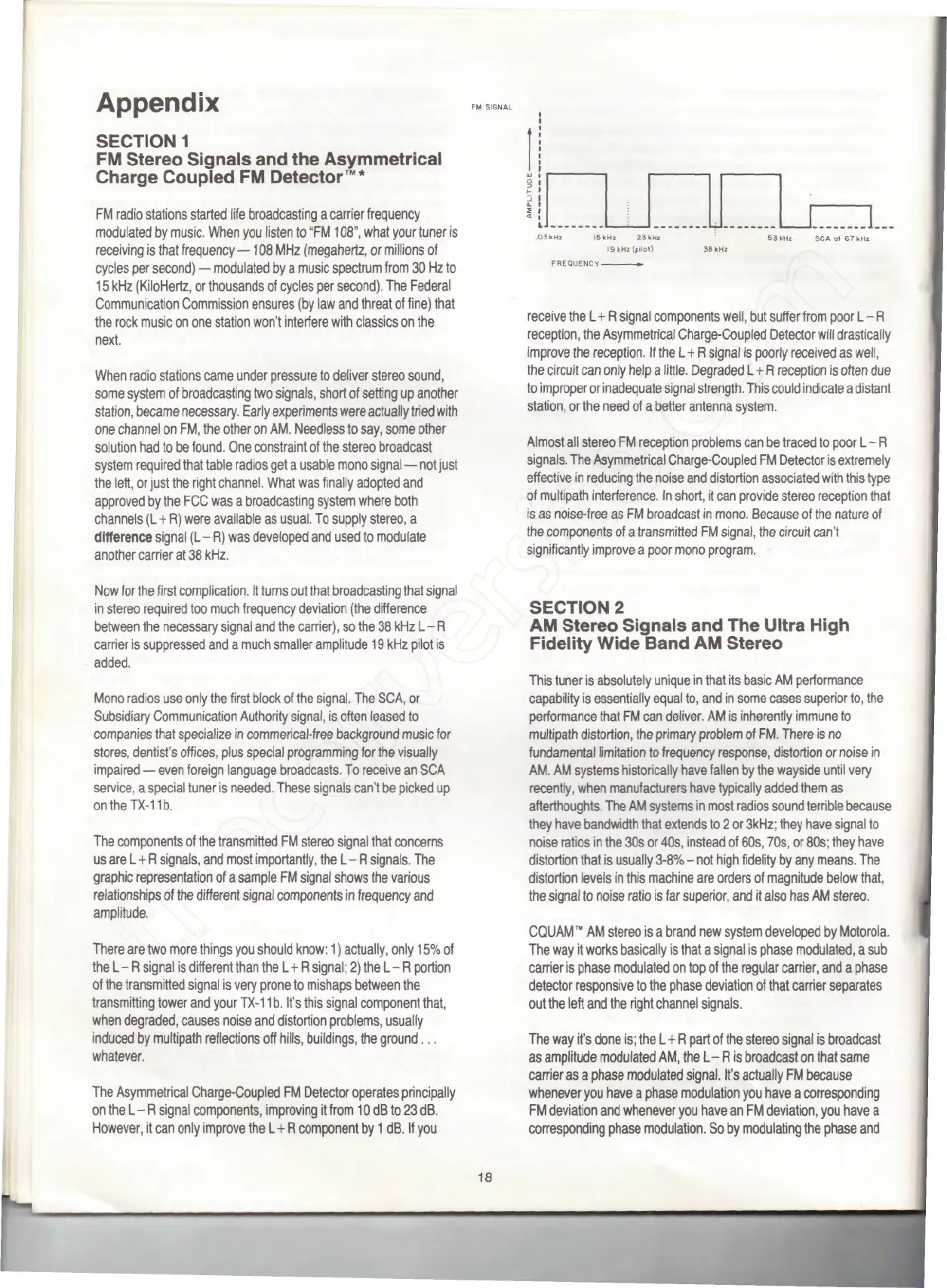
Mono
radios
use
only
the
first block
of the
signal.
The
SCA,
or
Subsidiary Communication Authority
signal,
is
often leased
to
companies that
specialize
in
commerical-free
background music
for
stores, dentist's offices, plus special programming
for the
visually
impaired
—
even foreign language broadcasts.
To
receive
an SCA
service,
a
special tuner
is
needed. These signals can't
be
picked
up
ontheTX-11b.
The
components
of the
transmitted
FM
stereo signal that concerns
us
are
L+R
signals,
and
most importantly,
the L- R
signals.
The
graphic
representation
of a
sample
FM
signal
shows
the
various
relationships
of the
different
signal
components
in
frequency
and
amplitude.
There
are two
more things
you
should know:
1)
actually, only
15%
of
the
L- R
signal
is
different than
the
L+R
signal;
2) the L- R
portion
of
the
transmitted signal
is
very prone
to
mishaps between
the
transmitting tower
and
your
TX-11
b.
It's this signal component that,
when
degraded, causes noise
and
distortion problems, usually
induced
by
multipath
reflections
off
hills,
buildings,
the
ground...
whatever.
The
Asymmetrical Charge-Coupled
FM
Detector operates
principally
on
the L - R
signal components, improving
it
from
10
dB to 23 dB.
However,
it can
only improve
the
L+R
component
by 1 dB. If you
kHz
15kHz
23kHz
19
kHz
(pilot)
FREQUENCY
«-
SCA
at
67 kHz
receive
the
L+R
signal components well,
but
suffer
from poor
L- R
reception,
the
Asymmetrical Charge-Coupled Detector will
drastically
improve
the
reception.
If the
L+R
signal
is
poorly received
as
well,
the
circuit
can
only help
a
little.
Degraded
L+R
reception
is
often
due
to
improper
or
inadequate signal
strength.
This could indicate
a
distant
station,
or the
need
of a
better antenna system.
Almost
all
stereo
FM
reception problems
can be
traced
to
poor
L- R
signals.
The
Asymmetrical Charge-Coupled
FM
Detector
is
extremely
effective
in
reducing
the
noise
and
distortion associated with this type
of
multipath interference.
In
short,
it can
provide stereo reception that
is
as
noise-free
as FM
broadcast
in
mono. Because
of the
nature
of
the
components
of a
transmitted
FM
signal,
the
circuit can't
significantly improve
a
poor mono program.
SECTION
2
AM
Stereo Signals
and The
Ultra High
Fidelity Wide Band
AM
Stereo
This tuner
is
absolutely unique
in
that
its
basic
AM
performance
capability
is
essentially equal
to, and in
some cases superior
to, the
performance that
FM can
deliver.
AM is
inherently immune
to
multipath
distortion,
the
primary problem
of FM.
There
is no
fundamental
limitation
to
frequency response,
distortion
or
noise
in
AM.
AM
systems historically have
fallen
by the
wayside
until
very
recently,
when manufacturers have typically added them
as
afterthoughts.
The AM
systems
in
most radios sound terrible because
they
have bandwidth that extends
to 2 or
3kHz; they have signal
to
noise
ratios
in the 30s or
40s, instead
of
60s, 70s,
or
80s; they have
distortion that
is
usually 3-8%
- not
high
fidelity
by any
means.
The
distortion
levels
in
this
machine
are
orders
of
magnitude
below that,
the
signal
to
noise ratio
is far
superior,
and it
also
has AM
stereo.
CQUAM™
AM
stereo
is a
brand
new
system
developed
by
Motorola.
The
way it
works basically
is
that
a
signal
is
phase modulated,
a sub
carrier
is
phase modulated
on top of the
regular carrier,
and a
phase
detector
responsive
to the
phase deviation
of
that carrier separates
out
the
left
and the
right channel signals.
The way
it's
done
is;
the
L+R
part
of the
stereo
signal
is
broadcast
as
amplitude
modulated
AM,
the L- R is
broadcast
on
that same
carrier
as a
phase
modulated
signal.
It's
actually
FM
because
whenever
you
have
a
phase
modulation
you
have
a
corresponding
FM
deviation
and
whenever
you
have
an FM
deviation,
you
have
a
corresponding phase modulation.
So by
modulating
the
phase
and
18


 To Next Page
 Loading...