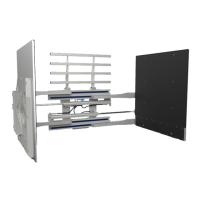
The document is a user manual for Cascade-KOOI Reachforks, specifically covering Single Range (20B, 30B, 35B TFT), Double Range (25B, 35B, 45B, 58B TFQ), and Extension Range (20B, 30B TFE) models.
Function Description
Reachforks are an attachment for forklift trucks designed to extend and retract, allowing for handling loads in confined spaces or reaching further than standard forks. The Cascade-KOOI Reachforks feature an integrated synchronizing system that enables both forks to extend and retract simultaneously. This system is crucial for efficient and safe load handling. In cases where the forks fail to operate simultaneously, the manual provides a procedure to reset the hydraulic system by fully retracting the sleeves and operating the valve for an additional ±10 seconds.
Important Technical Specifications
The manual provides a detailed nameplate legend for identification, including:
- Unit Description (ABC): Identifies the specific model.
- Serial Number (1234): Unique identifier for the unit.
- Retracted Center of Gravity: Indicates the center of gravity when the forks are retracted.
- Extended Center of Gravity: Indicates the center of gravity when the forks are extended.
- Retracted Load Center: Specifies the load center when the forks are retracted.
- Extended Load Center: Specifies the load center when the forks are extended.
- Weight (M): The weight of the Reachforks attachment.
- Max. Capacity on Retracted Load Center: The maximum load capacity when forks are retracted.
- Max. Capacity on Extended Load Center: The maximum load capacity when forks are extended.
- Maximum Allowed Oil Pressure: The maximum hydraulic pressure the system can withstand.
- Production Year (00): The year of manufacture.
- Extra Information (000): Additional relevant data.
The manual also includes a unit description of Reachforks, detailing:
- Model
- No. of cylinders per set
- Capacity x 100 Kg
- Retracted Length (mm)
- Stroke (mm)
- Mounting
Hydraulic system specifications are provided for different ranges:
- Single Range (20B, 30B, 35B): Recommended oil flow of 7.5-12.5 L/min (2-3.3 gal/min), recommended hose diameter of 3/8", maximum operating pressure of 250 bar (3626 psi), and 12L/7/16" JIC (USA) connection.
- Extension Range (20B, 30B): Shares the same hydraulic specifications as the Single Range.
- Double Range (25B, 35B, 45B, 48B): Recommended oil flow of 12.5-20.5 L/min (3.3-5.3 gal/min), recommended hose diameter of 3/8", maximum operating pressure of 250 bar (3626 psi), and /9/16" JIC (USA) connection.
The manual emphasizes that the maximum truck capacity, as seen on the truck nameplate, should never be exceeded. The rated capacity of both the truck and attachment is the responsibility of the original truck manufacturer and may be less than the capacity shown on the attachment's nameplate.
Usage Features
The manual outlines several safety precautions and usage guidelines:
- Safety Warnings:
- Do not ride on the Reachforks or the load.
- Do not walk or stand under the Reachforks.
- Do not reach through the mast of the forklift truck.
- Do not load the Reachforks beyond the manufacturer's stipulated lifting capacities and load center limits.
- Do not weld anything onto the Reachforks without express permission from the supplier, as unauthorized welding voids warranty.
- Do not use faulty Reachforks before professional repair or replacement.
- Do not carry out maintenance work while there is pressure in the hydraulic system (remove key from forklift ignition switch).
- Do not place limbs between pallet stops and the inner fork (vertical section) of the Reachforks, as shifting loads can cause serious injury.
- Do not use Reachforks in areas below -30°C (-22°F) unless otherwise agreed with the manufacturer.
- Safety Cautions:
- When leaving the lift truck, the engine must be switched off and the handbrake applied.
- Be aware of the space above and beneath the Reachforks.
- The load must be distributed as evenly as possible on the Reachforks.
- Retract the (loaded) Reachforks as soon as possible.
- If possible, retract the Reachforks before driving.
- Always drive with the Reachforks in the lowest possible position.
- Assembly:
- Mounting: The Reachforks are stamped with 'L' and 'R' for left and right, to be mounted as viewed from the forklift operator's seat.
- Sliding onto Carriage Bar: The Reachforks slide onto the carriage bar.
- Locking: Ensure locking knobs engage notches on the carriage, using the catch before operation.
- Hydraulic Connection: Connect the Reachforks to the hydraulic system according to specified flow rates, hose diameters, and pressure.
- Bleeding the Hydraulic System: Involves tilting the mast, operating the lever with retracted forks for 30 seconds to flush, and extending/retracting several times. Check for unobstructed hoses and oil leakages.
- Working with Reachforks:
- Synchronization: If forks fail to operate simultaneously, fully retract sleeves and operate the valve for ±10 seconds to reset the hydraulic system.
- Wear Minimization: Avoid contact with the ground during operation. Wear-resistant plates can be welded under the sleeve, and forklift mast chains can be shortened to prevent ground contact.
Maintenance Features
The manual provides a comprehensive maintenance schedule and instructions for specific repairs.
Maintenance Schedule:
- Weekly:
- Grease the underside and topside of the inner fork (Recommended lubricating grease: Novatex EP2).
- Monthly:
- Check inner fork for leaks (If leakage is detected, remove forks and contact supplier).
- Check wear strips for any sign of wear.
- Check sleeve for signs of wear, especially the heel side.
- Check for and remove any dirt in the sleeve.
- Check for any cylinder head leaks.
- 6 months or every 1000 hours:
- Annually or every 2000 hours:
- Check inner forks in accordance with ISO 5057 standards.
Wear:
- Wear Strips: Thickness must not be less than 1.5 mm (1/16"). Replace or fill with spacers (Art. N° RE0092002) if worn to this thickness.
- Inner Fork: Replace if S1 (thickness at the heel) is 5% thinner than S2 (thickness at the tip).
- Sleeve: Replace if surface A (dark grey, integrated wear plate) is worn level with or below surface B (light grey). For some Cascade-KOOI types, if there are signs of wear on the lower side of the sleeve, it must be replaced.
- Wear Plate Welding Data:
- Process: MAG (135), 210A, 28 VDC.
- Weld type: fillet weld a4, 1 layer.
- Cleaning: brush.
- Wire: 1 mm, EN 12534 / Mn3Ni1CrMo.
- Shielding gas: 80% Ar / 20% CO2, 15-16 L/min.
- Weld in wear-plate grooves.
- Caution: Sleeves must be removed, and pistons, piston rods, and cylinder heads must be removed before welding on the inner fork.
Instructions for Replacement of Sleeve:
- Preparation: Position Reachforks at hip height, tilt mast slightly forward, and remove key from ignition.
- Removal (General): Tap spring pins out of the sleeve using a hammer and Ø10 punch. Pull the sleeve off the fork.
- Removal (Specific Models):
- For some models: Unscrew screws (3) and remove stops (4) from the outer sleeve (5) using an Allen key 4.
- For other models: Unscrew screws (6) from stops (7) and remove the inner sleeve using an Allen key 4.
- Installation (General): Slide the new sleeve over the fork.
- Installation (Specific Models):
- For some models: Slide the new inner sleeve (8) onto the fork. Tighten screws (6) in stops (7) and lock with Loctite 270.
- For other models: Place stops (4) in the outer sleeve (5). Tighten screws (3) and lock with Loctite 270.
- Spring Pin Installation: Tap spring pin(s) into the new sleeve. Ensure holes in the sleeve align with openings in the bracket(s) welded onto the piston rod(s). Do not tap the spring pin onto the bracket or piston rod.
Replacement of Hydraulic Parts:
- Preparation: Follow steps 1-3 from 'Instructions for Replacement of Sleeve'.
- Hose Disconnection: Loosen hose connectors (3) slightly to prevent vacuum when removing hydraulic parts. Tools: Open-ended spanner 22.
- Hydraulics Removal: Pull the entire hydraulics set (piston, cylinder head, piston rod) out of the fork. Caution: Protect the piston rod surface from damage.
- Cylinder Head Removal: Place a drip tray. Unscrew cylinder head(s) (5) using a cylinder head spanner (4) and a 1/2" ratchet. Cylinder head spanners are available from Cascade-KOOI (Part No. 6927855).
- Piston Removal: Clamp the piston rod at the rod end (7). Use a size 24 open-ended spanner (8) to loosen piston (9). If stuck, heat with a burner (Note: heated pistons must be replaced due to seal damage). Tools: Open-ended spanner 24, clamp. Warning: Fire hazard when using a burner.
- Cylinder Head Installation: Slide the new cylinder head (5) onto the piston rod (10). Caution: Do not damage seals during assembly, especially when sliding over the thread.
- Piston Installation: Remove adhesive residue from piston rod thread (10), clean with Loctite 7063. Apply Loctite 270 to the thread. Clamp piston rod at rod end (7). Tighten piston (9) onto piston rod (10) to 100 Nm using a torque wrench 24. Tools: Loctite 270, Loctite 7063, torque wrench 24.
- Hydraulics Installation: Smear Copaslip onto cylinder head thread (5). Align hydraulic set (6) with cylinder, tap into bore. Screw cylinder head tight using cylinder head spanner (4) and torque wrench (Torque values: 30mm=60Nm, 35mm=80Nm, 40mm=90Nm). Tools: Hammer, Copaslip, cylinder head spanner, 1/2" ratchet. Caution: Do not damage piston or cylinder head seals.
- Hose Connection: Screw hose connectors (3) tight. Tools: Open-ended spanner 22.
- Final Steps: Follow steps 4-5 from 'Instructions for Replacement of Sleeve' and step 5 from 'Assembly'.
Troubleshooting:
The manual includes a detailed troubleshooting guide with observations, symptoms, possible causes, and solutions for common issues such as:
- Oil leak: Between cylinder head and piston rod, between cylinder head and fork blade, or at connector.
- Forks leaking oil: Cracked Reachforks.
- Forks not moving in unison: Wrong mounting, wrong hydraulic connection, leaking piston seal, air in hydraulic system, pistons not returning to rear position, dirt accumulation.
- Sleeves moving without operation: Leak in forklift's control valve.
- Sleeve fails to retract: Broken spring pin(s).
- Difference in length between sleeves: Piston rods not same length, loose piston, permanently deformed Reachforks, Reachforks not hanging on carriage plate, carriage plate not horizontal, mismatched forks.
- Difference in height between forks: Worn wear strips.
- Excessive play between fork blade and sleeve: Worn sleeves.
The manual also provides contact information for Cascade-KOOI service departments in the Americas.

 Need help?

 To Next Page
 General