Ballast & Weight Information
Rather than weighting the tractor down to pull
heavy loads, try reducing the load. Pulling a lighter
load at higher speed is cheaper and more efficient.
Liquid ballast should never be added until a deter-
mination is made for the need, however, there may
General Specifications
be times when it is desirable to weight the tractor to
decrease slippage and increase balance or stability.
Use no more ballast than necessary, and remove
ballast when it is no longer needed.
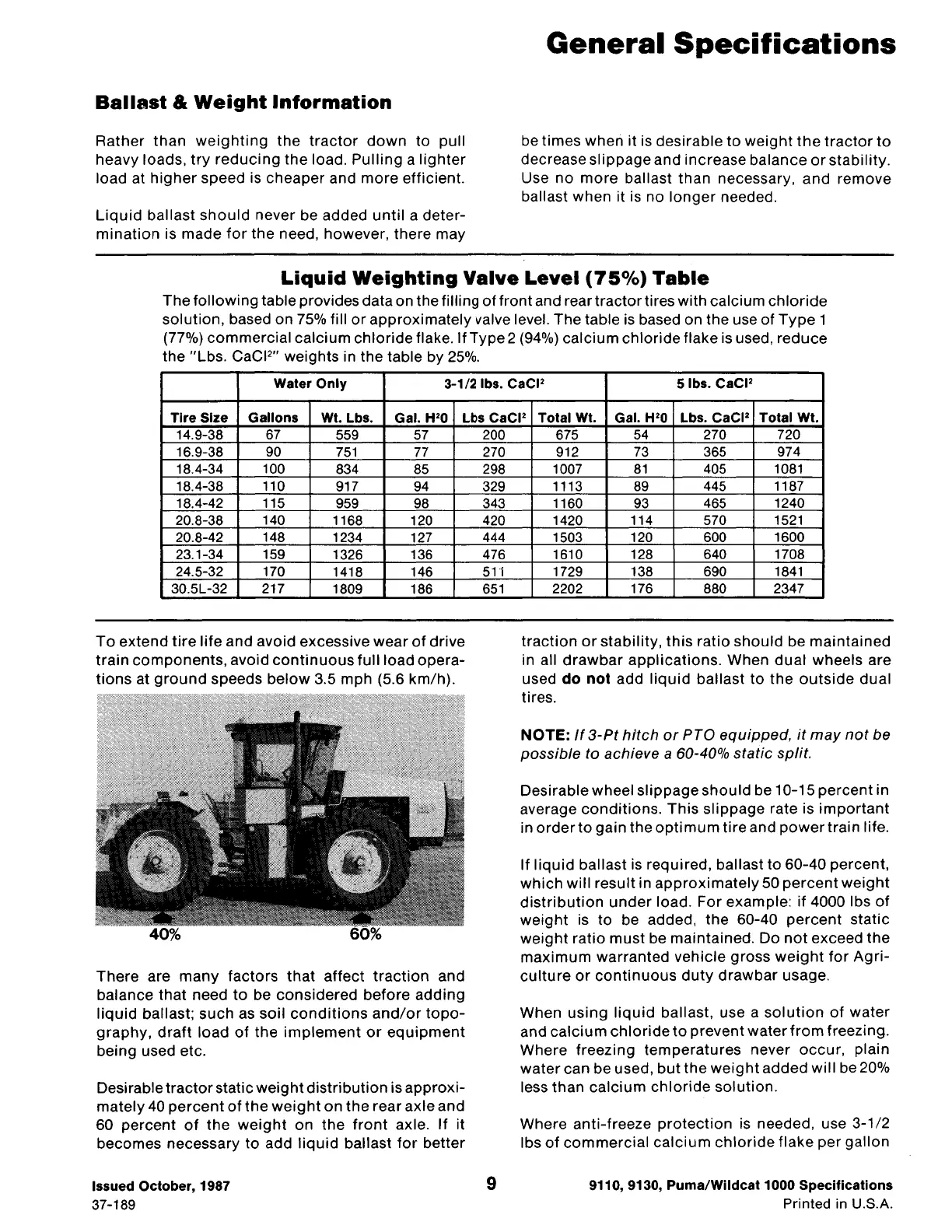
Liquid Weighting Valve Level (75%) Table
The following table provides data on the filling of front and rear tractor tires with calcium chloride
solution, based on 75% fill or approximately valve level. The table is based on the use of Type 1
(77%) commercial calcium chloride flake. If Type 2 (94%) calcium chloride flake is used, reduce
the "Lbs. CaCl2" weights in the table by 25%.
Water Only 3-1/2 lbs. CaCl2 5 lbs. CaCl2
Tire Size Gallons
Wt. Lbs. Gal.H20 Lbs CaCl
2
Total Wt.
Gal.H20 Lbs. CaCl
2
Total Wt.
14.9-38 67
559 57
16.9-38 90
751 77
18.4-34
100
834 85
18.4-38
110
917 94
18.4-42 115
959 98
20.8-38
140
1168
120
20.8-42
148
1234 127
23.1-34
159
1326 136
24.5-32 170
1418 146
30.5L-32 217 1809
186
To extend tire life and avoid excessive wear of drive
train components, avoid continuous full load opera-
tions at ground speeds below 3.5 mph (5.6 km/h).
There are many factors that affect traction and
balance that need to be considered before adding
liquid ballast; such as soil conditions and/or topo-
graphy, draft load of the implement or equipment
being used etc.
Desirable tractor static weight distribution is approxi-
mately 40 percent of the weight on the rear axle and
60 percent of the weight on the front axle. If it
becomes necessary to add liquid ballast for better
Issued October, 1987
37-189
200
270
298
329
343
420
444
476
51
·1
651
9
675 54 270 720
912 73 365
974
1007 81 405
1081
1113 89
445 1187
1160 93
465 1240
1420 114 570 1521
1503 120 600
1600
1610
128 640 1708
1729 138 690 1841
2202
176
880 2347
traction or stability, this ratio should be maintained
in all drawbar applications. When dual wheels are
used do not add liquid ballast to the outside dual
tires.
NOTE: If 3-Pt hitch or PTO equipped, it may not be
possible to achieve a 60-40% static split.
Desirable wheel slippage should be 10-15 percent in
average conditions. This slippage rate is important
in order to gain the optimum tire and power train life.
If liquid ballast is required, ballast to 60-40 percent,
which will result in approximately 50 percent weight
distribution under load. For example: if 4000 lbs of
weight is to be added, the 60-40 percent static
weight ratio must be maintained. Do not exceed the
maximum warranted vehicle gross weight for Agri-
culture or continuous duty drawbar usage.
When using liquid ballast, use a solution of water
and calcium chloride to prevent water from freezing.
Where freezing temperatures never occur, plain
water can be used, but the weight added will be 20%
less than calcium chloride solution.
Where anti-freeze protection is needed, use 3-1/2
lbs of commercial calcium chloride flake per gallon
9110, 9130, Puma/Wildcat 1000 Specifications
Printed in U.S.A.


 To Next Page
 Loading...