General Specifications
Bearcat·
&
Cougar 1000 Series Tractors
Approximate Shipping Weight
Bearcat/Cougar 1000
29,600 lbs. (13,440 Kg) Bar style axle with 20.8 x 42
R1 (10 ply) hub style duals and PTO.
23,000 lbs. (10,440 Kg) Std. Outboard Planetary
Axle with 23.1 x 34 R1 (8 ply) singles and PTO.
NOTE:
Estimated shipping weights listed are less
fuel, operator or other optional equipment. Add
1500 lbs (650 Kg) if TPH equipped.
Maximum Warranted Weight
32,000 lbs. (14,528 Kg) ·
NOTE:
The maximum warranted weight listed is the
maximum ballasted
G
VW with a 60% front and 40%
rear static split.
Ballast Information
There may be times when it is desirable to weight
the tractor to decrease slippage and increase stabi I ity.
There are many factors that affect traction and
balance that need to be considered before adding
liquid ballast; such as soil conditions and/or topo-
graphy, draft load of the implement or equipment
being used etc.
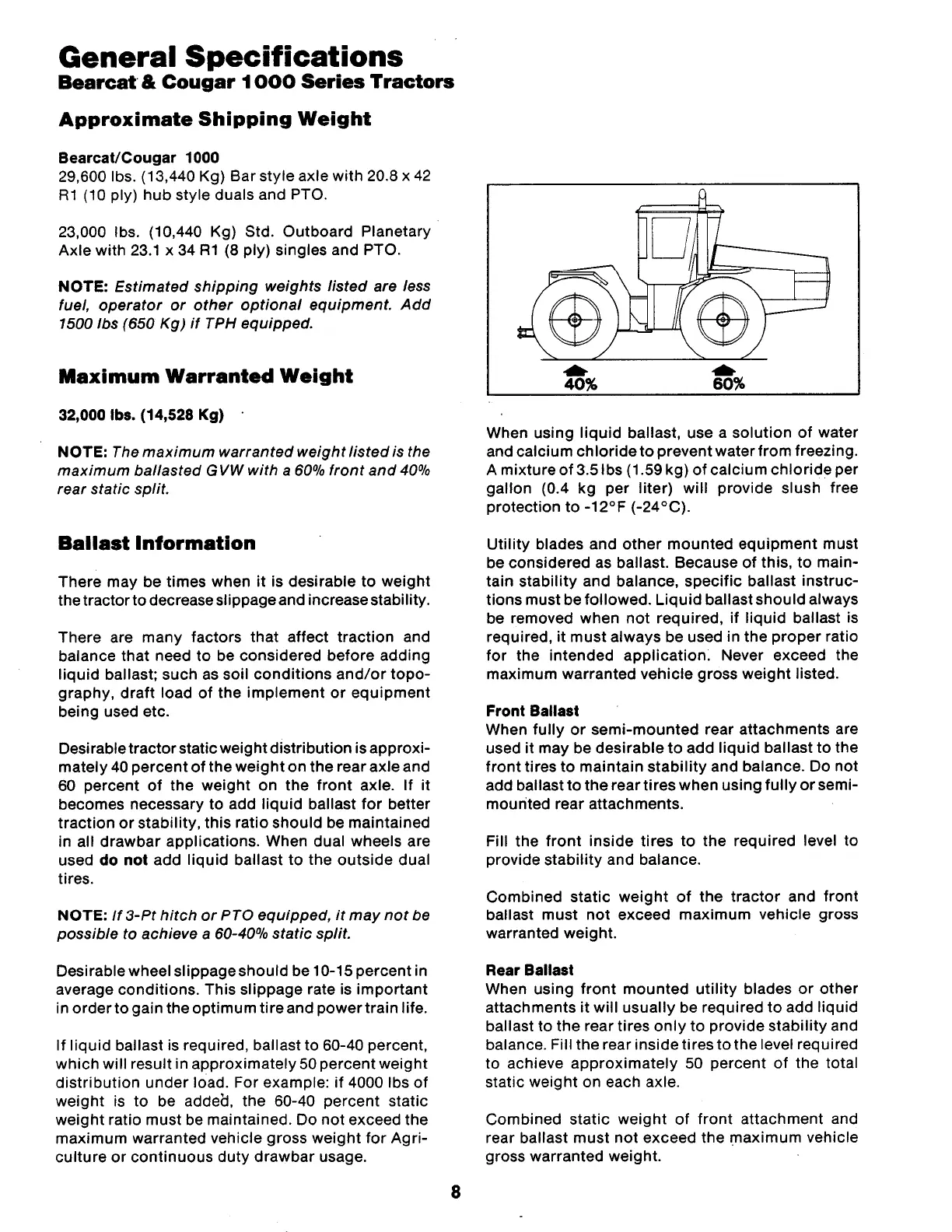
Desirable tractor static weight distribution is approxi-
mately 40 percent of the weight on the rear axle and
60 percent of the weight on the front axle. If it
becomes necessary to add liquid ballast for better
traction or stability, this ratio should be maintained
in all drawbar applications. When dual wheels are
used
do not
add liquid ballast to the outside dual
tires.
NOTE:
If 3-Pt hitch or PTO equipped, it may not be
possible to achieve a 60-40% static split.
Desirable wheel slippage should be 10-15 percent in
average conditions. This slippage rate is important
in order to gain the optimum tire and power train life.
If liquid ballast is required, ballast to 60-40 percent,
which will result in approximately 50 percent weight
distribution under load. For example: if 4000 lbs of
weight is to be addea, the 60-40 percent static
weight ratio must be maintained. Do not exceed the
maximum warranted vehicle gross weight for Agri-
culture or continuous duty drawbar usage.
8
..
40%
..
60%
When using liquid ballast, use a solution of water
and calcium chloride to prevent water from freezing.
A mixture of 3.5 lbs (1.59 kg) of calcium chloride per
gallon (0.4 kg per liter) will provide slush free
protection to -12°F (-24°C).
Utility blades and other mounted equipment must
be considered as ballast. Because of this, to main-
tain stability and balance, specific ballast instruc-
tions must be followed. Liquid ballast should always
be removed when not required, if liquid ballast is
required, it must always be used in the proper ratio
for the intended application. Never exceed the
maximum warranted vehicle gross weight listed.
Front Ballast
When fully or semi-mounted rear attachments are
used it may be desirable to add liquid ballast to the
front tires to maintain stability and balance. Do not
add ballast to the rear tires when using fully or semi-
mourited rear attachments.
Fill the front inside tires to the required level to
provide stability and balance.
Combined static weight of the tractor and front
ballast must not exceed maximum vehicle gross
warranted weight.
Rear Ballast
When using front mounted utility blades or other
attachments it will usually be required to add liquid
ballast to the rear tires only to provide stability and
balance. Fill the rear inside tires to the level required
to achieve approximately 50 percent of the total
static weight on each axle.
Combined static weight of front attachment and
rear ballast must not exceed the i:naximum vehicle
gross warranted weight.


 To Next Page
 Loading...