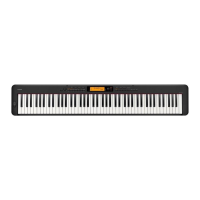
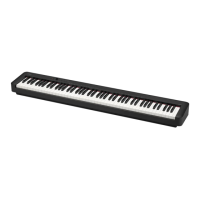
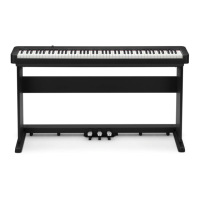
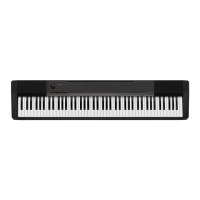
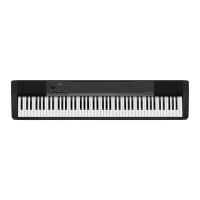
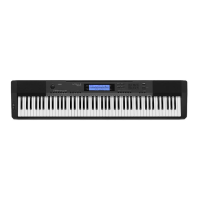
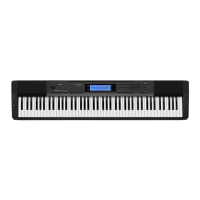
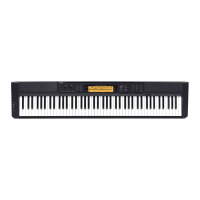
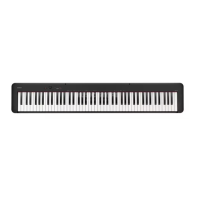
This document is the user's guide for the CASIO CDP-S90 Digital Piano, providing comprehensive instructions on its setup, operation, and maintenance.
Overview and Setup
The CDP-S90 Digital Piano is designed for ease of use, offering a range of functions for both beginners and experienced players. To begin, users must prepare the power supply. The device can be powered either by an AC adaptor or by six AA-size alkaline batteries. When using the AC adaptor, it should be plugged into a power outlet close to the Digital Piano for easy access. It's crucial to use only the specified AC adaptor (AD-A12150LW) to avoid fire, electric shock, or personal injury. For battery operation, six AA-size alkaline batteries are required. Users should ensure the batteries are loaded correctly, observing the positive and negative markings, and turn off the power before loading them. When the batteries are low, the power button lamp will flash, indicating it's time for replacement. Using the piano with very low batteries can lead to sudden power-off and potential data corruption.
Turning the Digital Piano on involves pressing the power button, which will light up as the device powers up. The volume can then be adjusted using the VOLUME knob. To turn off the piano, the power button should be held down until the lamp goes out. It's important to note that turning off the power puts the piano into a standby state, and for long periods of non-use or during a lightning storm, the AC adaptor should be unplugged. Most settings revert to their initial defaults upon power-off, except for the tuning setting.
The CDP-S90 also features an Auto Power Off function to conserve energy. When powered by the AC adaptor, it will turn off after approximately four hours of inactivity, and after six minutes when running on battery power. This feature can be enabled or disabled by holding down the FUNCTION button and pressing the B6 (Auto Power Off) keyboard key. A low beep indicates Auto Power Off is disabled, while a high beep indicates it's enabled.
For maintenance, the Digital Piano can be returned to its factory default settings. This procedure involves holding down the FUNCTION button and pressing the E7 (Factory Reset) and then G7 (Execute) keyboard keys. This will initialize all stored data and settings, and the piano will automatically power off upon completion.
Connecting a pedal enhances the playing experience. The supplied SP-3 damper pedal can be connected to the DAMPER PEDAL jack, allowing notes to reverberate when pressed. For private practice, headphones can be connected to the PHONES/OUTPUT jack, which mutes the built-in speakers. Users should always lower the volume before connecting headphones and use commercially available headphones. Prolonged listening at very high volumes should be avoided to prevent hearing damage.
Digital Piano Operation
The CDP-S90 offers various operational features. Users can listen to two built-in demo songs by pressing the FUNCTION and GRAND PIANO buttons simultaneously. During demo play, the piano's setup is optimized for the songs. To switch between demo songs, hold FUNCTION and press the [-] (D4) or [+] (Eb4) keyboard key. Demo play repeats until stopped by pressing FUNCTION or GRAND PIANO again. The Auto Power Off function can still activate during demo play if not disabled.
The piano includes 10 built-in tones. A single tone can be selected by holding FUNCTION and pressing one of the Tone keyboard keys (C3 through A3). For example, to select HARPSICHORD, press the F#3 key. The GRAND PIANO STANDARD tone can be quickly selected by pressing the GRAND PIANO button, which also lights up its lamp. This is the default tone upon power-on.
The CDP-S90 also supports tone layering, allowing two different tones to sound simultaneously. To layer tones, hold FUNCTION and press the Tone keyboard keys for the first and then the second desired tone. For instance, to layer HARPSICHORD and STRINGS, press F#3 and then G3. To cancel layering, select a single tone or press the GRAND PIANO button.
The Digital Piano includes effects to enhance the sound, such as reverb and chorus. To add reverb, hold FUNCTION and press the REVERB keyboard key (Eb5) to cycle through settings (Reverb off, Virtual Hall, etc.) or use the [0] (E4) to [4] (Ab4) keys for direct selection. The same process applies to adding chorus, using the CHORUS keyboard key (E5).
A metronome is available for practicing with a regular tempo. It can be started or stopped by holding FUNCTION and pressing the METRONOME ON/OFF keyboard key (Bb3). The metronome beat can be changed by holding FUNCTION, pressing the METRONOME BEAT keyboard key (C4), and then selecting a beat value from [0] (E4) to [9] (C#5). The tempo can be adjusted similarly by pressing the METRONOME TEMPO keyboard key (B3) and inputting a three-digit tempo value using the [0] (E4) to [9] (C#5) keys. The metronome volume can also be adjusted using the METRONOME VOLUME keyboard key (C#4) and inputting a two-digit volume value.
Configuring Settings
Several settings can be configured to customize the playing experience. The keyboard's touch response determines how volume changes based on key press strength. There are four settings: Off (fixed volume), Light (strong sound with light pressure), Normal (default), and Heavy (normal sound with strong pressure). This can be adjusted by holding FUNCTION and pressing the TOUCH RESPONSE keyboard key (D5), then cycling through settings or using [0] (E4) to [3] (G4) keys.
The transpose feature allows users to raise or lower the overall pitch in semitone steps, from -12 to +12 semitones. This is useful for matching a vocalist's range or playing in a more comfortable key. To change the transpose setting, hold FUNCTION and press the TRANSPOSE- (F5) or TRANSPOSE+ (F#5) keyboard keys, or input a two-digit value using the [0] (E4) to [9] (C#5) keys.
Fine tuning the pitch of the A4 note is also possible, with a range of 415.5 to 465.9 Hz (default 440.0 Hz). This setting is retained even after power-off. To adjust, hold FUNCTION and press the TUNE- (G5) or TUNE+ (Ab5) keyboard keys for 0.1 Hz increments, or input a three-digit frequency value using the [0] (E4) to [9] (C#5) keys.
The beep setting, which provides auditory feedback for key operations, can be enabled or disabled by holding FUNCTION and pressing the B7 (Beep) keyboard key.
MIDI settings include Keyboard Channel and Local Control. The Keyboard Channel specifies the MIDI channel (1-16) for sending data to external devices. Local Control, when off, sends MIDI data without producing sound from the piano's speakers, useful for controlling external devices. Both can be configured by holding FUNCTION and pressing the G6 (Keyboard Channel) or A6 (Local Control) keyboard keys, respectively, and then selecting the desired value or toggling the setting.
Connecting External Devices
The CDP-S90 can connect to various external devices. For audio output to stereo, amplifier, or recording equipment, connecting cords with a stereo mini plug on one end and a matching plug for the external device on the other are required. These should be connected to the PHONES/OUTPUT jack. Always turn off both devices, lower volumes, then turn on the piano first, followed by the external device.
To play audio from an external device through the Digital Piano, a 3-pole stereo mini plug cord is needed, connected to the AUDIO IN jack. The volume for this input is controlled by the external device. Similar precautions regarding power and volume should be followed when connecting.
The Digital Piano can also be linked with a smart device (smartphone, tablet) using a commercially available USB cable connected to the piano's USB port. This enables control of the piano via the Chordana Play for Piano app. The app can be downloaded from the CASIO website.
For computer connection, the Digital Piano can exchange MIDI data with music software. Users need a computer meeting specific operating system requirements (Windows 7, 8.1, 10, or macOS 10.7-10.15) and a USB 2.0 or 1.1 A-B connector type USB cable. The connection process involves turning off the piano, starting the computer (without music software), connecting the USB cable, turning on the piano (which installs drivers automatically on first connection), starting the music software, and then configuring the software to select "CASIO USB-MIDI" as the MIDI device. It's crucial to turn on the Digital Piano before starting the music software.
Reference and Troubleshooting
The user's guide includes a troubleshooting section to address common issues such as power problems, sound issues (no sound, notes sustaining, cut off notes, volume/tone changes, pitch mismatch, reverb changes), and computer connection problems. For most sound-related issues, adjusting volume, checking connections, replacing batteries, or initializing settings are recommended. For computer connection issues, verifying USB cable connection, MIDI device selection in software, and restarting devices in the correct order are advised.
The manual also provides a tone list, a keyboard function list detailing functions assigned to specific keys, and a MIDI implementation chart for advanced users.


 To Next Page
 General