EasyManua.ls Logo

Casio CFX-9800G - Page 112

Casio CFX-9800G
206 pages
Print Icon
To Next Page IconTo Next Page
To Previous Page IconTo Previous Page
Loading...
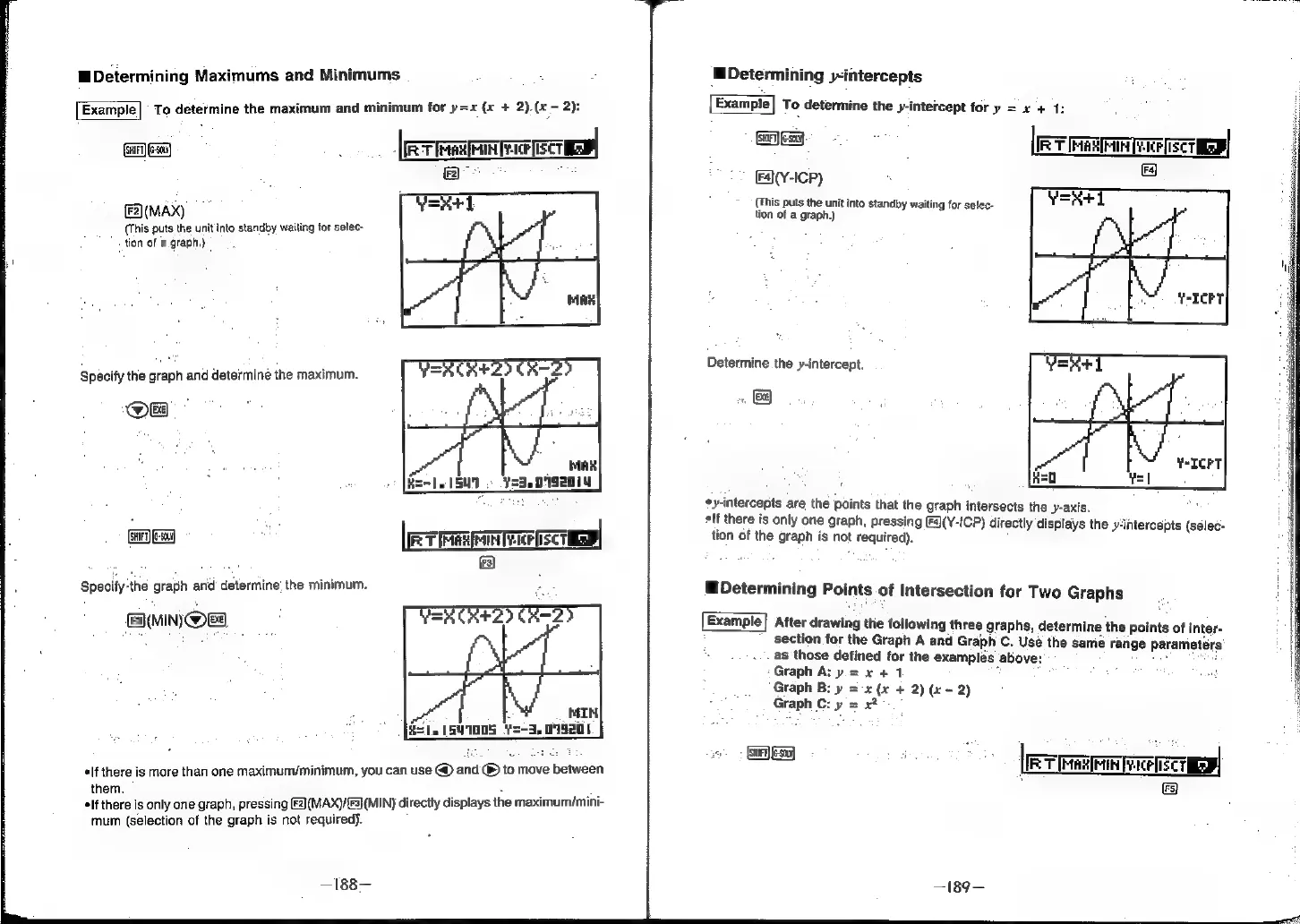
Determining
y-intercepts
To
determine
the
y-intercept
for
y
=
x
+
1:
RT
MaAgIMIn
TRF
lisc
Fa
BDetermining
Maximums
and
Minimums
Example]
To
determine
the
maximum
and
minimum
for
y=x
(x
+
2).
(@-
2):
Ga]
F
Ir
TT
Maxon
Gea
=.
(This
puts
the
unit into
standby
waiting
for
selec-
(F)(MAX)
tion
of
a
graph.)
(This
puts
the
unit
into
standby
waiting
for
selec-
:
tion
of
a
graph.)
(F4)(Y-ICP)
Determine
the
y-intercept.
.
&
Specify
the
graph
and
determine
the
maximum.
COB
*y-intercepts
are
the
points
that
the
graph
intersects
the
y-axis.
sf
there
is
only
one
graph,
pressing
F4(Y-
-ICP)
directly
displays
the
y-intercepts
(selec-
tion
of
the
graph
is
not
required).
SHIFT)
(-s04y
Specity:the
graph
and
determine
the
minimum.
a
WDetermining
Points
of
Intersection
for
Two
Graphs
I
(MIN)@
eel
Example|
After
drawing
the
following
three
graphs,
determine
the
points
of
inter-
z
section
for
the
Graph
A
and
Graph
C.
Use
the
same
range
Parameters
as
those
defined
for
the
examples
:
above:
Graph
A:
y
=
x +
1
Graph
B:
y
=
x
{x
+
2)
(x
~
2)
Graph
C:
y
=
x?”
(#1.
isuno0s
¥=-3,0719801
Ae
os
;
ie
RET
TMAR
Pin
ener
fect
«lf
there
is
more
than
one
maximum/minimum,
you
can
use
@
and
ee
to
move
between
|
<=
them.
*lf
there
is
only
one
graph,
pressing
[F2
(MAX)
mum
(selection
of
the
graph
is
not
required).
(MIN)
directly
displays
the
maximum/mini-