
 Need help?
Do you have a question about the Casio CT-S1BK and is the answer not in the manual?
Describes the Instrument's MIDI structure: System, Performance Controller, and Sound Generator sections.
Explains how sound generator instrument receive messages depend on Timbre Type.
Details controlling MIDI message send/receive via global and instrument-specific settings.
Lists conditions like startup, shutdown, or flash memory access that disable MIDI.
Defines the MIDI Note Off message format, transmission, and reception.
Defines the MIDI Note On message format, transmission, and reception.
Explains the MIDI Control Change message format and its parameters, including various controllers like Bank Select, Volume, Pan, etc.
Explains the MIDI Program Change message and its relation to Timbre Type.
Details the Channel Pressure (Aftertouch) MIDI message.
Explains the Pitch Bend Change MIDI message and its range.
Describes the Active Sensing system message and its mode.
Details System Exclusive (SysEx) messages, including Universal Real Time, Non Real Time, and CASIO General types.
Provides tables mapping MIDI transmit/receive values to DSP parameter values for various settings like volume, pan, and tuning.
Explains notation conventions, including hexadecimal and binary, for MIDI data values.
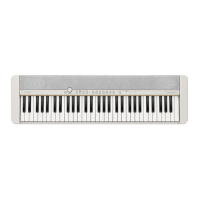
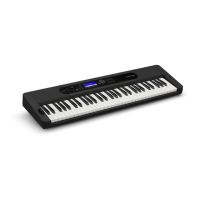
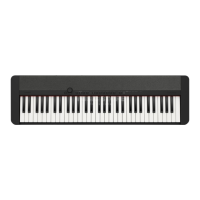
The CASIO CT-S1 is a MIDI-compatible instrument designed to integrate seamlessly into various musical setups, offering a blend of performance control, sound generation, and system management capabilities. As a MIDI device, it comprises three main sections: the System Section, the Performance Controller Section, and the Sound Generator Section, each contributing to its overall functionality.
The System Section is the core management unit of the CT-S1, overseeing the instrument's operational status and user-defined data. It ensures the stable and consistent performance of the device by managing internal settings and configurations.
The Performance Controller Section is dedicated to capturing and transmitting performance-related data. This includes input from keyboard play and various controller operations. When you play the keyboard or manipulate a controller, this section generates performance messages that are sent both to external destinations and to the internal Sound Generator Section. The channel number for these messages is determined by the instrument's MIDI settings, allowing for flexible routing and control within a larger MIDI ecosystem. This design ensures that the CT-S1 can act as a central control point or a responsive component in a complex musical arrangement.
The Sound Generator Section is responsible for processing performance information and sound source settings to produce audio. It is divided into a common block and multiple instrument part blocks. The common block handles system effects and master control functions, which can be managed through general universal system exclusive messages or instrument-specific system exclusive messages. The CT-S1 features two types of system effects: those applied to keyboard playing parts and those applied to other parts, offering a nuanced approach to sound shaping. The instrument part section is organized into A, B, and C groups, totaling 48 parts. While all part settings can be modified using channel messages or instrument-specific system exclusive messages, only the C group channels are externally controllable via channel messages, providing a structured approach to managing sound layers and timbres.
The CT-S1 offers extensive control over its sound generation and performance parameters through MIDI messages.
Note On/Off: The instrument transmits a "Note On" message when a key is pressed on the keyboard, including key number and velocity. It receives "Note On" messages to sound a note for the corresponding instrument part. Conversely, a "Note Off" message is transmitted when a key is released, and receiving this message stops a note that is currently sounding. The key number in both transmit and receive operations is influenced by the Transpose and Octave Shift functions, allowing for real-time pitch adjustments.
Control Change: A wide array of control change messages enables dynamic manipulation of sound characteristics.
All Sound Off (78H): Transmitted when MIDI send settings are changed, and received to stop all sounding voices.
Reset All Controllers (79H): Transmitted when MIDI send settings are changed, and received to initialize each performance controller to its default state.
All Notes Off (7BH): Received to release all sounding voices (key release).
Omni Mode Off/On (7CH, 7DH): While the CT-S1 always operates in Omni Mode Off, receiving these messages performs the same operation as "All Notes Off."
Mono Mode On/Poly Mode On (7EH, 7FH): The CT-S1 always operates in Poly Mode On. Receiving these messages performs the same operation as "All Notes Off."
Program Change (CnH ppH): Transmitted when a tone number is selected or when the Program number send function is used. Receiving this message changes the tone of the corresponding part, determined by the program value and the preceding Bank Select message. It may also change the Timbre Type associated with the selected tone. The instrument supports various Timbre Types:
Channel Pressure (Aftertouch) (DnH vvH): Received to add modulation to the sounding tone, with depth determined by the value. This effect accumulates and varies by tone type.
Pitch Bend Change (EnH 11H mmH): Received to change the pitch of the currently sounding note, with the range dependent on the bend range value setting.
The CT-S1's MIDI implementation includes several features that contribute to its stability and ease of maintenance within a MIDI setup.
Controlling Send/Receive of MIDI Messages: The ability to control MIDI message send and receive for each instrument part through global MIDI settings and instrument-specific system exclusive messages allows for precise configuration and troubleshooting. This granular control helps in isolating issues and optimizing performance in complex MIDI environments.
Conditions that Disable Message Send and Receive: The manual explicitly states that no MIDI messages can be sent or received while the instrument is undergoing critical internal operations such as startup, shutdown, or flash memory access. This is a crucial maintenance feature as it prevents data corruption or unexpected behavior during sensitive processes, ensuring the integrity of the device and its settings. By temporarily disabling MIDI communication during these times, the CT-S1 protects itself from external interference, contributing to its long-term reliability.
The comprehensive MIDI implementation of the CT-S1 makes it a versatile instrument, capable of both generating rich sounds and serving as a responsive component in a sophisticated MIDI setup. Its detailed control over various parameters, coupled with robust system management, ensures a flexible and reliable user experience.
 General
| Keyboard | 61 keys |
|---|---|
| Touch Response | Yes |
| Number of Tones | 61 |
| Sound Sources | AHL |
| Metronome | Yes |
| Weight | 3.3 kg |
| Speakers | 2 speakers |
| Connectivity | USB to Host, Headphone output |
| Power Supply | AC adapter or 6 AA batteries |
| Included Accessories | Music rest |
| Polyphony (Maximum) | 64 notes |
| Polyphony | 64 notes |
| Amplifiers | 2 x 2.5W |



 To Next Page