EasyManua.ls Logo

Casio CTK-650 - Part 5: Other Settings; Keyboard Tuning and Transposition

Casio CTK-650
33 pages
Print Icon
To Next Page IconTo Next Page
To Previous Page IconTo Previous Page
Loading...
*
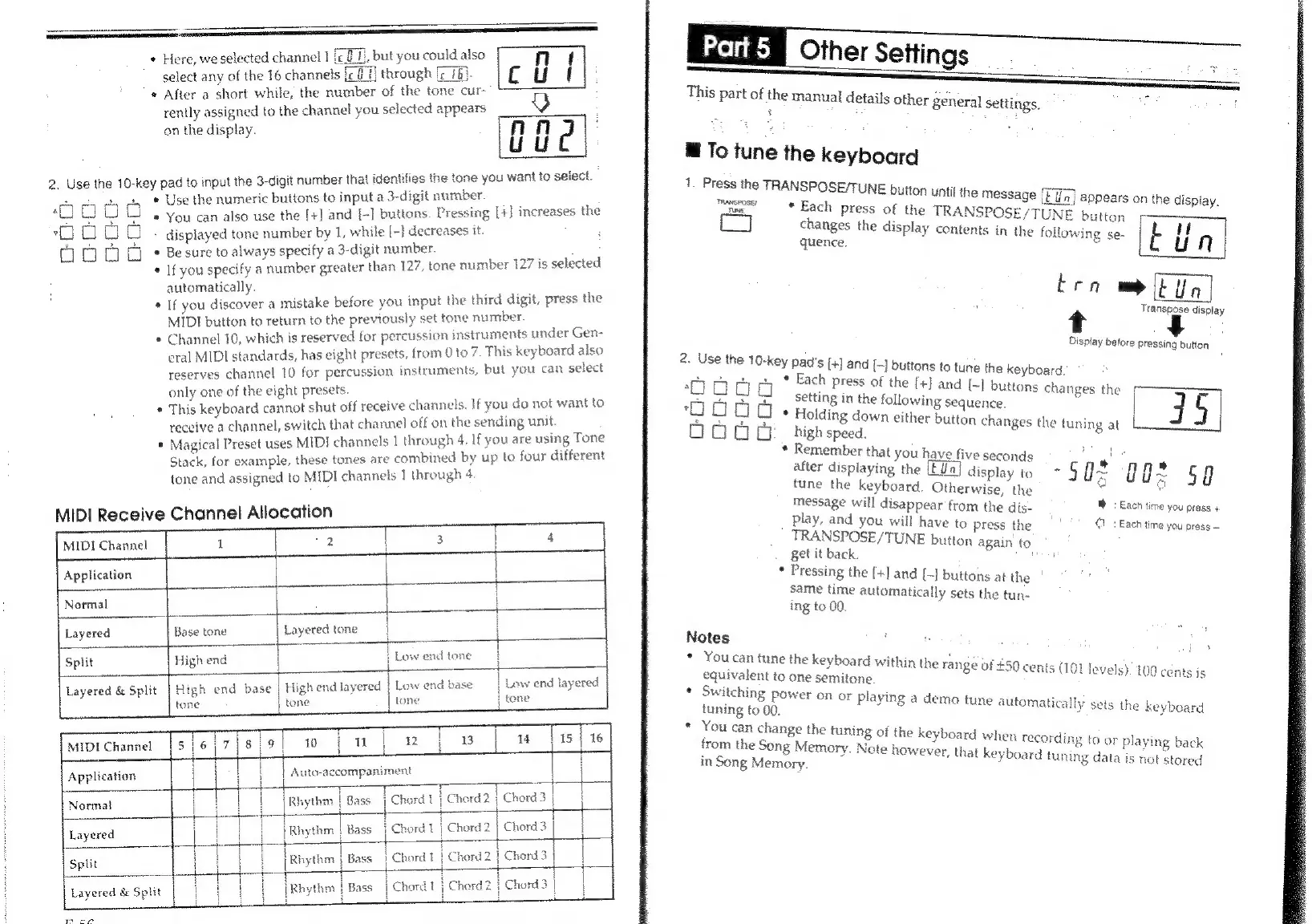
Here,
we
selected
channel
1
|
but
you
could
als
nt
select
any
of
the
16
channels
ic
|
through
76
Cc
uel
e
After
a
short
while,
the
number
of
the
tone
cur-
renily
assigned
to
the
channel
you
selected
appears
o
on
the
display.
nn
Py
UU
2,
Use
the
10-key
pad
to
input
the
3-digit
number
that
identifies
the
tone
you
want
to
select.
..
©
Use
the
numeric
buttons
to
input
a
3-digit
number.
ani
anti
ontt
ant
oe
ts
g
Ll
«
You
can
also
use
the
[+]
and
[-]
buttons.
Pressing
[+]
increases
the
am
Ud
-
O
-
displayed
tone
number
by
1,
while
[-]
decreases
it.
7
0
«
Besure
to
always
specify
a
3-digit
namber.
If
you
specify
a
number
greater
than
127,
tone
number
127
is
selected
automatically.
*
If
you
discover
a
mistake
before
you
input
the
third
digit,
press
the
MIDI
button
to
return
to
the
previously
set
tone
number
Channel
10,
which
is
reserved
for
percussion
instruments
u
nder
Gen-
eral
MIDI
standards,
has
eight
presets,
from
0
to
7.
This
keyboard
also
reserves
channel
10
for
percussion
instruments,
but
you
can
select
only
one
of
the
eight
presets.
This
keyboard
cannot
shut
off
receive
channels.
}f
you
do
not
want
to
receive
a
channel,
switch
that
channel
off
on
the
sending
unit.
Magical
Preset
uses
MIDI
channels
1
through
4.
If
you
are
using
Tone
Stack,
for
example,
these
tones
are
combined
by
up
to
four
different
tone
and
assigned
to
MIDI
channels
I
through
4
°
MIDI
Receive
Channel
Allocation
MIDI
Channel
Application
|
|
|
i
]
|
Normal
|
|
|
ees
Boe
|
=
:
Layered
Base
tone
jb
yered
tone
|
|
4
ft
Split
High
end
|
{tone
t
=
|
2s
.
;
2
Layered
&
Split
|
High
end
base
|
High
end
layered
|
Low
end
base
i
Lew
end
layered
tone
j
tone
|
tone
|
tone
ui
ae
eee
ae
Se
=a
ie
|
Sea
a
Se
Fa
|
Sete
epics
84
MIpiChannel
[5/6
|
7/8)
9
|
wo
)
ul
wa
|
~
est
Application
|
\
t]
|
Auto-accompaniment
\
tT
i
T
]
i
wae
T
Normal
|
i
|
|
|
Rhythm
|
Bass
|
Chord
t
|
Chord
2
|
Chord
3
i
‘ee
sade
|
we
H
i
ee
it
a
i
t
|
|
=
zy
lives
ss
1
Layered
ho
Fo
|
Rhythe
|
Bass
Chord
1
|
Chord
2
)
Chord
3
|
r
tt
pt
Ss
mt
ie
4
4
-
na
~
Pop
|
|
:
|
|
H
Split
PTT
Tenythm
|
Bass
|
Chord
t
|
Chord
2
|
Chord
||
P
i
'
i
:
[Ee
i
H
H
j
i
H
x
a
|
Isr
i
sath
|
|
Layered
&
Split
ho
bf)
|
Rhythm
|
Bass
|
Chord
t
|
Chord
2
|
Chord3
|
|
ee
aioe
a
Ce
!
!
i
i
roe
|
Part
5
|
Other
Settings
;
.
%
This
part
of
the
manual
details
other
general
se
3
ttings,
To
tune
the
keyboard
LP
seclih
TRANSPOSE/TUNE
button
until
the
message
[fF
ner
*
Each
press
of
the
TRANSPOSE
/TUNE
changes
the
display
contents
i
pe
pag
he
display
contents
in
the
following
se-
|
t
i
n
Erin
mp
iE
in
|
t
=
display
Display
before
pressir
,
Appears
on
the
display.
2.
Use
thi
- x
@
10-key
pad's
[+]
and
{-]
buttons
to
tune
the
keyboard.
sarah
&
°
Each
press
of
0
O
c]
fm
eo
Pre
es
I+]
and
[~]
buttons
changes
the
ooog.*
ae
e
following
sequence.
a
Ju
lolding
down
either
button
changes
the
tuning
{7
(1
__
high
speed.
7
bea
7
pan
that
you
have
five
seconds
Bh
ie
after
displaying
the
[EUa}
display
to
7
a
*
tune
the
keyboard,
Ollieiwne
the
30;
uos
5g
Message
will
disappear
from
the
dis-
ep
ce
will
have
to
press
the
RANSPOSE/TUNE
button
again’
sat
it
back.
ufton
again
to.
Pressing
the
[+]
and
(-]
buttons
at
the
same
time
automatically
sets
atically
sets
the
tun-
ing
to
00.
on.
o
:
Each
time
you
prass
+
oa
:
Each
time
you
press
Notes
*
You
can
tune
the
keyboard
within
the
equivalent
to
one
semitone.
Switching
powel
ron
or
playing
a
de:
3
She
Ok
playing
a
demo
tune
You
can
change
the
tuning
of
the
keybo:
from
the
Song
Memory.
Note
I
:
in
Song
Memory.
range
of
£50
cents
(101
levels).
100
cents
is
Sis
automatically
sets
the
keyboard
ard
when
recording
to
or
playin
ne
ng
bac!
however,
that
keyboard
tuni
he.
ng
data
is
not
stored