
 Need help?
Do you have a question about the Casio G-SHOCK MUDMASTER GG1000 and is the answer not in the manual?
Enters the Timekeeping Mode from any other mode by holding down a button.
Automatically returns the watch to Timekeeping Mode after a period of inactivity.
Displays previously viewed data upon entering Alarm, World Time, or Digital Compass Modes.
Uses buttons to scroll through data, with high-speed scrolling when buttons are held.
Sets the Home City and daylight saving time (DST) for accurate timekeeping.
Adjusts the daylight saving time (summer time) setting for the Home City.
Adjusts the current time and date settings for accurate timekeeping.
Corrects the alignment of analog hands if they become misaligned due to magnetism or impact.
Determines north and checks bearing to a destination using the digital compass.
Explains how direction readings and angle values are displayed.
Calibrates the bearing sensor in relation to magnetic north for accuracy.
Calibrates the bearing sensor by aligning it with opposing directions.
Sets declination angle to allow the watch to indicate true north.
Saves a particular bearing to memory for later reference.
Aligns a map with the watch's northerly direction for orientation.
Explains the difference between magnetic north and true north.
Avoids sources of strong magnetism and indoor locations for accurate readings.
Recommends storing the watch away from magnets to maintain sensor precision.
Measures and displays the current temperature.
Allows selection between Celsius (°C) and Fahrenheit (°F) for temperature display.
Adjusts the temperature sensor for accurate readings if errors occur.
Sets the desired unit (°C or °F) for temperature measurements.
Accesses the World Time Mode to view times in different time zones.
Sets the World Time City and adjusts summer time settings.
Exchanges the Home City and World Time City settings for easy travel.
Accesses the Stopwatch Mode for timing events.
Measures elapsed time, split times, and two finishes.
Temporarily stops the stopwatch to record a split time.
Accesses the Countdown Timer Mode to set and start countdowns.
Sets the desired start time for the countdown timer.
Executes a countdown timer operation and sounds an alarm at completion.
Accesses the Alarm Mode to manage daily alarms and hourly signals.
Configures the time for one of the five daily alarms.
Enables or disables individual alarms and the hourly time signal.
Manually illuminates the display by pressing a button.
Selects between 1.5 or 3 seconds for manual illumination.
Enables automatic illumination when the watch is angled towards the face.
Toggles the auto light feature between enabled and disabled states.
Toggles the button operation tone on or off, indicated by a mute indicator.
Addresses incorrect time settings due to Home City or DST configuration.
Resolves time discrepancies in World Time Mode related to DST.
Explains the low battery indicator and its implications.
Discusses issues with direction and temperature sensor readings.
Troubleshoots error messages during digital compass or thermometer operations.
Addresses error messages following bidirectional calibration, indicating sensor issues.
Addresses common causes for inaccurate direction readings.
Explains how calibration and magnetic interference affect readings.
Addresses difficulties taking direction readings indoors due to interference.
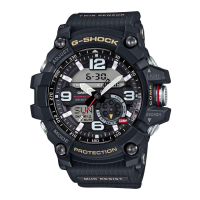
This document describes the operation of a CASIO watch, model 5476, which features built-in sensors for direction and temperature measurement. The watch indicates measurement results using both its hands and digital displays, making it suitable for outdoor activities like hiking and mountain climbing.
The watch offers several modes, each with specific functionalities:
This is the primary mode for viewing and setting the current time and date. The watch displays the month, day, hour, minutes, and seconds, along with the day of the week. It supports both 12-hour and 24-hour formats and includes a full auto-calendar that accounts for different month lengths and leap years. Users can configure their Home City, which automatically adjusts UTC offsets for other time zones in World Time Mode. Daylight Saving Time (DST) settings can also be toggled on or off for the Home City.
This mode allows users to determine magnetic north and their bearing to a destination. The second hand points to magnetic north, while the display shows the direction and bearing angle. The watch can take continuous readings for up to 20 seconds. It also features a Bearing Memory function, allowing users to store a specific direction angle reading for later reference. This is particularly useful for navigation, as the stored bearing can be indicated by a digital meter, guiding the user towards their objective.
The watch is equipped with a temperature sensor that measures and displays temperature in units of 0.1°C or 0.2°F. Readings are taken every five seconds for one to two minutes. Users can select between Celsius (°C) and Fahrenheit (°F) as the display unit.
This mode enables users to view the current time in one of 31 time zones (48 cities) around the globe. The selected city is referred to as the "World Time City." Users can scroll through city codes to view different time zones and can also swap their Home Time City with their World Time City, which is convenient for frequent travelers. DST settings can be adjusted for individual World Time Cities.
The stopwatch measures elapsed time, split times, and two finishes with a measuring unit of 1/100 second and a capacity of 23 hours, 59 minutes, 59.99 seconds. It supports standard elapsed time operations, pausing at split times, and measuring two finishes.
This mode features a countdown timer that can be set to a start time from 1 to 60 minutes, in one-minute increments. An alarm sounds for 10 seconds when the countdown reaches zero, and the timer automatically resets to its starting value.
The watch allows setting up to five independent daily alarms, including one snooze alarm. Alarms sound for about 10 seconds at the preset time, even if the watch is not in Timekeeping Mode. The snooze alarm repeats every five minutes up to seven times. An Hourly Time Signal can also be activated, causing the watch to beep twice every hour on the hour.
The watch's display can be illuminated for easy reading in the dark using an LED (light-emitting diode). Users can manually activate illumination or enable an auto light feature, which turns on illumination automatically when the wrist is angled towards the face. The illumination duration can be set to either 1.5 seconds or 3 seconds.
Modes are selected by pressing the appropriate buttons, as illustrated in the manual. Holding down a specific button for about two seconds typically returns the watch to Timekeeping Mode from any other mode. The mode dial hand indicates the current mode.
Many settings, such as Home City, time, date, and alarm times, are configured through dedicated setting screens. These screens often involve holding down a button until "ADJ" or "SET" appears, followed by using other buttons to scroll through options or adjust values. Holding down buttons during scrolling can accelerate data navigation.
Strong magnetism or impact can cause the watch's analog hands to go out of alignment. The watch provides a home position adjustment feature to correct this. Users can enter a dedicated adjustment mode, where the second, hour, minute, and mode dial hands can be individually adjusted to their correct 12 o'clock positions.
The digital meter on the display serves multiple purposes, indicating seconds in Timekeeping, World Time, and Timer Modes, 1/10-second counts in Stopwatch Mode, and acting as a bearing pointer in Digital Compass Mode when viewing bearing memory contents.
The watch provides an audible tone with each button press. This tone can be enabled or disabled as desired, though alarms, the Hourly Time Signal, and the Countdown Timer Mode alarm will still operate normally even if the button operation tone is off.
A low battery indicator appears on the display when the battery power is low. In this state, all hands stop, and most display functions, watch tones, and illumination are disabled.
Digital Compass: The bearing sensor can be calibrated using two methods:
Temperature Sensor: The temperature sensor is factory-calibrated but can be recalibrated if significant errors are noticed. This involves comparing the watch's reading with a reliable thermometer and adjusting the watch's sensor accordingly. It is recommended to remove the watch from the wrist and allow it to stabilize for 20-30 minutes before recalibration.
The manual provides guidance for common issues such as incorrect time settings (Home City or DST), inaccurate World Time, and sensor errors ("ERR" display). It advises checking Home City settings, DST settings, and performing calibrations as needed. For persistent sensor errors, contacting an authorized CASIO distributor is recommended.
Digital Compass: To ensure accurate readings, the watch should be placed on a flat, horizontal surface and pointed in the desired direction. Readings can be affected by strong magnetism from permanent magnets, metal objects, high-voltage wires, or electrical appliances. Indoor readings, especially in ferro-concrete structures, can also be inaccurate. Temperature Measurement: Readings can be affected by body temperature, direct sunlight, and moisture. For accurate measurements, the watch should be removed from the wrist, placed in a well-ventilated area away from direct sunlight, and wiped dry. Auto Light: While convenient, auto light should be used with caution. It may not activate if the watch face is not angled correctly or if static electricity/magnetic force interferes. Users are warned to be in a safe place when using auto light and to disable it when operating vehicles to avoid distraction. Storage: To maintain the precision of the bearing sensor, the watch should be stored away from strong magnetic sources to prevent magnetization.
 General
| Model | GG1000 |
|---|---|
| Series | G-SHOCK MUDMASTER |
| Water Resistance | 200 meters |
| Shock Resistance | Yes |
| Mud Resistance | Yes |
| Digital Compass | Yes |
| Thermometer | Yes |
| World Time | Yes |
| Countdown Timer | Yes |
| Alarm | 5 daily alarms |
| Size of Case | 56.2 × 55.3 × 17.3 mm |
| Case Material | Resin |
| Band Material | Resin |
| Glass | Mineral Glass |
| Movement | Quartz |
| Digital Display | Yes |
| Analog Display | Yes |
| Auto Calendar | Yes |
| 12/24 Hour Format | Yes |
| Button Operation Tone | Yes |
| Stopwatch | 1/100 second |
| Battery Life | 2 years |
| Weight | 92 grams |


 To Next Page