Need help?
Do you have a question about the Castles Technology UPT100F and is the answer not in the manual?
Identifies and labels front view components of the UPT1000F device.
Guides connecting to the UPT1000F via console and initial program manager overview.
Details the options and functions available within the UPT1000F's system menu.
Provides detailed pinout information for serial communication cables.
Contains FCC compliance statements, cautions, and radiation exposure information.
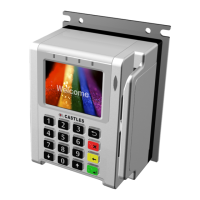
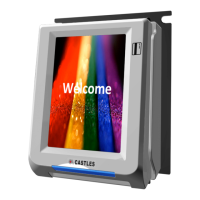
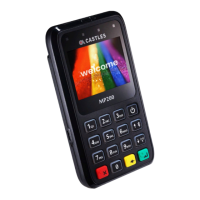
The Castles UPT1000F is a versatile terminal designed for various payment and operational tasks, offering a range of features for both users and administrators. It is primarily intended for use in environments where a compact, keypad-less terminal with touch screen interaction is desired. The device supports multiple communication interfaces, making it adaptable to different network setups and peripheral connections.
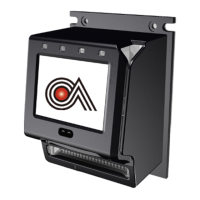
The UPT1000F serves as a payment terminal capable of processing transactions through various methods. It integrates a Magnetic Stripe Reader (MSR) for traditional card swipes, an EMV-compliant ICC Reader with an LED indicator for chip card transactions, and a Contactless Reader for NFC-based payments. This multi-faceted approach ensures broad compatibility with modern payment systems. The device features a 3.5" Touch Screen, which is the primary interface for user interaction and displaying information. Without a physical keypad, all input is managed through the touch screen or external connections.
Beyond payment processing, the UPT1000F is equipped with a robust operating system that allows for the management and execution of various applications. It supports the download and installation of user applications, enabling customization for specific business needs. The terminal can operate in a "Program Manager" mode, which lists all installed applications and allows users to select and run them. This manager also facilitates viewing application information, deleting applications, and setting a default application to launch automatically upon power-on.
Connectivity is a key aspect of the UPT1000F's functionality. It includes a USB (Type B) port for connecting peripherals, such as a USB keyboard, which can serve as an alternative input method to the touch screen. An Ethernet port provides wired network connectivity for reliable data transmission. Additionally, the device supports wireless communication through Bluetooth, managed via the "Bluetooth Setup" in the system menu, and potentially cellular networks with GSM Antenna and SIM card slots, indicating support for mobile data. Serial communication is also available via a COM (RJ45) port, which is crucial for console access and device configuration. The presence of SAM (Secure Access Module) slots suggests support for enhanced security features, often used in payment applications for cryptographic operations.
The UPT1000F is designed for straightforward operation, even without a physical keypad. The 3.5" touch screen provides an intuitive interface for navigating menus and interacting with applications. When powered on, if no default application is selected, the device automatically enters the "Program Manager." From here, users can easily browse through a list of installed applications. Selecting an application is done by pressing the corresponding number on the touch screen, or by using up/down navigation if an external keyboard is connected, followed by an "OK" action to launch it.
For administrative tasks and advanced configuration, the device offers a "System Menu." This menu is accessible by pressing a specific button (e.g., '0' for Download) from the Program Manager. The System Menu is organized into multiple pages, allowing access to various settings and utilities. Navigation between these pages is facilitated by designated up and down buttons.
Key usage features within the System Menu include:
The serial cable PIN assignment details are provided to ensure correct connection for console access, which is essential for initial setup and advanced debugging. This allows administrators to connect the UPT1000F to a PC using a serial cable and use terminal emulation software like TeraTerm or PuTTY to send commands and receive output. The specified baud rate of 115200 is critical for establishing a stable connection.
The UPT1000F incorporates several features to facilitate maintenance, troubleshooting, and security management. These features are primarily accessed through the "System Menu," providing administrators with comprehensive control over the device's state and configuration.
The serial console access, as detailed in the "Technical Notes," is a fundamental maintenance tool. By connecting the device to a PC via the COM port and using terminal software, administrators can gain low-level access to the device, execute commands, and monitor its operation, which is often necessary for advanced diagnostics and recovery procedures that might not be available through the touch screen interface. The clear PIN assignment ensures that the correct serial connection can be established without ambiguity.
Overall, the UPT1000F is designed to be a robust and manageable payment terminal, offering a balance of user-friendly operation and comprehensive administrative controls for effective deployment and long-term maintenance.
 General
| Device Type | Payment Terminal |
|---|---|
| Model | UPT100F |
| Manufacturer | Castles Technology |
| Memory | 128MB Flash, 64MB RAM |
| Card Reader | Magnetic stripe, Smart card (EMV) |
| Contactless | Yes |
| Connectivity | Ethernet, RS232 |
| Security | PCI PTS 5.x |
| Operating System | Linux |
| Operating Temperature | 0°C to +50°C |
| Storage Temperature | -20°C to 70°C |
| Supported Cards | EMV, Magstripe, Contactless |
| Battery | Optional, rechargeable |
| Processor | 32-bit ARM Cortex-M4 |

 To Next Page