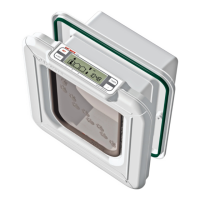
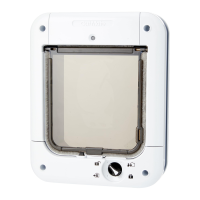
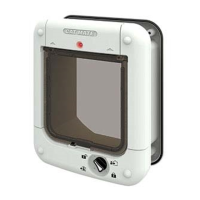
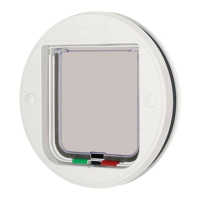
The Cat Mate Microchip Cat Flap (Ref. 360) is an advanced pet access system designed to control the entry and exit of up to 30 cats. This device is compatible with all popular microchips and can also be operated using a Cat Mate I.D. Disc (available separately), making it suitable for cats without microchips or those with faulty/poorly positioned microchips.
Function Description:
The primary function of the Cat Mate Microchip Cat Flap is to provide selective access for your cats while preventing unwanted animals from entering your home. It achieves this by reading your cat's microchip or I.D. Disc as they approach the tunnel, activating a catch (D, Fig. 1) to allow entry or exit based on programmed settings. The flap features a rotary 4-way lock (E, Fig. 1) that offers flexible access options:
- 'In & Out': Allows programmed cats to enter and exit freely.
- 'In Only': Allows programmed cats to enter but not leave.
- 'Out Only': Allows programmed cats to leave but not enter.
- 'Locked': Prevents all cats from using the flap.
Important Technical Specifications:
- Compatibility: Suitable for all popular microchips and Cat Mate I.D. Discs.
- Capacity: Can store up to 30 unique microchip/I.D. Disc registrations.
- Power Source: Requires 4 x AA (R6) alkaline batteries. Lithium batteries MUST NOT be used.
- Battery Life: Good quality alkaline batteries should last approximately 12 months, depending on the number of cats and usage.
- Installation: Can be installed in wood, plastic, UPVC doors, metal doors, walls, and glass panels. For metal doors thicker than 35mm (1⅜"), a Cat Mate Cat Flap Adapter Kit is required. For walls/glass panels, an adapter kit (Product Ref. 361) is needed.
- Door Thickness (Wood/Plastic):
- 3mm (⅛") - 25mm (1") thick: Requires cutting excess liner from the exterior frame for panels less than 17mm (⅝") thick. Uses 37mm (1½") screws for installation.
- 25mm (1") + thick: Uses 13mm (½") screws for the exterior frame and 22mm (⅞") screws for the interior frame.
- Dimensions: The tunnel (C, Fig. 1) should not be cut. The exterior frame (G, Fig. 1) is used as a template for marking the cut-out.
- Drill Bit Sizes: 6mm (¼") diameter for screw clearance holes in wood/plastic doors (3mm-25mm thick); 5mm (³⁄₁₆") diameter for screw clearance holes in interior frame (for doors 25mm+ thick).
Usage Features:
- Programming: Cats' microchips or I.D. Discs are programmed by pressing and holding the PROGRAM button (H, Fig. 1) for 5 seconds until the LED (A) illuminates, waiting 10 seconds, then encouraging the cat to pass slowly through the tunnel with the flap held open (Fig. 4) or placing an I.D. Disc in the tunnel opening (Fig. 5). The LED will flash upon successful programming. The PROGRAM button is pressed again to save the setting.
- Training Mode: To help cats adapt to the flap, a training mode can be activated by removing one battery for 60 seconds, replacing it, waiting for the interior lock (D) to drop, then removing the battery within 5 seconds before the lock reactivates. In this mode, the flap allows access for all animals. To exit, simply reinstall all batteries.
- Battery Warning: A slow flash of the red LED (A) every 30 seconds indicates that alkaline batteries need to be replaced.
- Cleaning Reminder: A double flash of the red LED (A) every 30 seconds indicates that the detector lenses and tunnel surfaces require cleaning.
- Factory Reset: All programmed I.D. Discs/microchips can be erased by pressing and holding the PROGRAM button for 30 seconds until the LED flashes. After another 30 seconds, new I.D. Discs/microchips can be reprogrammed.
- Metal Door Retuning: For metal doors, it is essential to retune the cat flap after fitting. This is done by pressing the PROGRAM button (H) for 5 seconds until the LED (A) lights, then pressing it again after 10 seconds to complete retuning.
Maintenance Features:
- Cleaning: Regularly clean the two detector lenses (B, Fig. 6) located at the top of the tunnel and the interior surfaces of the tunnel bottom (C, Fig. 1) using a damp cloth. This helps ensure optimal performance and prevents false cleaning reminders.
- Battery Replacement: Replace alkaline batteries when the LED flashes slowly (every 30 seconds). Note that the battery warning may take up to 15 minutes to disappear after new batteries are fitted.
Important Considerations:
- The tunnel (C, Fig. 1) of the cat flap should never be cut.
- It is recommended to program the cat flap for all cats before installation to ensure correct microchip positioning and functionality.
- The cat flap is not recommended for use with metal panels in combination with FDXA 10-digit microchips (typically used in the U.S. only).
- For metal doors, a small trial hole can be drilled to test for metal panels, which may reduce the microchip reader's range.
- Ensure the 4-way lock is set correctly for desired access.
- Verify that the catch (D, Fig. 1) moves freely.
- If using an I.D. Disc, ensure it is correctly fitted to the cat's collar.
- If troubleshooting, try using another programmed I.D. Disc/microchip to rule out individual faults.
- Ensure batteries are correctly oriented and not depleted.
- Mount the cat flap at the correct height, approximately level with your pet's stomach.
- If all else fails, a factory reset followed by reprogramming may resolve issues.

 Need help?
 General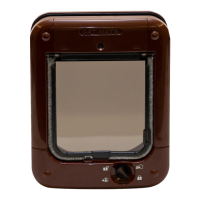

 To Next Page