EasyManua.ls Logo

CDL NANO RO - User Manual

CDL NANO RO
22 pages
Print Icon
To Next Page IconTo Next Page
Loading...
OWNER’S
MANUAL
NANO RO
REVERSE
OSMOSIS SYSTEM
Version 1.0
06/11/2020
© All rights reserved - CDL Maple Sugaring Equipment
Question and Answer IconNeed help?

Do you have a question about the CDL NANO RO and is the answer not in the manual?

Summary

Introduction

Remarks and Instructions

Key instructions and safety advice for operating the RO system.

Characteristics

Parts

Product Design

Technical Specifications

Fittings

Flow Diagram (2-Membrane Model)

Flow Diagram (3-Membrane Model)

Rinse

Wash

Drain

Concentration (1 Pass)

Concentration (Batch)

How to Replace Filtration Cartridges

How to Install Membranes

Detailed instructions for correctly inserting new RO membranes into their housings.

Daily Membrane Cleaning

Protect from Freezing

Important Notes

Long-Term Storage Procedure

Water Quality Guidelines

Warranty

Notes

Overview

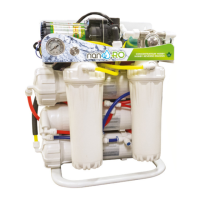
The CDL Nano RO Reverse Osmosis System is a sophisticated device designed for the concentration of maple and birch sap. Available in both 2-membrane and 3-membrane configurations, it serves as an efficient tool for producers seeking to increase the Brix level of their sap. The system's core function is to remove water molecules and dissolved oxygen, thereby concentrating organic molecules like sugar and essential minerals.

Function Description:

The system operates through a multi-stage filtration and reverse osmosis process:

  • Stage 1: Feed Line Strainer: This initial stage features a 3/8" yellow feed tube connected to a strainer that captures impurities in the raw sap, preventing pump blockage and ensuring smooth operation.
  • Stage 2: 5-Micron Pre-filter (Organic Substances): The sap then passes through a 5-micron filter, which is responsible for absorbing harmful substances such as colorants and various organic compounds. This stage also uses a 3/8" yellow feed tube.
  • Stage 3: 5-Micron Pre-filter (Sediment and Suspended Matter): A second 5-micron filter further refines the sap by effectively removing sediment, mold, suspended matter, and other particulate substances, again utilizing a 3/8" yellow feed tube. These pre-filtration stages are crucial for protecting the delicate RO membranes and enhancing the system's overall performance and longevity.
  • Stage 4: Reverse Osmosis: The pre-filtered sap is then subjected to reverse osmosis using 600 GPD RO membrane filters. The 2-membrane system uses two such filters, while the 3-membrane system uses three. These membranes, with a pore size of 0.0001 µm, allow only pure water molecules and dissolved oxygen to pass through as permeate. The concentrated sap, rich in sugars and minerals, is directed through a 3/8" red tube on the recirculation circuit and a 1/4" red tube on the concentrate outlet.
  • Stage 5: Concentration Control: A regulating valve on the 1/4" concentrate outlet (red tube) allows for precise control over the operating pressure and, consequently, the level of concentration.

Important Technical Specifications:

The CDL Nano RO system comes in two main models:

Reverse Osmosis System with 2 Membranes (Model # 81008):

  • Number of Taps: Suitable for 25-75 taps.
  • Membranes: 2 x 600 GPD membranes.
  • Water Removal: 6-8 GPH (gallons per hour) at 4-5 Brix concentrate.
  • Pump Rating Max Flow: 40 GPH.
  • Power Consumption: 144 W.
  • Transformer: 110 volts, included.
  • Shipping Weight: 17 kg.
  • Shipping Dimensions: 22" x 21" x 12".
  • Included Components: 2x 600 GPD membranes, 2x pre-filter cartridges, tools for pre-filter and membrane housings, 12' 3/8" suction tubing with strainer (yellow), 12' 3/8" permeate tubing (blue), 12' 1/4" concentrate tubing (red), spare fitting kit, and spare O-ring kit.
  • Test Conditions: Sap temperature 42 °F, 2 Brix, 50/50 water reduction, 70 psi.
  • Maximum Operating Pressure: 70 psi.
  • Concentration Capacity: Not designed for concentrations exceeding 4 degrees Brix in batch mode.

Reverse Osmosis System with Recirculation Pump and 3 Membranes (Model # 81013R):

  • Number of Taps: Suitable for 50-≥150 taps.
  • Membranes: 3 x 600 GPD membranes.
  • Recirculation Pump: 110 V, 0.45 A. This unique feature enhances performance by creating more cross-flow on the membrane surface, ensuring steady permeate flow and higher concentration.
  • Water Removal: 10-13 GPH at 5-6 Brix concentrate.
  • Pump Rating Max Flow: 40 GPH.
  • Power Consumption: 242 W.
  • Transformer: 110 volts, included.
  • Shipping Weight: 22 kg.
  • Shipping Dimensions: 22" x 21" x 12".
  • Included Components: 3x 600 GPD membranes, 2x pre-filter cartridges, tools for pre-filter and membrane housings, 12' 3/8" suction tubing with strainer (yellow), 12' 3/8" permeate tubing (blue), 12' 1/4" concentrate tubing (red), spare fitting kit, and spare O-ring kit.
  • Test Conditions: Sap temperature 42°F, 2 Brix, 65/35 water reduction, 100 psi.
  • Maximum Operating Pressure: 100 psi.
  • Concentration Capacity: Not designed for concentrations exceeding 5 to 6 degrees Brix.

Usage Features:

  • Ease of Operation: The system features a simple on-off button and pressure gauge for monitoring.
  • Flow Diagram: Detailed flow diagrams are provided for both 2-membrane and 3-membrane models, illustrating the path of sap, concentrate, and permeate.
  • Rinse Procedure: A dedicated rinse cycle is outlined, involving 15 gallons or more of permeate to clean the system.
  • Wash Procedure: A washing cycle uses 5 gallons of a washing solution (e.g., Super Flow Green membrane cleaner) in a closed loop for 30 minutes, followed by flushing and rinsing.
  • Drain Procedure: Instructions are provided for draining the system, including placing the suction tube out of the tank.
  • Concentration Modes: The manual details both "1 Pass" and "Batch" concentration methods, allowing users to choose the most suitable approach for their needs.
  • Water Quality Guidelines: Strict guidelines are provided for the quality of water used for flushing and cleaning, emphasizing the importance of low levels of iron (<0.05ppm), manganese (<0.02ppm), silicate (<5ppm), aluminum (<0.05ppm), hardness (<85ppm), particles (<5μm), and turbidity (<1NTU). Chlorinated water must be avoided. RO permeate is preferred for washing and rinsing.

Maintenance Features:

  • Filter Replacement: Step-by-step instructions are given for replacing filtration cartridges, including unscrewing the housing, removing the old cartridge, inserting a new one, lubricating the gasket, and re-centring the cartridge.
  • Membrane Installation/Replacement: Detailed steps for installing or replacing membranes are provided, including unscrewing the cover, removing the old membrane, lubricating O-rings and casing seals with food-grade silicone grease, inserting the new membrane fully, ensuring the membrane seal is on the cover side, and screwing the cover back on.
  • Daily Membrane Cleaning: A routine for daily cleaning involves rinsing with permeate, draining, washing with Super Flow Green membrane cleaner in a closed loop, flushing, and a final rinse with clean permeate.
  • Protection from Freezing: Critical instructions are given to protect the equipment from freezing during temporary storage. This includes removing filters, draining the equipment, running the pump dry to remove residual water, and thawing with warm water or a hair dryer if necessary before use.
  • Long-Term Storage Procedure: For extended storage, the manual outlines a comprehensive procedure:
    1. Thoroughly clean RO membranes with CDL Super Flow Green membrane cleaner until the wash solution is clear.
    2. Replace filtration cartridges with new ones.
    3. Rinse membranes with RO permeate or acceptable quality water.
    4. Perform a citric acid treatment: add 1/4 cup of citric acid to 5 gallons of 80 °F permeate, run in a closed loop for 1 hour or more, and allow to soak overnight. Re-wash if the water becomes cloudy.
    5. Prepare a storage solution: add 1/4 cup of CDL citric acid to 5 gallons of permeate, run the RO in a closed loop for 1/2 hour.
    6. Disconnect suction (yellow), concentrate (red), and permeate (blue) tubes and insert provided plugs to prevent leaks.
    7. Store the equipment in a cool, frost-protected room.

Important Notes:

  • Always read the instructions before installation and operation.
  • Avoid unnecessary disassembly to prevent damage or leaks.
  • Plug the unit into a GFCI electrical outlet for safety.
  • Use only CDL-supplied cleaning chemicals and filters.
  • Handle the unit with care to avoid damaging delicate parts.
  • Install membranes and 5-micron filters before operation.
  • Thoroughly wash and rinse the system before concentrating sap.
  • Adhere to maximum operating pressures (100 psi for 3-membrane, 70 psi for 2-membrane).
  • For the 2-membrane system, ensure concentrate flow is double the permeate flow to prevent membrane fouling.
  • The system is not designed for concentrations exceeding 5-6 Brix (3-membrane) or 4 Brix (2-membrane batch mode).
  • Concentration capacity varies with membrane condition, sap temperature, quality, and operating pressure.
  • Membranes must be cleaned daily.
  • If unused for a few days, wash membranes with citric acid solution (3 pH) and install plugs to prevent bacterial growth.
  • Rinse equipment before resuming concentration after storage.

CDL NANO RO Specifications

General IconGeneral
BrandCDL
ModelNANO RO
CategoryWater Filtration Systems
LanguageEnglish