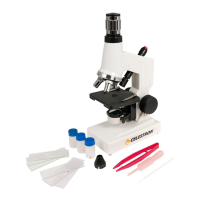
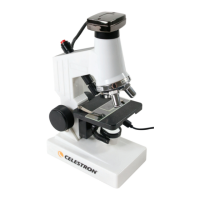
The Celestron Digital Microscope Kit, Model #44320, is a precision optical instrument designed for observing magnified images, capturing video, and taking snapshots of various specimens. This kit is intended for users 14 years of age and older, offering a lifetime of pleasure with minimal maintenance.
Function Description:
The microscope provides high magnifications ranging from 40x to 600x, making it ideal for examining a wide array of specimens. It is particularly well-suited for observing specimen slides of yeasts, molds, cultures, plant and animal parts, and fibers. Additionally, at lower powers, it can be used to examine small and thin objects such as coins, rocks, and insects. The included digital camera and software allow users to connect the microscope to a computer (Windows or Mac) to view magnified images on a larger screen, capture still photos, and record videos of their observations. The software also provides basic image capture and organization functionalities.
Usage Features:
The microscope is designed for ease of use, with several features to enhance the viewing experience:
- Zoom Eyepiece: The 10x-20x zoom eyepiece allows for continuous magnification adjustment. Users can rotate a knurled ring on the eyepiece to smoothly transition between 10x and 20x positions, thereby changing the total magnification. Refocusing is typically required after adjusting the zoom.
- Objective Lenses: The microscope comes with 4x, 15x, and 30x objective lenses mounted on a triple nosepiece. To change magnification, users rotate the nosepiece until the desired objective lens clicks into position. It is recommended to start with the lowest power (4x objective and 10x zoom eyepiece for 40x total magnification) for initial observation, especially for solid objects.
- Focusing: A coarse focus knob is provided for adjusting the focus. When changing to higher powers, it is crucial to lower the stage first to prevent the objective lens from hitting and damaging the specimen slide or object.
- Illumination System: The microscope features both top and bottom LED illuminators.
- Top Illuminator: This illuminator is used exclusively for solid objects, shining light down onto the specimen. It is activated by pushing a button on top of the illuminator.
- Bottom Illuminator: This illuminator is used for specimen slides, shining light up through the slide and the hole in the stage. It is turned on by rotating it upwards and off by rotating it downwards. The brightness of the bottom illuminator can be adjusted with slight movements.
- Light Diffuser: A light diffuser is included to reduce brightness and glare from the bottom illuminator, which can make views sharper and increase contrast, especially with some specimen slides. It fits over the bulb area by press-fitting.
- Digital Camera Integration: The kit includes a digital camera and a USB cable for connecting to a computer.
- Installation: For Windows users, the included VP EYE software must be installed before connecting the camera. For Mac users (OS X 4.9 and higher), the camera can be used with existing imaging software like Photo Booth, iChat, or iPhoto without installing additional software.
- Attachment: To attach the camera, the zoom eyepiece is removed by unthreading it counterclockwise. The protective cap is then removed from the camera, and the camera is threaded clockwise into the eyepiece tube. The USB cable connects the camera to an open USB port on the computer.
- Image Orientation: The image orientation on the computer screen can be adjusted by rotating the camera in the eyepiece tube, typically counterclockwise to avoid overtightening.
- Power Requirement: It's important to note that the microscope camera requires sufficient power and will not work through USB ports found on many Mac keyboards; it must be connected directly to the computer tower.
- Specimen Handling: Specimen slides are placed under the stage clips and centered over the hole in the stage. The image seen through the eyepiece is upside down and reversed, requiring some practice for precise centering.
Maintenance Features:
To ensure the longevity and optimal performance of the Celestron Digital Microscope Kit, several care and maintenance tips are provided:
- Post-Usage Cleaning: After each use, remove any specimens from the stage and turn off both top and bottom illuminators.
- Battery Management: If the microscope will not be used for an extended period, remove the batteries from both illuminators to prevent leakage and damage.
- Protection: Always place the dust cap over the eyepiece and the camera sensor when the microscope is not in use or during storage to protect against dust and debris.
- Storage: Store the microscope in a clean, dry place to prevent moisture and dust accumulation.
- Handling: When moving the microscope, always carry it by the arm with one hand for secure transport.
- Cleaning External Surfaces: The outside surfaces of the microscope can be cleaned with a moist cloth.
- Cleaning Optical Surfaces:
- Never use cloth or paper towels on optical surfaces, as they can cause scratches.
- Use a camel's hair brush or an air blower specifically designed for optical surfaces to blow off dust.
- For fingerprints, use a lens cleaning agent and lens tissue, available at most photo outlets. When cleaning, avoid rubbing in circles to prevent streaks or scratches.
- Internal Components: Never attempt to disassemble or clean internal optical surfaces. This should only be performed by qualified technicians at the factory or authorized repair facilities.
- Sunlight Exposure: Be extremely careful when using the microscope in direct sunlight to prevent damage to the instrument or your eyes. Never point the camera sensor towards the sun, as this can permanently damage the camera.
The Celestron Digital Microscope Kit is a robust and user-friendly instrument designed to provide an engaging and educational experience in microscopy, with straightforward setup and maintenance procedures to ensure years of quality performance.

 Need help?
 General
 Weight and Dimensions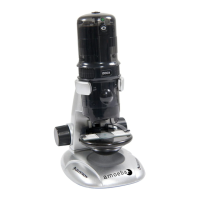

 To Next Page