14 | ENGLISH
OBSERVING DEEP-SKY OBJECTS
Deep-sky objects are simply those objects outside the boundaries of our solar system. They include star clusters,
planetary nebulae, diffuse nebulae, double stars and other galaxies outside our own Milky Way. Most deep-sky objects
have a large angular size. Therefore, low-to-moderate power is all you need to see them. Visually, they are too faint to
reveal any of the color seen in long exposure photographs. Instead, they appear black and white. And, because of their
low surface brightness, they should be observed from a dark-sky location. Light pollution around large urban areas washes
out most nebulae making them difficult, if not impossible, to observe. Light Pollution Reduction filters help reduce the
background sky brightness, thus increasing contrast.
STAR HOPPING
One convenient way to find deep-sky objects is by star hopping. This technique uses bright stars to “guide” you to an
object. For successful star hopping, it is helpful to know the field of view of your telescope. If you’re using the standard
20 mm eyepiece with the AstroMaster telescope, your field of view is approximately 1º. If you know an object is 3º away
from your present location, then you just need to move 3 fields of view. If you’re using another eyepiece, consult the
section on determining field of view. Below, you’ll find instructions for locating two popular objects.
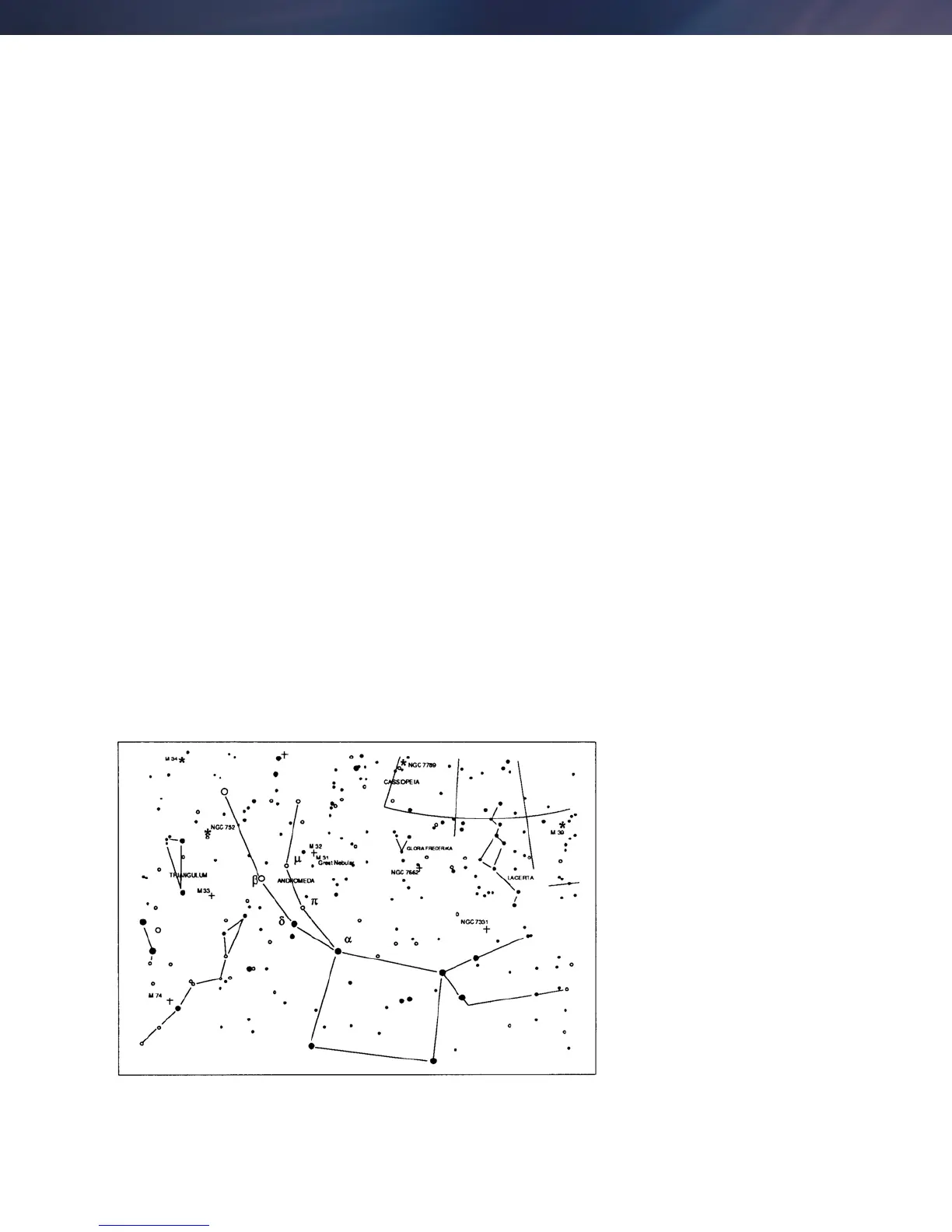
The Andromeda Galaxy (Figure 4-1), also known as M31, is an easy target.
To find M31:
1. Locate the constellation of Pegasus, a large square visible in the fall (in the eastern sky, moving toward the point
overhead) and winter months (overhead, moving toward the west).
2. Start at the star in the northeast corner—Alpha (α) Andromedae.
3. Move northeast approximately 7°. There you will find two stars of equal brightness—Delta (δ) and Pi (π)
Andromeda—about 3° apart.
4. Continue in the same direction another 8°. There you will find two stars—Beta (β) and Mu (µ) Andromedae—also about
3° apart.
5. Move 3° northwest—the same distance between the two stars—to the Andromeda galaxy.
Fig. 4-1







 To Next Page