EasyManua.ls Logo

Celestron C4.5 - Pointing at Polaris; Eiie a Is Epe Eset Tied Oa E EA Dac

Celestron C4.5
60 pages
Print Icon
To Next Page IconTo Next Page
To Previous Page IconTo Previous Page
Loading...
(30
©
Astronomy
Basics
I
a
a
Pointing
at
Polaris
This
method
utilizes
Polaris
as
a
guidepost
to
the
celestial
pole.
Since
Polaris
is
less
than
a
degree
from
the
celestial
pole,
pointing
the
polar
axis
of
the
telescope
puts
you
within
one
degree.
Although
this
is
by
no
means
perfect
alignment,
it
is
close.
1.
Set
the
telescope
up
so
that
the
polar
axis
is
pointing
north.
2.
Release
the
DEC
clamp
and
move
the
telescope
so
that
the
tube
is
parallel
to
the
polar
axis.
When
this
is
done,
the
declination
setting
circle
will
read
+90°.
If
the
declination
setting
circle
is
not
aligned,
move
the
telescope
so
that
the
tube
is
parallel
to
the
polar
axis
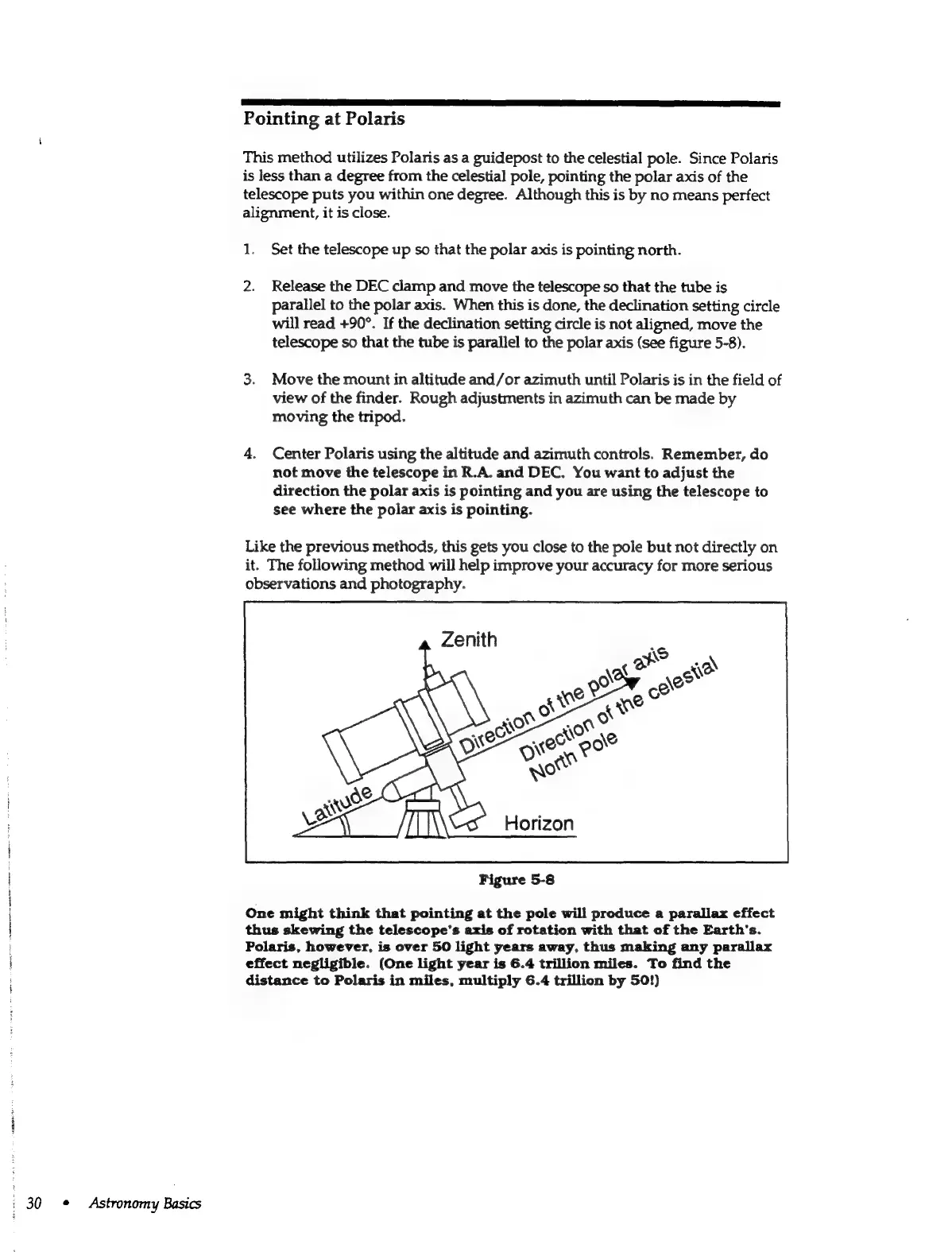
(see
figure
5-8).
3.
Move
the
mount
in
altitude
and/or
azimuth
until
Polaris
is
in
the
field
of
view
of
the
finder.
Rough
adjustments
in
azimuth
can
be
made
by
moving
the
tripod.
4.
Center
Polaris
using
the
altitude
and
azimuth
controls.
Remember,
do
not
move
the
telescope
in
R.A.
and
DEC.
You
want
to
adjust
the
direction
the
polar
axis
is
pointing
and
you
are
using
the
telescope
to
see
where
the
polar
axis
is
pointing.
Like
the
previous
methods,
this
gets
you
close
to
the
pole
but
not
directly
on
it.
The
following
method
will
help
improve
your
accuracy
for
more
serious
observations
and
photography.
Horizon
Figure
5-8
One
might
think
that
pointing
at
the
pole
will
produce
a
parallax
effect
thus
skewing
the
telescope's
axis
of
rotation
with
that
of
the
Earth's.
Polaris,
however,
is
over
50
light
years
away,
thus
making
any
parallax
effect
negligible.
(One
light
year
is
6.4
trillion
miles.
To
find
the
distance
to
Polaris
in
miles,
multiply
6.4
trillion
by
50!)

Table of Contents

Related product manuals