Need help?
Do you have a question about the Center 327 and is the answer not in the manual?
Read safety information carefully before operating; use only as specified to maintain protection.
Operate within specified environmental conditions and clean with a dry cloth only.
Comply with EMC directives and use specified replacement parts for servicing.
Sound level calibrator for sound measurement equipment, supports 1" and 1/2" microphones.
Conforms to standards, offers 94 dB at 125Hz/250Hz, and fits 1"/1/2" microphones.
Specifies output levels of 94dB at 125Hz and 250Hz with specified tolerances.
Details reference conditions (temp, humidity) and influences of ambient factors.
Defines THD, accuracy, and stabilization time for reliable measurements.
Covers battery requirements, life, dimensions, weight, and operating/storage conditions.
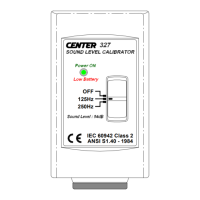
Identifies key parts including LEDs, switches, microphone cavities, and battery cover.
Instructions for battery installation and quick operational checks.
Guidance on microphone insertion, instrument setup, and reading measurements.
The CENTER 327 is a sound level calibrator designed for the calibration of sound level meters and other sound measurement equipment. It conforms to ANSI S1.4-1984 and IEC 60942-2003 Class 2 standards, ensuring reliable and accurate performance.
The primary function of the CENTER 327 is to provide a stable and accurate sound pressure level for calibrating microphones. It offers two selectable output frequencies: 125Hz and 250Hz, both at a sound level of 94dB. This allows users to calibrate their instruments in various environments and check frequency response. The calibrator is designed to accommodate 1-inch microphones directly. For instruments with 1/2-inch microphones, a supplied adapter must be gently pushed into the cavity until it reaches the end.
To operate, the user turns the power switch from OFF to the 94dB position. A green LED indicates that the unit is ready for operation; if the LED is red, the battery needs replacement. The calibrator features a power and output frequency select switch, a transducer assembly with a 1-inch cavity for microphone insertion, a 1/2-inch microphone adapter, and a battery cover.
When calibrating, the sound level calibrator is placed over the microphone of the instrument under test. On the instrument, the level range control should be set to a range with 100dB as its upper limit if 94dB was selected on the calibrator. The instrument may be set to FAST or SLOW response. The user then reads the level on the instrument. The manual provides a table detailing different readings after selecting different frequency weightings (LA, Lc, LP) for nominal frequencies of 1000Hz, 250Hz, and 125Hz, along with their respective tolerance limits for Class 1 and Class 2 devices. It is crucial to switch off the calibrator when not in operation to conserve battery life. A caution is included regarding ambient sources of noise or vibration, which can cause false calibration indications. To avoid this, the surrounding noise/vibration level should be kept below 60 dBA.
The CENTER 327 is designed for ease of use. It features a simple power ON/OFF and frequency selection switch. The LED indicator provides clear feedback on the power status and battery condition (green for ON, red for low battery). It is compatible with both 1-inch and 1/2-inch microphones, making it versatile for various sound measurement instruments. The quick check procedure allows users to verify the calibrator's operation before use. The compact and lightweight design makes it portable and convenient for field use. The device adheres to international standards IEC 60942 Class 2 and ANSI S1.40 - 1984, ensuring reliable performance for professional applications.
The calibrator incorporates internal circuitry that continuously checks the battery condition. If the battery voltage falls below an acceptable range, the green LED will turn red, indicating that the battery needs to be replaced. This prevents operation with an insufficient power supply, ensuring accurate calibration results. The battery compartment is easily accessible for replacement. For general maintenance, the case should be periodically wiped with a dry cloth. Abrasives or solvents should not be used on the instrument. Any repairs or servicing not covered in the manual should only be performed by qualified personnel to maintain the integrity and safety of the device. The device is marked with the CE symbol, indicating compliance with EMC directives. When servicing, only specified replacement parts should be used.
 General
| Brand | Center |
|---|---|
| Model | 327 |
| Category | Measuring Instruments |
| Language | English |

 To Next Page