EasyManua.ls Logo

Cessna 1971 Super Skymaster - Page 40

Cessna 1971 Super Skymaster
63 pages
Print Icon
To Next Page IconTo Next Page
To Previous Page IconTo Previous Page
Loading...
LUBRICATION
AND
SERVICING
PROCEDURES
Specific
servicing
information
is
provided
here
for
items
requiring
dally
attention. A
Servicing
Intervals
Check
List
is
included to
inform
the
pilot
when
to
have
other
items
checked
and
serviced.
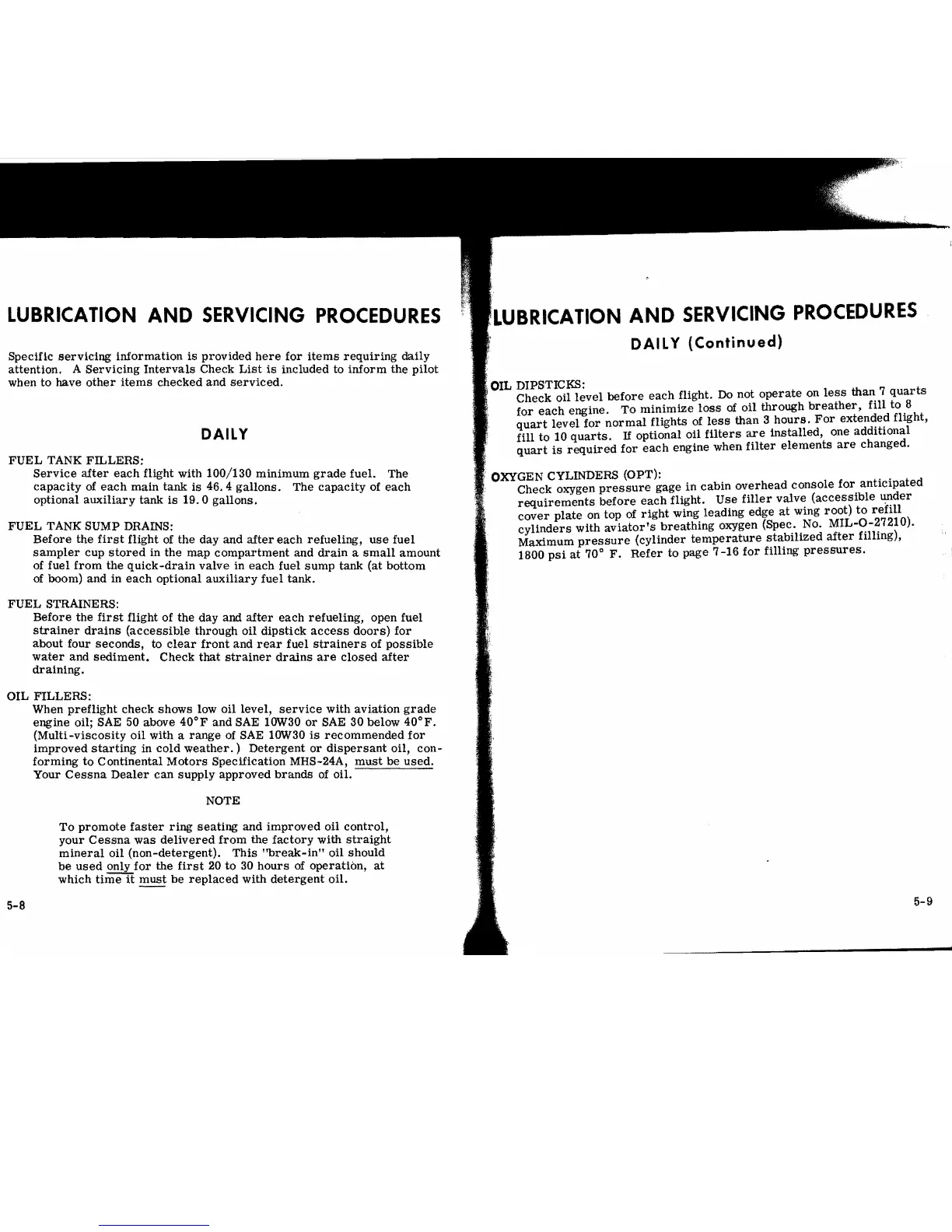
DAILY
FUEL
TANK FILLERS:
Service
after
each
flight with 100/130
minimum
grade
fuel. The
capacity
of
each
main
tank
is
46.4
gallons.
The
capacity
of
each
optional
auxiliary
tank
is
19.0
gallons.
FUEL
TANK SUMP DRAINS:
Before
the
first
flight of
the
day and
after
each
refueling,
use
fuel
sampler
cup
stored
in
the
map
compartment
and
drain
a
small
amount
of fuel
from
the
quick-drain
valve
in
each
fuel
sump
tank
(at bottom
of
boom) and in
each
optional
auxiliary
fuel tank.
FUEL STRAINERS:
Before
the
first
flight of the day and
after
each
refueling,
open fuel
strainer
drains
(accessible
through
oil
dipstick
access
doors)
for
about four
seconds,
to
clear
front
and
rear
fuel
strainers
of
possible
water
and
sediment.
Check
that
strainer
drains
are
closed
after
draining.
OIL FILLERS:
When
preflight
check
shows low
oil
level,
service
with
aviation
grade
engine oil; SAE 50 above
40°F
and SAE
1OW30
or
SAE 30 below
40°F.
(Multi-viscosity
oil
with a
range
of
SAE
1OW30
is
recommended
for
improved
starting
in
cold
weather.)
Detergent
or
dispersant
oil,
con-
forming
to
Continental
Motors
Specification MHS-24A,
must
be
used.
Your
Cessna
Dealer
can
supply approved
brands
of oil.
NOTE
To
promote
faster
ring
seating
and
improved
oil
control,
your
Cessna
was
delivered
from
the
factory
with
straight
mineral
oil
(non-detergent).
This
"break-in"
oil
should
be
used
only
for
the
first
20 to
30
hours
of
operation,
at
which
time
it
must
be
replaced
with
detergent
oil.
LUBRICATION
AND
SERVICING
PROCEDURES
DAILY
(Continued)
OIL
DIPSTICKS:
Check
oil
level
before
each
flight. Do not
operate
on
less
than
7
quarts
for
each
engine.
To
minimize
loss
of
oil
through
breather,
fill
to 8
quart
level
for
normal
flights
of
less
than
3
hours.
For
extended flight,
fill
to 10
quarts.
If
optional oil
filters
are
installed,
one additional
quart
is
required
for
each
engine when
filter
elements
are
changed.
OXYGEN CYLINDERS (OPT):
Check oxygen
pressure
gage
in
cabin
overhead
console
for
anticipated
requirements
before
each
flight.
Use
filler
valve
(accessible
under
cover
plate
on top of
right
wing leading edge
at
wing
root)
to
refill
cylinders
with
aviator's
breathing
oxygen (Spec. No. MIL-O-27210).
Maximum
pressure
(cylinder
temperature
stabilized
after
filling),
1800
psi
at
70
0
F.
Refer
to
page
7-16
for
filling
pressures.
~.
5-8
5-9
I

Related product manuals