EasyManua.ls Logo

Cessna 1971 Super Skymaster - Description and Operating Details

Cessna 1971 Super Skymaster
63 pages
Print Icon
To Next Page IconTo Next Page
To Previous Page IconTo Previous Page
Loading...
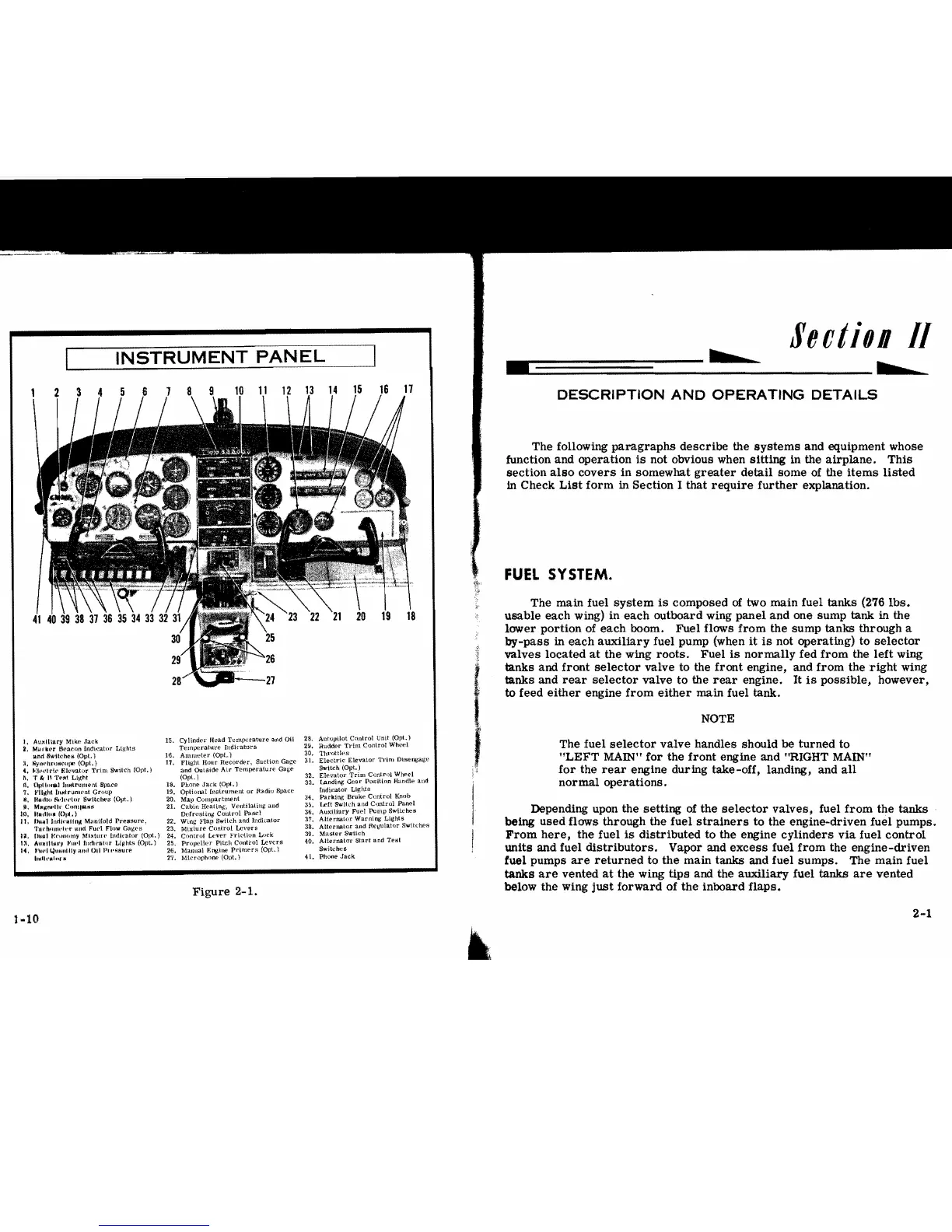
INSTRUMENT
PANEL
Section
II
--
========~~~----.>---
DESCRIPTION
AND
OPERATING
DETAILS
The following
paragraphs
describe
the
systems
and equipment whose
function and operation
is
not obvious when
sitting
in the
airplane.
This
section
also
covers
in
somewhat
greater
detail
some of the
items
listed
2B.
AntopHot
Control
29.
Rudder
Trim
Conlrol
30.
Throttles
31.
Electr
:1.
HVlwhrmlc<nle
Switch
..
32.
Elevator
'.
33.
l.anding
Gear
Position
ffitndle
aud
n.
Indicator
7.
34,
Parking
Control
'.
35.
Left
Switch
and
Conlrol
P.
36.
Auxiliary
Fuel
Pump
Switches
11>.
37.
Alternator
WaI
II.
38.
Alternator
and
39.
Masll:.'r
Switch
II.
40.
Alternator
Start
and
Tel;;l
D.
Switctll'S
14.
41. phone
Jack
Figure
2-1.
1~10
In Check
List
form
in Section I that
require
further
explanation.
FUEL
SYSTEM.
The maln fuel
system
is
composed of two
main
fuel tanks (276
lbs.
usable
each wing) in
each
outboard wing
panel
and
one sump tank in the
lower portion of
each
boom. Fuel flows
from
the sump tanks through a
by-pass
in
each
auxiliary
fuel pump (when
it
is
not operating) to
selector
valves
located
at
the wing
roots.
Fuel
is
normally
fed
from
the
left
wing
tanks and
front
selector
valve to the
front
engine, and
from
the
right
wing
tanks and
rear
selector
valve
to
the
rear
engine.
It
is
pOSSible, however,
to feed
either
engine
from
either
main fuel tank.
NOTE
The fuel
selector
valve
handles should
be
turned
to
"LEFT
MAIN"
for
the
front
engine and "RIGHT MAIN"
for
the
rear
engine durlng take-off, landing, and
all
normal
operations.
Depending upon the
setting
of
the
selector
valves,
fuel
from
the tanks
being used flows through the fuel
strainers
to the engine-driven fuel pumps.
From
here,
the fuel
is
distributed
to the engine
cylinders
via
fuel
control
units and fuel
distributors.
Vapor and
excess
fuel
from
the
engine-driven
fuel pumps
are
returned
to
the
main tanks and fuel
sumps.
The
main
fuel
tanks
are
vented
at
the wing
tips
and the
auxiliary
fuel
tanks
are
vented
below the wing
just
forward
of
the
inboard
flaps.
2-1
~

Related product manuals