EasyManua.ls Logo

Cessna 1971 Super Skymaster - Section III - Emergency Procedures

Cessna 1971 Super Skymaster
63 pages
Print Icon
To Next Page IconTo Next Page
To Previous Page IconTo Previous Page
Loading...
--
Section
III
II
.>
..
-
EMERGENCY
PROCEDURES
ENGINE
FAILURE
DURING
TAKE-OFF.
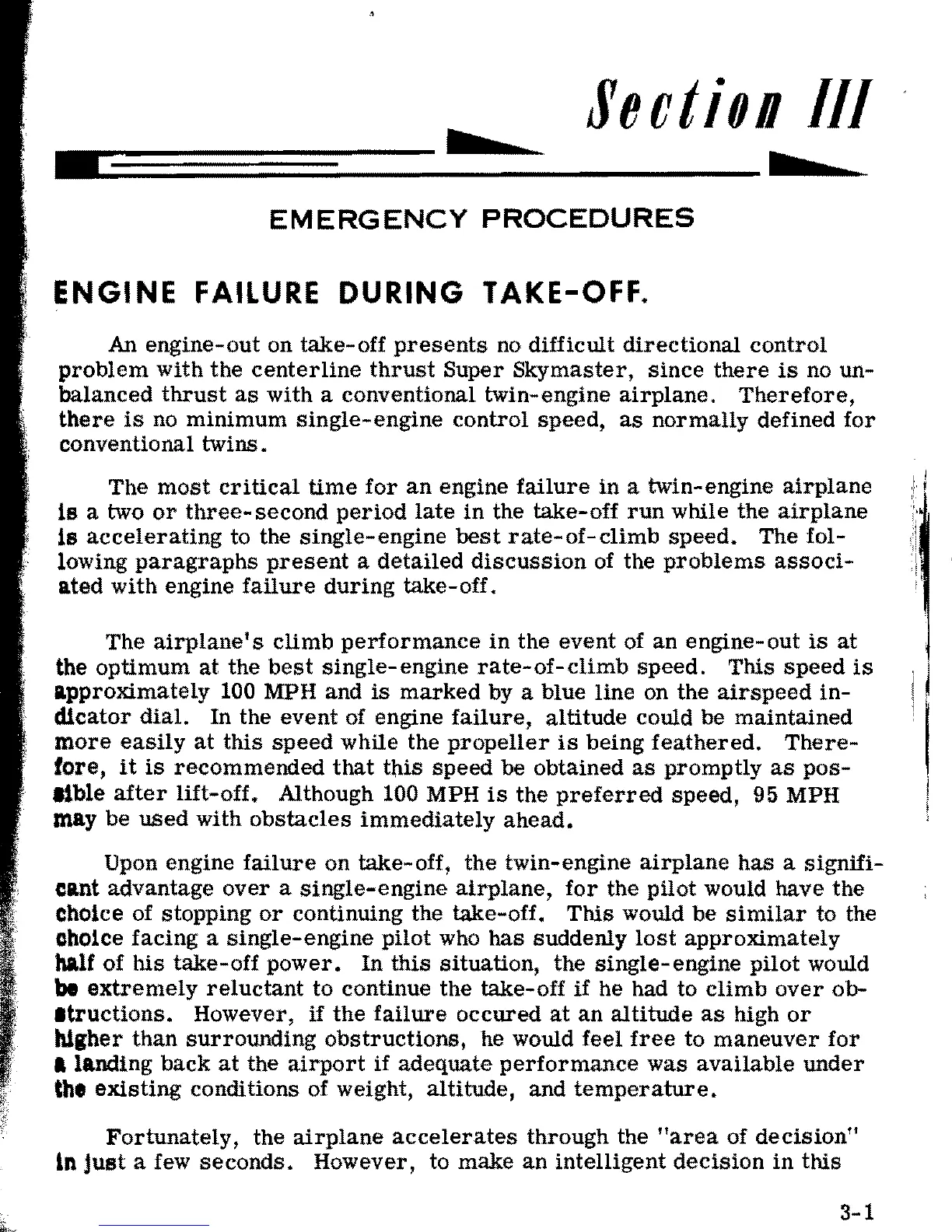
An
engine-out
on
take-off
presents
no difficult
directional
control
problem
with
the
centerline
thrust
Super
Skymaster,
since
there
is
no un-
balanced
thrust
as
with a conventional twin-engine
airplane.
Therefore,
there
is
no
minimum
single-engine
control
speed,
as
normally
defined
for
conventional
twins.
The
most
critical
time
for
an
engine
failure
in
a twin-engine
airplane
18
a two
or
three-second
period
late
in
the
take-off
run
while
the
airplane
18
accelerating
to the
single-engine
best
rate-of-climb
speed.
The
fol-
,:11
i
lowing
paragraphs
present
a
detailed
discussion
of the
problems
associ-
ated
with engine
failure
during
take-off.
The
airplane's
climb
performance
in
the
event
of
an
engine-out
is
at
the
optimum
at
the
best
single-engine
rate-of-climb
speed.
This
speed
is
apprOximately 100 MPH and
is
marked
by a blue line on the
airspeed
in-
dicator
dial.
In the
event
of engine
failure,
altitude
could be
maintained
more
easily
at
this
speed
while the
propeller
is
being
feathered.
There-
fore,
it
is
recommended
that
this
speed
be obtained
as
promptly
as
pos-
.lble
after
lift-off.
Although 100 MPH
is
the
preferred
speed,
95 MPH
may
be
used
with
obstacles
immediately
ahead.
Upon engine
failure
on
take-off,
the
twin-engine
airplane
has
a
signifi-
\
cant
advantage
over
a
single-engine
airplane,
for
the
pilot
would have
the
\
choice of stopping
or
continuing the
take-off.
This
would
be
similar
to the
chOice
facing
a
single-engine
pilot
who
has
suddenly
lost
apprOximately
half
of
his
take-off
power.
In
this
situation,
the
single-engine
pilot
would
be
extremely
reluctant
to
continue the
take-off
if
he had to
climb
over
ob-
.tructions.
However,
if
the
failure
occured
at
an
altitude
as
high
or
higher
than
surrounding
obstructions,
he would
feel
free
to
maneuver
for
I landing
back
at
the
airport
if
adequate
performance
was
available
under
the
existing
conditions of weight,
altitude,
and
temperature.
Fortunately,
the
airplane
accelerates
through
the
"area
of
decision"
in
just
a few
seconds.
However, to make
an
intelligent
decision
in
this
3-1
! '
~
.
'''i¥~

Related product manuals