EasyManua.ls Logo

Cessna 1971 Super Skymaster - Page 23

Cessna 1971 Super Skymaster
63 pages
Print Icon
To Next Page IconTo Next Page
To Previous Page IconTo Previous Page
Loading...
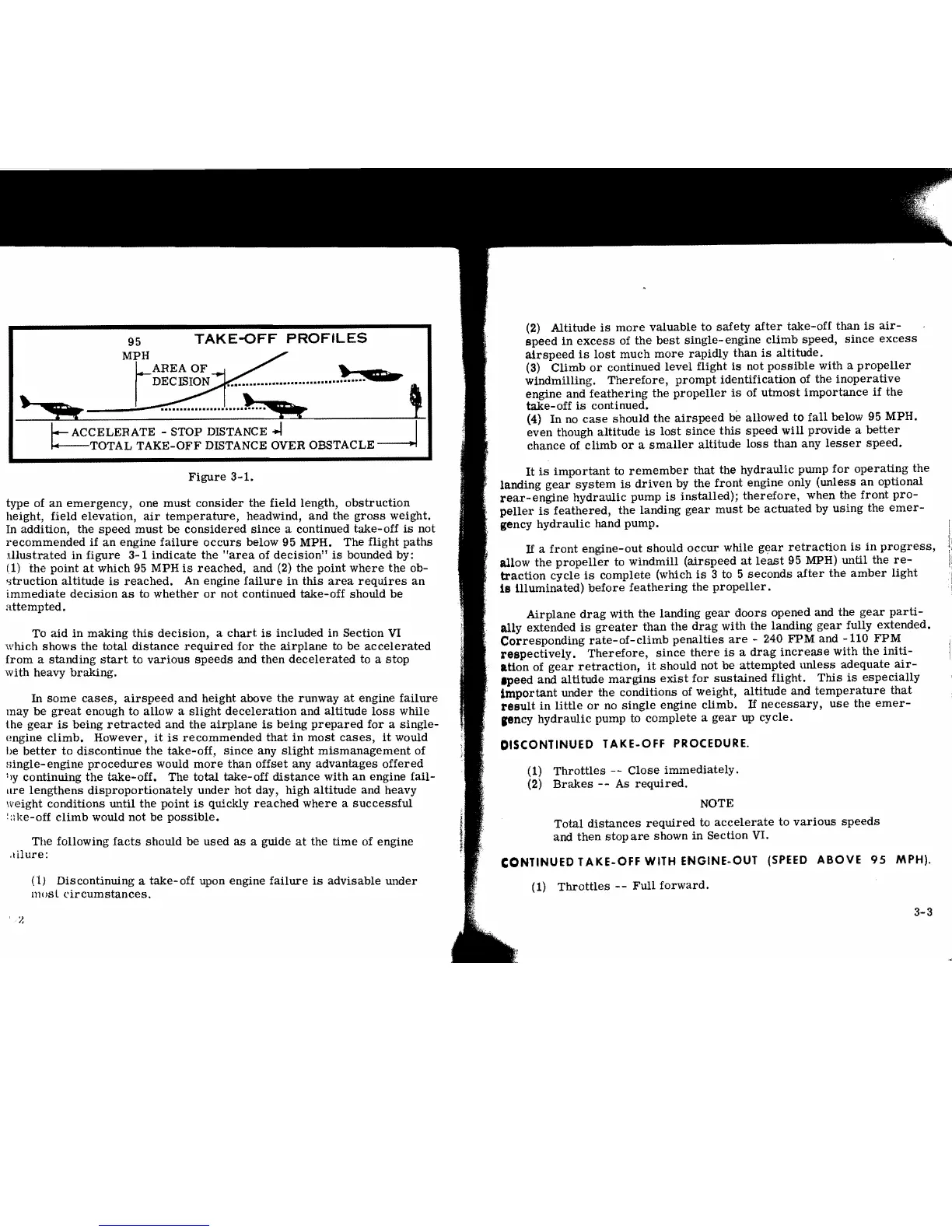
TAKE-oFF
PROFILES
Figure
3-1.
type of
an
emergency,
one
must
consider
the
field
length,
obstruction
height,
field
elevation,
air
temperature,
headwind, and the
gross
weight.
In addition, the
speed
must
be
considered
since
a continued
take-off
is
not
recommended
if
an
engine
failure
occurs
below
95
MPH. The flight
paths
Illustrated
in
figure
3-1
indicate
the
"area
of
decision"
is
bounded by:
(1)
the
point
at
which 95 MPH
is
reached,
and (2) the
point
where
the
ob-
"truction
altitude
is
reached.
An
engine
failure
in
this
area
requires
an
immediate
decision
as
to
whether
or
not continued
take-off
should
be
attempted.
To
aid
in
making
this
decision,
a
chart
is
included
in
Section
VI
which
shows
the
total
distance
required
for
the
airplane
to be
accelerated
from
a
standing
start
to
various
speeds
and then
decelerated
to a
stop
with
heavy
braking.
In
some
cases,
airspeed
and height above
the
runway
at
engine
failure
may
be
great
enough to allow a
slight
deceleration
and
altitude
loss
while
the
gear
is
being
retracted
and
the
airplane
is
being
prepared
for
a
single-
engine
climb.
However,
it
is
recommended
that
in
most
cases,
it
would
he
better
to
discontinue
the
take-off,
since
any
slight
mismanagement
of
Hingle-engine
procedures
would
more
than
offset
any
advantages
offered
\ly
continuing
the
take-off.
The
total
take-off
distance
with
an
engine
fail-
lire
lengthens
disproportionately
under
hot day, high
altitude
and heavy
weight conditions
until
the
point
is
quickly
reached
where
a
successful
:.ke-off
climb
would
not
be
possible.
The following
facts
should be
used
as a guide
at
the
time
of engine
.Iilure:
Discontinuing a
take-off
upon engine
failure
is
advisable
under
mosl
circumstances.
,
:J.
(2)
Altitude
is
more
valuable
to
safety
after
take-off
than
is
air-
speed
in
excess
of
the
best
single-engine
climb
speed,
since
excess
airspeed
is
lost
much
more
rapidly
than
is
altitude.
(3)
Climb
or
continued
level
flight
is
not
possible
with a
propeller
windmilling.
Therefore,
prompt
identification
of the
inoperative
engine and
feathering
the
propeller
is
of
utmost
importance
if
the
take-off
is
continued.
(4)
In
no
case
should
the
airspeed
be allowed
to
fall
below 95 MPH.
even though
altitude
is
lost
since
this
speed
will
provide
a
better
chance
of
climb
or
a
smaller
altitude
loss
than
any
lesser
speed.
It
is
important
to
remember
that
the
hydraulic
pump
for
operating
the
landing
gear
system
is
driven
by the
front
engine only (unless
an
optional
rear-engine
hydraulic
pump
is
installed);
therefore,
when the
front
pro-
peller
is
feathered,
the
landing
gear
must
be
actuated
by
using
the
emer-
gency
hydraulic
hand pump.
If
a
front
engine-out
should
occur
while
gear
retraction
is
in
progress,
allow
the
propeller
to
windmill
(airspeed
at
least
95 MPH)
until
the
re-
traction
cycle
is
complete
(which
is
3 to 5
seconds
after
the
amber
light
Is
illuminated)
before
feathering
the
propeller.
Airplane
drag
with
the
landing
gear
doors
opened and the
gear
parti-
ally
extended
is
greater
than
the
drag
with
the landing
gear
fully
extended.
Corresponding
rate-of-climb
penalties
are
- 240
FPM
and
-110
FPM
respectively.
Therefore,
since
there
is
a
drag
increase
with
the
initi-
ation
of
gear
retraction,
it
should not
be
attempted
unless
adequate
air-
.peed
and
altitude
margins
exist
for
sustained
flight.
This
is
especially
important
under
the conditions of weight,
altitude
and
temperature
that
result
in
little
or
no
single
engine
climb.
If
necessary,
use
the
emer-
pncy
hydraulic
pump to
complete
a
gear
up
cycle.
DISCONTINUED
TAKE-OFF
PROCEDURE.
(1)
Throttles
--
Close
immediately.
(2)
Brakes
--
As
required.
NOTE
Total
distances
required
to
accelerate
to
various
speeds
and
then
stop
are
shown
in
Section VI.
CONTINUED
TAKE-OFF
WITH
ENGINE-OUT
(SPEED
ABOVE
95
MPH).
(1)
Throttles
--
Full
forward.
3-3

Related product manuals