EasyManua.ls Logo

Cessna 1971 Super Skymaster - Page 5

Cessna 1971 Super Skymaster
63 pages
Print Icon
To Next Page IconTo Next Page
To Previous Page IconTo Previous Page
Loading...
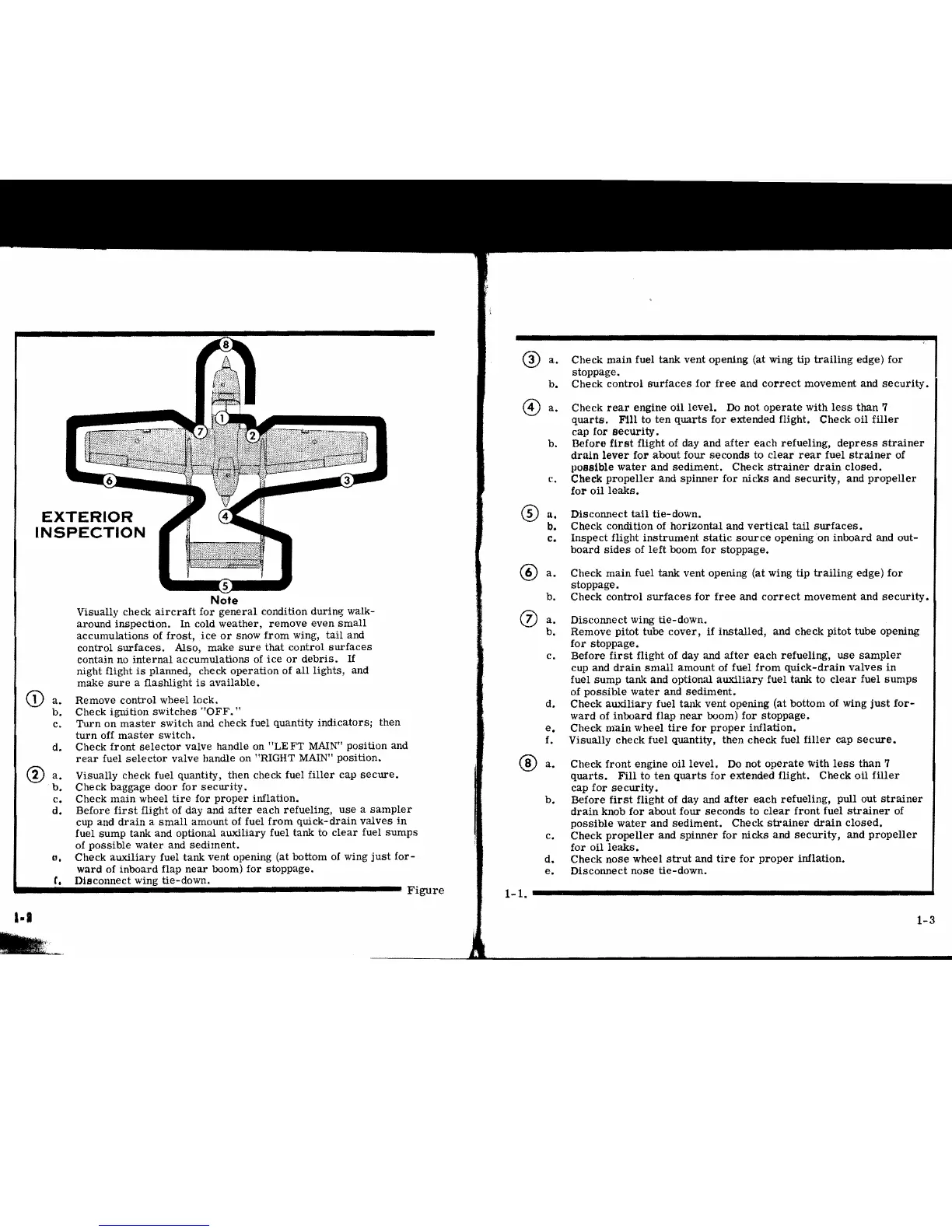
EXTERIOR
INSPECTION
Note
Visually check
aircraft
for
general
condition
durin~
walk-
around inspection. In cold
weather,
remove
even
small
accumulations of
frost,
ice
or
snow
from
wing,
tail
and
control
surfaces.
Also, make
sure
that
control
surfaces
contain
no
internal
accumulations
of
ice
or
debris.
If
night flight
is
planned, check
operation
of
all
lights, and
make
sure
a flashlight
is
available.
CD
a.
Remove
control
wheel lock.
b.
Check ignition
switches
"OFF."
c.
Turn
on
master
switch
and check fuel quantity
indicators;
then
turn
off
master
switch.
d.
Check
front
selector
valve handle on
"LEFT
MAlN"
position
and
rear
fuel
selector
valve handle
on
"RIGHT MAIN"
position.
®
a.
Visually check fuel quantity,
then
check fuel
filler
cap
secure.
b.
Check baggage
door
for
security.
c.
Check
main
wheel
tire
for
proper
inflation.
d.
Before
first
flight of day and
after
each
refueling,
use
a
sampler
cup and
drain
a
small
amount
of
fuel
from
quick-drain
valves
in
fuel
sump
tank and optional
auxiliary
fuel tank to
clear
fuel
sumps
of
possible
water
and
sediment.
0.
Check
auxiliary
fuel
tank
vent opening (at bottom of wing
just
for-
ward
of
inboard
flap
near
boom) for stoppage.
C.
Disconnect
wing tie-down.
Figure
1·1
®
a.
Check
main
fuel
tank
vent
opening (at wing tip
trailing
edge) for
stoppage.
b.
Check
control
surfaces
for
free
and
correct
movement and
security.
o
a.
Check
rear
engine
oil
level.
Do not
operate
with
less
than
7
quarts.
Fill
to
ten
quarts
for
extended flight. Check
oil
filler
cap
for
security.
b.
Before
first
flight of day and
after
each
refueling,
depress
strainer
drain
lever
for
about
four
seconds
to
clear
rear
fuel
strainer
of
possible
water
and
sediment.
Check
strainer
drain
closed.
c.
Check
propeller
and
spinner
for
nicks
and
security,
and
propeller
for
oil
leaks.
®
a.
DiscOlIDect
tail
tie-down.
b.
Check condition of
horizontal
and
vertical
tail
surfaces.
c.
Inspect
flight
instrument
static
source
opening
on
inboard
and
out-
board
sides
of
left
boom
for
stoppage.
®
a.
Check
main
fuel
tank
vent opening (at wing
tip
trailing
edge)
for
stoppage.
b.
Check
control
surfaces
for
free
and
correct
movement
and
security.
CD
a.
Disconnect
wing tie-down.
b.
Remove
pitot
tube
cover,
if
installed,
and check
pitot
tube opening
for
stoppage.
c.
Before
first
flight of day and
after
each
refueling,
use
sampler
cup and
drain
small
amount
of fuel
from
quick-drain
valves
in
fuel
sump
tank
and
optional
auxiliary
fuel
tank
to
clear
fuel
sumps
of
possible
water
and
sediment.
d.
Check
auxiliary
fuel tank
vent
opening (at bottom of wing
just
for-
ward
of
inboard
flap
near
boom)
for
stoppage.
e.
Check
m<ain
wheel
tire
for
proper
inflation.
f.
Visually
check
fuel quantity, then
check
fuel
filler
cap
secure.
®
a.
Check
front
engine
oil
level.
Do not
operate
With
less
than
7
quarts.
Fill
to
ten
quarts
for
extended flight.
Check
oil
filler
cap
for
security.
b.
Before
first
flight
of
day and
after
each
refueling,
pullout
strainer
drain
knob
for
about
four
seconds
to
clear
front
fuel
strainer
of
possible
water
and
sediment.
Check
strainer
drain
closed.
c.
Check
propeller
and
spinner
for
nicks
and
security,
and
propeller
d.
e.
for
oil
leaks.
Check
nose
wheel
strut
and
tire
for
proper
inflation.
Disconnect
nose
tie-down.
1-1.
1-3

Related product manuals