EasyManua.ls Logo

Cessna SKYMASTER 336 1964 - UNFEATHERING SYSTEMS; MAINTENANCE

Cessna SKYMASTER 336 1964
303 pages
Print Icon
To Next Page IconTo Next Page
To Previous Page IconTo Previous Page
Loading...
accomplished
in
the
field.
Repairs to
governors
are
classed
as
propeller
major
repairs
in
FAM
18,
which
also
defines
who may
accomplish
such
repairs.
12-10.
REMOVAL.
a.
Remove
cowling
and
baffles
as
required
for
access.
b.
If
an
optional
unfeathering
system
is
installed,
place
propeller
control
in
high
rpm
position.
c.
Disconnect
propeller
control
from
governor.
d.
If
an
optional
unfeathering
system
is
installed,
release
accumulator
pressure,
then
disconnect
ac-
cumulator
hose
from
governor
fitting.
e.
Remove
nuts
and
washers
securing
governor
and
pull
governor
from
mounting
studs.
f.
Remove gasket
between
governor
and
engine
mounting
pad.
12-11.
INSTALLATION.
a.
Wipe
governor
and
engine mounting
pad
clean.
b.
Install
a
new
gasket,
with
the
raised
surface
of
the
screen
away
from
the
engine
pad.
c.
Position
governor
on
mounting
studs,
aligning
governor
splines
with
splines
in
engine,
and
install
mounting
washers
and
nuts.
Do
not
force
spline
en-
gagement. Rotate
engine
crankshaft
and
splines will
engage
smoothly
when
aligned.
d.
If
an optional
unfeathering
system
is
installed,
connect
accumulator
hose
to
governor,
and
recharge
the
accumulator.
e.
Connect governor
control
to
governor
arm.
If
rod-end adjustment
was
not
disturbed,
it
should
not
be
necessary
to
rig the
control.
Check
rigging
and
adjust
as
required.
Refer
to
paragraph
10-55.
f.
Reinstall
baffles
and
cowling
removed
for
access.
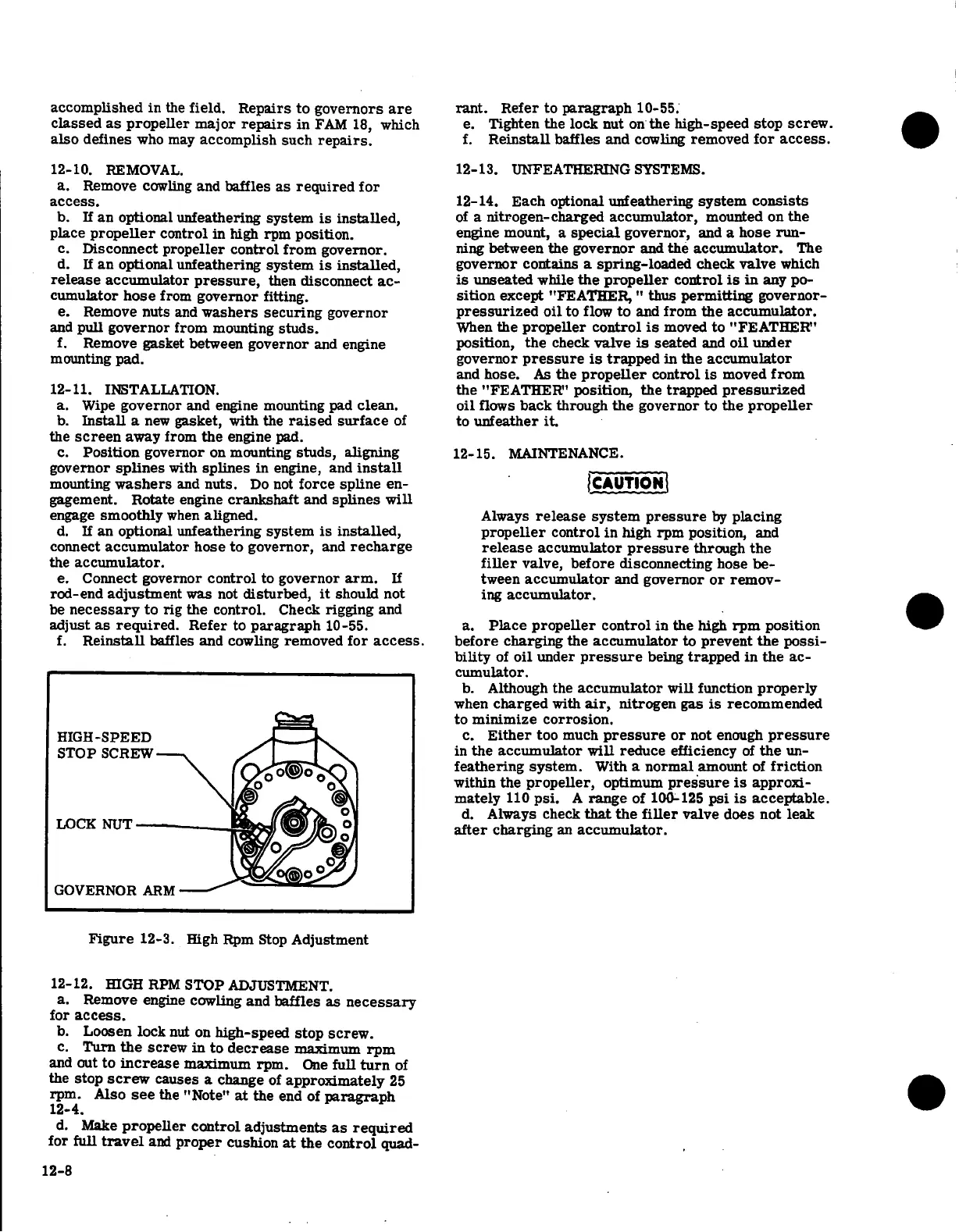
HIGH
-SPEED
STOP
SCREW
LOCK
NUT
GOVERNOR
ARM
rant.
Refer
to
paragraph
10-55.
e.
Tighten
the
lock
nut
on
the
high-speed
stop screw.
f.
Reinstall
baffles
and
cowling
removed
for
access.
12-13.
UNFEATHERING
SYSTEMS.
12-14.
Each optional
unfeathering
system
consists
of
a
nitrogen-charged
accumulator,
mounted
on
the
engine
mount,
a
special
governor,
and
a hose
run-
ning
between the
governor
and
the
accumulator.
The
governor
contains
a
spring-loaded
check
valve
which
is
unseated
while
the
propeller
control
is
in
any
po-
sition
except
"FEATHER,"
thus
permitting
governor-
pressurized
oil
to
flow
to
and
from
the accumulator.
When
the
propeller
control
is
moved
to
"FEATHER"
position,
the
check
valve
is
seated
and
oil
under
governor
pressure
is
trapped
in
the
accumulator
and
hose.
As
the
propeller
control
is
moved
from
the
"FEATHER"
position,
the trapped
pressurized
oil
flows
back
through
the
governor
to
the
propeller
to
unfeather
it.
12-15.
MAINTENANCE.
CAUTION
Always
release
system
pressure
by
placing
propeller
control
in
high
rpm
position,
and
release
accumulator
pressure
through
the
filler
valve,
before disconnecting
hose
be-
tween
accumulator
and
governor
or
remov-
ing
accumulator.
a.
Place
propeller
control
in
the
high
rpm
position
before
charging
the
accumulator
to
prevent
the
possi-
bility
of
oil
under
pressure
being
trapped
in
the
ac-
cumulator.
b.
Although the
accumulator
will
function
properly
when
charged
with
air,
nitrogen
gas
is
recommended
to
minimize
corrosion.
c.
Either
too
much
pressure
or
not
enough
pressure
in
the accumulator
will
reduce
efficiency
of
the
un-
feathering
system.
With
a
normal
amount
of
friction
within
the
propeller,
optimum
pressure
is
approxi-
mately
110
psi.
A
range
of
100-125
psi
is
acceptable.
d.
Always
check
that
the
filler
valve
does not
leak
after
charging
an
accumulator.
Figure
12-3.
High
Rpm
Stop
Adjustment
12-12.
HIGH
RPM
STOP
ADJUSTMENT.
a.
Remove
engine cowling
and
baffles
as
necessary
for
access.
b.
Loosen
lock
nut
on
high-speed
stop
screw.
c.
Turn
the
screw
in
to
decrease
maximum
rpm
and
out
to
increase
maximum
rpm.
One
full
turn
of
the
stop
screw
causes
a
change
of
approximately
25
rpm.
Also
see
the
"Note"
at
the
end
of
paragraph
12-4.
d.
Make
propeller
control
adjustments
as
required
for
full
travel
and
proper
cushion
at
the
control
quad-
12-8

Table of Contents

Related product manuals