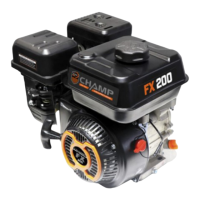
This document is an owner's manual for the Champ Manufacturing FX390 and FX390E engines, providing detailed information on their operation, maintenance, and parts breakdown.
Function Description:
The Champ FX390 and FX390E are internal combustion engines designed for various applications, likely powering equipment such as generators, pressure washers, tillers, or other machinery requiring a robust and reliable power source. The manual covers both standard (FX390) and electric start (FX390E) models, indicating versatility in starting methods.
Important Technical Specifications:
The manual provides a comprehensive specification table for both FX390 and FX390E models:
- Bore x Stroke: 88 x 64 mm
- Displacement: 389 CC
- Compression Ratio: 8.5:1
- Net Power: 7.8 Kw / 3600 Rpm
- Net Torque: 25 N.m / 2500 Rpm
- PTO Shaft Rotation: Counter Clockwise
- Ignition System: Transistorized magneto ignition
- Lubrication System: Forced splash
- Carburetor: Flat suction valve carburetor
- Governor System: Centrifugal mechanical
- Engine Type: Forced air-cooling 4-stroke, OHV (Overhead Valve)
- Starting System: Recoil / Electric start (for FX390E)
- Fuel Tank Capacity: 6.5 Liters
- Engine Oil Capacity: 1.1 Liters
- Fuel Consumption: ≤374 g/Kw.h
- Dimensions (LxWxH): 465 x 415 x 440 mm
- Net Weight: 30.5 Kg (FX390) / 33.5 Kg (FX390E)
These specifications indicate a powerful, air-cooled, single-cylinder engine suitable for demanding tasks. The OHV design typically contributes to better fuel efficiency and lower emissions compared to older side-valve designs.
Usage Features:
The manual outlines critical steps for safe and effective operation:
- Pre-operation Check: Emphasizes checking engine oil, air cleaner, and fuel levels before starting.
- Fuel Requirements: The engine is designed to use gasoline with a pump octane number of 86 or higher (research octane number 91 or higher). Lead-free fuel is recommended to reduce deposits and extend exhaust system component life. The manual explicitly warns against stale, contaminated gasoline or oil/gasoline mixtures.
- Gasolines Containing Alcohol: Provides specific guidelines for using gasohol, advising against mixtures with more than 10% ethanol or more than 5% methanol (even with cosolvents and corrosion inhibitors). It warns that fuel system damage from alcohol-containing fuels is not covered under warranty.
- Starting the Engine: Involves turning the fuel valve to the ON position, moving the choke lever to the CLOSE position (if the engine is cold), moving the throttle lever slightly to the left, and then using the recoil starter (pulling briskly until resistance is felt). Once the engine warms up, the choke lever should be moved to the OPEN position.
- Stopping the Engine: For emergencies, the engine switch should be turned to the OFF position. Under normal conditions, the throttle lever should be moved fully to the right, the engine switch turned OFF, and the fuel valve turned to the OFF position.
- Safety Warnings: The manual prominently features "DANGER" and "WARNING" symbols to highlight potential hazards, including serious injury or death from not following instructions, fire/explosion risks with gasoline, carbon monoxide poisoning from exhaust, and skin contact with used motor oil. It stresses the importance of operating in well-ventilated areas and proper refueling procedures.
Maintenance Features:
The manual details a comprehensive maintenance schedule and procedures to ensure the engine's longevity and performance:
- Maintenance Schedule: A table outlines periodic checks and services:
- Each Use: Check oil level, reduction gear oil level, air cleaner.
- 25 Hours: Change oil.
- 50 Hours: Change reduction gear oil.
- 100 Hours: Clean sediment cup, clean spark plug, clean spark arrester.
- 300 Hours: Change air cleaner, check valve clearance, clean fuel tank strainer.
- Every 2 Years: Check fuel line.
- Oil Change: Recommends draining oil when the engine is warm, then refilling with recommended oil (SAE 10W-30 is suitable for general, all-temperature use). It warns about the risks of prolonged skin contact with used motor oil and emphasizes proper disposal. The oil alert system automatically stops the engine if the oil level falls below a safe limit.
- Air Cleaner Service: Instructs users to regularly clean the air cleaner, especially in dusty conditions. It warns against using gasoline or low-point solvents for cleaning due to fire/explosion risks. The procedure involves unscrewing the wing nut, removing the element, washing it in detergent and warm water (or nonflammable solvent), drying it, soaking it in clean engine oil, squeezing out excess oil, and then reinstalling. Running the engine without an air cleaner can cause rapid engine wear.
- Sediment Cup Cleaning: Involves turning the fuel valve to OFF, removing and cleaning the sediment cup and O-ring, drying them, and reinstalling securely.
- Spark Plug Service: Recommends using the specified spark plug or equivalent. It details how to remove, inspect, clean, and measure the gap (0.7-0.8 mm or 0.028-0.031 inches). Proper tightening is crucial to prevent overheating and damage.
- Spark Arrester Maintenance (Optional): Provides steps to remove and clean the spark arrester, emphasizing care to avoid damage to the screen.
- Troubleshooting: Includes a basic troubleshooting guide for common issues like the engine not starting (out of fuel, flooded engine), stopping suddenly (low oil shutdown, empty/impure fuel tank), and knocking (engine overload).
- Warranty Service: Explains that warranty service is available through the dealership where the equipment was purchased. It provides a process for resolving warranty issues and requests specific information (name, address, phone, engine model, purchase date, dealer info, problem nature) to assist with claims.
- Parts Breakdown: The manual includes detailed exploded diagrams and parts lists for various subassemblies, such as the Head Subassembly, Crankcase, Gear Assembly, Crankshaft Rod, Camshaft Subassembly, Starter, Carburetor, Air Cleaner, Muffler Assembly, Fuel Tank, and Throttle Control. Each part is identified by a reference number, part number, description, and quantity, which is invaluable for ordering replacement parts and performing repairs.

 Need help?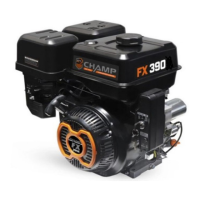

 To Next Page
 General