
 Need help?
Do you have a question about the CHINT NZ7 Series and is the answer not in the manual?
Visual guide demonstrating manual testing procedures for equipment modes.
Visual guide showing power test procedures for equipment operation.
Specifies acceptable temperature, altitude, and pollution degree for storage.
Details required humidity levels and visual representation of proper packaging.
Lists essential tools like hex keys and screwdrivers for assembly.
Details included accessories such as screws and connectors for various models.
Illustrates connecting the equipment to bus-bar systems for power distribution.
Shows main circuit wiring diagrams for 3-pole and 4-pole configurations.
Explains connections for external terminals, including status indications and signals.
Guides on how to install the controller unit within a cabinet.
Details the functions of buttons and indicators on the device's control panel.
Explains how to set various operational parameters and modes.
Illustrates the operational flow for Type A controllers in different power source scenarios.
Describes specific terminal connections for passive signals and generator integration.
Provides dimensions for wire terminals and connection plates for different models.
Shows installation of phase barriers for safety and proper separation.
Presents detailed dimensions for the equipment's outline and installation.
Provides installation dimensions and overall size of the controller module.
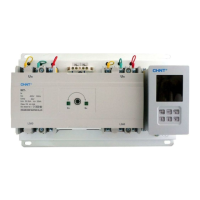
The CHINT NZ7 Series Automatic Transfer Switching Equipment is a sophisticated device designed for reliable and continuous power supply management. Its primary function is to automatically switch between a normal power source and an alternative power source, ensuring uninterrupted operation for critical loads. This automatic transfer capability is crucial in applications where power outages can lead to significant disruptions or safety concerns. The device is built to handle various power configurations, including grid-to-grid and grid-to-generator setups, offering flexibility in different operational environments.
The core function of the NZ7 Series is to monitor the status of both the normal and alternative power supplies. When the normal power supply fails or its parameters (such as voltage) fall outside acceptable limits, the device automatically initiates a transfer to the alternative power supply. Once the normal power supply is restored and stable, the device can be configured to automatically switch back, ensuring that the primary power source is utilized whenever available. This intelligent monitoring and switching mechanism minimize downtime and maintain operational continuity.
The controller, which is the brain of the ATS, provides a comprehensive display and operation interface. This interface allows users to view various parameters, including normal and alternative power voltage, current, and frequency. It also indicates the working mode (automatic or manual), failure status, and the on/off status of breakers for both power sides. The display area shows critical information such as transfer delay times, which are crucial for managing the transition between power sources smoothly.
The device supports several operational modes, including grid-to-grid self-throw and self-reset, grid-to-grid mutual alternative operation, and grid-to-power generation self-throw and self-reset. These modes cater to different power management strategies, allowing the ATS to adapt to specific site requirements. For instance, in a grid-to-generator setup, the ATS can initiate the generator's start sequence upon grid failure and shut it down once grid power is restored, all while managing the transfer of load.
The controller also features a parameter setting menu, accessible through dedicated buttons. This menu allows users to configure various operational parameters, such as under-voltage and over-voltage transfer values for both normal and alternative power, as well as different transfer delay times. These settings enable fine-tuning of the ATS behavior to match the specific characteristics and sensitivities of the connected loads and power sources. For example, users can set the delay time before disconnecting the normal power (T1), the return delay time before switching back to normal power (T2), and the delay times for starting (T3) and shutting down (T4) a generator.
The NZ7 Series is designed for ease of use and installation, although it requires professional handling for mounting and servicing. The manual provides clear instructions for both vertical and horizontal installation, along with detailed wiring diagrams for connecting bus-bars and external terminals of the controller. The wiring terminal of the zero line and the main circuit bus-bar connections are clearly illustrated, emphasizing the importance of correct phase sequence and voltage signal sampling.
A key usage feature is the ability to perform manual tests and power tests, which are essential for commissioning and periodic verification of the ATS functionality. The manual test allows users to manually switch between QN (normal power) and QR (alternative power) to ensure the mechanical and electrical integrity of the switching mechanism. The power test, on the other hand, involves simulating power conditions to observe the automatic transfer behavior and confirm that all settings are correctly applied.
The controller's display provides real-time feedback on the system's status, including any failure alarms. In case of a failure, the malfunction lamp illuminates, and users can inquire about the detailed malfunction code using the failure inquiry button. This diagnostic capability helps in quickly identifying and addressing issues, minimizing troubleshooting time.
The device incorporates safety features such as reliable grounding protection and the requirement to disable automatic control during inspection of loading lines. The design also considers electromagnetic compatibility, with a note that usage in certain environments (Environment B) might require mitigation measures to prevent unwanted disturbances.
Maintenance of the NZ7 Series is facilitated by its robust design and clear operational guidelines. The manual emphasizes the importance of professional installation and servicing to ensure the longevity and reliable operation of the equipment. Regular inspections are recommended, particularly for the automatic control function, which should be disabled during such checks to prevent unintended transfers.
The parameter setting menu, while primarily for configuration, also serves as a maintenance tool. It allows technicians to review and adjust operational thresholds and delay times, ensuring the ATS remains optimized for changing power conditions or load requirements. The ability to inquire about detailed malfunction codes aids in diagnosing issues, which is a critical aspect of maintenance.
The device's construction, as indicated by the installation diagrams, suggests a modular design that could simplify component replacement if necessary. The clear labeling of terminals and the provision of standard accessories, including various sizes of screws and optional cables, indicate a design that supports straightforward maintenance procedures.
Environmental considerations for storage are also outlined, including temperature, humidity, and altitude ranges, as well as pollution degree. Adhering to these storage guidelines helps preserve the device's integrity before installation and during periods of non-use, contributing to its overall reliability and reducing the need for premature maintenance. The instruction to remove the sampling line of the controller during insulation tests for the product highlights a specific maintenance procedure to ensure accurate testing and prevent damage to the controller. The requirement for insulation resistance not less than 10MΩ provides a clear benchmark for evaluating the electrical health of the device.
 General
| Mechanical Life | 20000 cycles |
|---|---|
| Electrical Life | 10000 cycles |
| Rated Current (In) | 25A, 40A, 63A |
| Poles | 2P, 4P |
| Rated Residual Operating Current (IΔn) | 30mA, 100mA, 300mA |
| Rated Voltage (Ue) | 230V, 400V |
| Breaking Capacity | 6000A |
| Standard | IEC/EN61009-1 |
| Mounting | DIN Rail |

 To Next Page