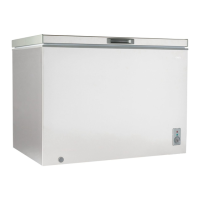
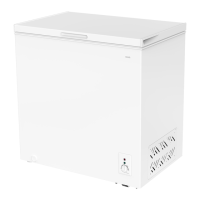
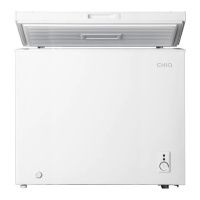
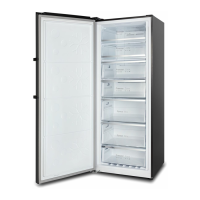
This document is a user manual for a CHiQ Hybrid Chest Freezer, covering models CCF199DW, CCF198DB, CCF142DW, CCF141DB, CCF099DW, and CCF098DB. It provides essential information for the safe and efficient operation, installation, and maintenance of the appliance.
The CHiQ Hybrid Chest Freezer is designed for domestic use, offering a versatile storage solution for frozen and refrigerated items. Its hybrid functionality allows it to operate as either a freezer or a refrigerator, depending on the user's needs, controlled by a thermostat adjustment knob. This flexibility makes it suitable for various household storage requirements.
Part Names and Locations:
The freezer consists of several key components:
- Handle: For opening and closing the lid. The lid opens to an angle of less than 90 degrees.
- Door (Lid): The top-opening lid that seals the internal compartment.
- Hinge: Connects the lid to the cabinet, allowing it to open and close.
- Basket: A removable storage basket inside the cabinet for organizing smaller items.
- Cabinet: The main body of the freezer, housing the cooling system and storage compartment.
- Ventilation: Areas designed for proper air circulation around the compressor.
- Foot: Adjustable feet at the bottom for leveling the appliance.
Important Safety Instructions:
The manual emphasizes several safety precautions to minimize risks of fire, electrical shock, or injury.
- Intended Use: The freezer is strictly for normal domestic use and not for commercial applications like supermarkets or commercial kitchens, as commercial use will void the warranty.
- Supervision: Persons with limited experience or capabilities, and children, must be supervised when using the appliance. Children should not play with or clean the freezer without supervision.
- Safe Operation: Users must read all instructions before operating and should not attempt to repair or modify the unit, as this can cause harm and void the warranty. All users should be informed of and comply with the safety details.
- Packaging: Cardboard and plastic packaging should be kept out of reach of children.
- Defects: Any notable defects should be reported to CHiQ or the retailer immediately to avoid non-warranty claims. Packaging materials should be kept until the unit is properly installed.
- Power Cord: If the power cord is damaged, it must be replaced by a qualified service agent to prevent injury. The cord should be situated safely to prevent damage, electrical shock, or fire hazards.
- Service: Installation and servicing should only be performed by a qualified technician or service company.
- Ventilation Hazards: The freezer or its parts should never be cleaned with flammable fluids. Gasoline or other flammable vapors and liquids should not be stored near the freezer, as they pose fire, explosion, or inhalation hazards.
- Electrical Connection: During installation or moving, ensure the power outlet is properly grounded by a qualified electrician, meeting Australian Electrical Standards.
R600a Warnings:
This model uses R600a, a flammable refrigerant. Specific warnings are provided:
- Environmentally Friendly: R600a is environmentally friendly, does not damage the ozone layer, and does not increase the greenhouse effect.
- Transportation and Installation: Ensure the refrigerant circuit tubing is not damaged during transport and installation.
- Refrigerant Leaks: Leaking refrigerant can ignite and damage eyes. In case of damage, avoid open flames and spark-creating devices. Disconnect the appliance from the mains power.
- Ventilation: Thoroughly ventilate the room where the appliance is located for several minutes.
- Customer Service: Notify Customer Service for advice and action if damage occurs.
- Room Size: The installation room must be at least 1 cubic meter per 8 grams of refrigerant. The refrigerant quantity is listed on the appliance's Rating Plate.
- Explosive Substances: Do not store explosive substances, such as aerosol cans with flammable propellants, inside the appliance.
- Authorized Service: Only authorized service personnel should carry out servicing or repairs. In Queensland, a Gas Work Authorisation for hydrocarbon refrigerants is required for servicing involving cover removal.
- Ventilation Openings: Keep ventilation openings clear of obstruction.
- Defrosting: Do not use mechanical devices or other means to accelerate defrosting, other than those recommended by the manufacturer.
- Refrigerant Circuit: Do not damage the refrigerant circuit.
- Electrical Appliances: Do not use electrical appliances inside the food storage compartments unless they are of the type recommended by the manufacturer.
Disposal:
The appliance should be disposed of safely at a recycle center, considering environmental and personal safety. It should not be disposed of in landfill due to flammable insulation and refrigerant gas.
Installation Instructions:
Proper installation is crucial for performance and longevity.
- Unpacking: Remove all exterior and interior packing materials.
- Settling Time: Before connecting to power, let the unit stand upright for approximately 4 hours to allow the cooling system fluids to settle after transportation.
- Cleaning: Clean the interior surface with warm water and a soft cloth.
- Placement: The appliance is free-standing and should not be recessed or built-in.
- Moving: There are no wheels; lift the appliance when moving to avoid damaging or scratching flooring.
- Clearance: Allow at least 10cm of space between the back and sides for proper air ventilation. Insufficient space can lead to cooling issues and void the warranty.
- Level Surface: Place the freezer on a level, strong floor surface (concrete, tile, or waterproof is recommended) to support its weight when fully loaded and prevent vibrations. This also helps manage defrost water or condensation.
- Leveling: Adjust the bottom feet to properly level or elevate the appliance.
- Heat Sources: Keep the freezer away from direct sunlight and heat sources (stove, heater, radiator) to prevent acrylic coating damage and increased power consumption.
- Outdoor Use: This unit is not designed for outdoor installation.
- Environment: Avoid moist or pest-infested areas.
- Power Connection: Plug into a dedicated, properly installed-grounded wall outlet. Do not cut or remove the third (ground) prong from the power cord. Consult a certified electrician for power and grounding questions.
- Initial Cooling: After plugging in, turn on the unit and allow it to cool for 4-6 hours before placing food inside.
- Top Loading: Do not place heavy items on top of the appliance.
Energy Saving Tips:
- Cool Foods: Allow hot foods to cool to room temperature before placing them in the freezer to reduce compressor workload.
- Proper Wrapping: Wrap foods properly and wipe containers dry to minimize frost buildup.
- Organization: Organize and label food to reduce door openings and search times. Remove multiple items at once and close the door quickly.
Operating Instructions:
- Starting: Plug in the power cord. The green "run" light indicates the compressor is running. It will turn off when the set temperature is reached. Do not load immediately; wait 2-4 hours for the freezer to reach the correct temperature.
- Thermostat Adjustment Knob: The internal temperature is regulated by a knob with marks "1,2,3,4,5,6,7." Smaller numbers indicate higher temperatures, and larger numbers indicate lower temperatures.
- "1" (Refrigerator): Temperature range (5°C)
- "2-4" (Freezer): Temperature range (-12°C to -18°C)
- "4-7" (Freezer): Temperature range (-18°C to -24°C)
- "7" (Fast freezer): Temperature range (below -24°C)
- Recommended Setting: "4" is recommended for normal use in freezer mode.
- Fast Freezer Mode: Setting the knob to "7" activates Fast Freezing, recommended for initial use or quick freezing of food. After 12 hours, return the knob to "4." Do not leave it on Fast Freezer mode for more than 24 hours.
- Sensitive Thermostat: The appliance uses a sensitive thermostat to maintain stable internal temperatures, which may cause the compressor to cycle on and off more frequently, a normal operation.
Close and Open the Freezer Door (Lid):
- Immediate Re-opening: After closing, the lid may be difficult to re-open immediately due to negative pressure created as warm room air cools and contracts inside the sealed freezer.
- Pressure Equalization: Pressure will normalize over time as air is drawn in through the gasket, drain tube, or other small openings, making the door easier to open.
- Frost/Ice on Edge/Hinge: The special seal design includes two small holes near the hinge area to quickly release air pressure, allowing quicker door re-opening. This design may cause slight air exchange, leading to more frost or ice buildup near the hinge area. This is normal and does not affect performance; it can be wiped off easily.
Defrosting:
Manual defrosting is required when an ice layer of approximately 7 mm (1/4") has formed.
- Preparation: Before defrosting, set the thermostat knob to "7" for at least 6 hours to ensure food is at its lowest temperature before removal. Store food in a cool place.
- Process: Switch off and unplug the freezer. Leave the lid open and remove the freezer basket. Warm water can be used to speed up defrosting.
- Caution: Never use sharp metal tools, as they can damage the gas pipe or inner liner and void the warranty.
- Drainage: The freezer has a drain hole with a plug at the bottom back and a rubber cap inside. Remove the plug and open the cap to drain water.
- Drying: After draining, replace the plug and cap, then thoroughly dry the interior.
- Restart: Switch on the freezer and leave it on for about three hours before reloading.
General Care and Maintenance:
- Initial Cleaning: Upon installation, clean the appliance thoroughly.
- Regular Cleaning: Turn off and unplug the freezer. Remove all food. Wash the interior with a damp cloth soaked in lukewarm water and dishwasher liquid. Do not use chemical detergents that could damage the coating or inner liner.
- Door Gasket: Keep the door gasket (seal) clean to maintain efficiency. Improper cleaning can cause the seal to dislodge or tear.
- Drying: Dry the interior and exterior with a soft cloth.
Vacation Time:
- Short Vacations (less than three weeks): Leave the freezer operating.
- Long Vacations (several months): Remove all food, unplug the power cord, clean and dry the interior thoroughly. Leave the lid open slightly to prevent condensation, mold, or odors. Exercise extreme caution if children are present; the unit should not be accessible for play.
Repositioning and Relocating the Freezer:
- Preparation: Unplug the power cord. Remove all food and drinks. Securely tape down all loose items inside and tape the doors closed.
- Transportation: It is recommended to keep the freezer in an upright position during transport. If laid down, lift it upright immediately after moving.
- Restart: Wait at least 24 hours before plugging in the power cord after repositioning.
Troubleshooting Guide:
The manual provides solutions for common issues:
- No Power: Check if the power cord is plugged in, if the circuit breaker has tripped, or if a fuse is blown. Try a different power point.
- Compressor Runs All the Time: This can be due to high room temperature, a large amount of food added, frequent door openings, the door not closing completely, incorrect temperature control settings, a faulty door gasket seal, insufficient clearances, or the freezer recently being disconnected (requires 6+ hours to cool down).
- Temperature Inside Too Cold: The temperature control is set too cold. Turn the control to a warmer setting and allow several hours for stabilization.
- External Freezer Walls Are Warm: This is normal. The exterior walls can be 15-20 degrees warmer than room temperature as the compressor transfers heat from inside to the condenser behind the walls.
- Popping or Cracking Sound: Normal expansion and contraction of metal parts, similar to hot water pipes. The sound will diminish as the freezer continues to run.
- Bubbling or Gurgling Sound: Normal operation as refrigerant circulates throughout the system.
- Vibrations: Check if the freezer is on a level surface. If it rocks, ensure the floor can support it. Level the freezer with shims. If it's touching a wall, re-level and move it away.
- Moisture on Outside: The door may be slightly open, allowing cold air to meet warm, moist outside air.
- Doors Not Closing Properly: The freezer may not be on a level surface, the gasket(s) may be dirty or not properly maintained (clean and dry them), or the storage basket/shelves are out of position.
For any inquiries, customers are directed to call CHiQ Customer Service at 1300 796 688 or visit www.chiq.com.au.



 To Next Page
 General