This document serves as a user manual for CHiQ chest freezers, covering models CCF142W, CCF200W, CCF292W, CCF199S, and CCF291S. It provides essential information for safe operation, installation, maintenance, and troubleshooting of the appliance.
Function Description
The CHiQ chest freezer is designed for domestic household use or similar applications, such as staff areas in shops and offices, hotels, motels, and catering environments. Its primary function is to freeze and store food items at low temperatures, preserving their quality over extended periods. The freezer operates using an R600a flammable refrigerant in a sealed system, which is environmentally friendly and does not harm the ozone layer or contribute to the greenhouse effect. The appliance features a manual defrost system, requiring user intervention when an ice layer of approximately 7 mm (1/4") has formed.
Usage Features
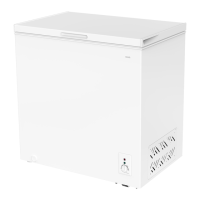
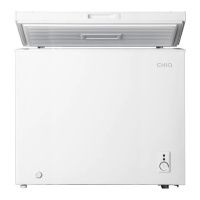
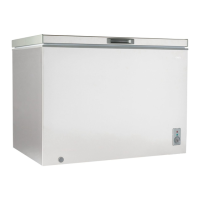
The freezer's design includes a handle, door, hinge, basket, trim, cabinet, ventilation cover, and feet. The control panel, located on the bottom right-hand side, features indicator lights and a thermostat adjustment knob.
- Temperature Control: The temperature of the freezer is adjusted by turning the knob on the thermostat. A higher number on the knob indicates a colder setting, with "5" being the coldest. For normal operation, a setting of "3" is recommended, but users can adjust it to best suit their needs. After any adjustment, it is advised to allow 24 hours for the temperature to stabilize. If the unit is unplugged or loses power, a delay of 3 to 5 minutes is necessary before restarting to prevent operational issues.
- Indicator Lights: The control panel includes two indicator lights:
- Red LED: This light indicates that the appliance is supplied with electricity. It should remain on continuously when the freezer is connected to power.
- Green LED: This light indicates that the compressor is actively working. It will turn off once the freezer reaches its set temperature and the compressor cuts off.
- Food Storage: Users are advised to allow hot foods to cool to room temperature before placing them in the freezer to prevent the compressor from working harder and to maintain food quality. Proper wrapping of foods and wiping containers dry before storage helps reduce frost build-up. Organizing and labeling food can minimize door openings and extended searches, contributing to energy conservation.
- Lid Operation: When the lid is closed, it may be difficult to re-open immediately due to negative pressure created as the warm air inside cools and contracts. To easily re-open the lid shortly after closing, users can gently grasp and peel back the flexible gasket slightly to allow air to flow in and equalize the pressure.
- Installation: Before initial use, the freezer should be allowed to stand upright for approximately 4 hours to settle the cooling system. It must be placed on a level and strong floor surface, away from direct sunlight and heat sources. A minimum of 10cm space around the back and sides is required for proper air ventilation. The leveling feet can be adjusted to ensure stability. The appliance is designed for free-standing use and should not be recessed or built-in. It is not suitable for outdoor installation or placement in moist or pest-infested areas. The freezer should be plugged into a dedicated, properly grounded wall outlet. After plugging in, allow the unit to cool for 2-3 hours before placing food inside.
Maintenance Features
Regular maintenance is crucial for the longevity and efficient operation of the CHiQ chest freezer.
- Cleaning:
- Interior: The interior should be cleaned with a damp cloth soaked in a solution of lukewarm water and about 2 tablespoons of baking soda per liter of water. All food content must be removed before cleaning.
- Exterior: The exterior, including the door and sides, should be cleaned with a mild detergent and warm water, then dried with a soft cloth.
- Door Gasket (Seal): The door gasket must be kept clean to ensure efficient operation and prevent dislodging or tearing.
- Condenser Coils: The condenser coils, which are internal and non-serviceable, should be vacuumed when dusty or dirty.
- Water Tray: The water tray above the compressor does not need to be emptied as the water evaporates from the heat generated by the compressor.
- Defrosting: The freezer requires manual defrosting when an ice layer of about 7 mm (1/4") forms.
- Before defrosting, set the thermostat knob to "5" for at least 6 hours to ensure food is at its lowest temperature before removal. Store food in a cool place during defrosting.
- Switch off the freezer and unplug it from the main power.
- Leave the lid open and remove the freezer basket. Warm water can be used to speed up the defrosting process.
- Important: Never use sharp metal tools for defrosting, as this can damage the gas pipe and void the warranty.
- Once defrosting is complete, remove the plug from the hole at the bottom back of the freezer and the rubber cap inside the freezer to drain the water.
- After all water has drained, replace the plug and cap, and thoroughly dry the freezer interior.
- Switch on the freezer and let it run for about three hours before reloading food.
- Vacation Time:
- Short Vacations (less than three weeks): Leave the freezer operating.
- Long Vacations (several months): Turn off and unplug the freezer. Remove all food, clean and dry the interior thoroughly. To prevent odors and mold, leave the door slightly open, blocking it if necessary, or remove the door entirely.
- Repositioning and Relocating:
- Turn off and unplug the freezer.
- Remove all food and drinks.
- Securely tape down all loose items inside.
- Tape the doors shut.
- Ensure the freezer remains in an upright position during transportation.
Safety Instructions
Users must adhere to basic safety precautions to minimize risks of fire, electrical shock, or injury. It is critical to use the appliance safely and avoid any attempts to repair or modify it, as this can cause harm and void the warranty. All packaging materials, especially plastic, should be kept out of reach of children. If the power cord is damaged, it must be replaced by the manufacturer or a qualified service agent. The power cord should be situated safely to prevent damage. Always switch off the unit from the outlet before unplugging; do not yank the cord.
Child Safety: To prevent child entrapment when discarding the unit, remove the door(s) and leave shelves in place to prevent children from climbing inside. Children should never be allowed to operate, play with, or crawl inside the freezer and should always be supervised near the unit. This appliance is not intended for use by persons with reduced physical, sensory, or mental capabilities, or lack of experience and knowledge, unless supervised or instructed by a responsible person. Dispose of the appliance at an authorized waste disposal center.
Ventilation Hazards: Never clean the freezer or its parts with flammable fluids, and do not store gasoline or other flammable vapors and liquids near the freezer, as they can cause fire, explosion, or inhalation hazards.
Electrical Connection: Ensure the power outlet is properly installed by a qualified electrician and the ground wire is correctly connected to meet Australian Electrical Standards.
R600a Refrigerant Warnings: The appliance contains R600a refrigerant. During transportation and installation, ensure the refrigerant circuit tubing is not damaged. Leaking refrigerant can ignite and harm eyes. In case of damage, avoid open fires or spark-creating devices, disconnect the appliance from mains power, ventilate the room thoroughly, and contact Customer Service. The room for installation must be at least 1 cubic meter per 8 grams of refrigerant. Do not store explosive substances like aerosol cans with flammable propellants in the appliance. Only authorized service personnel with a Gas Work Authorisation for hydrocarbon refrigerants should perform servicing or repairs involving cover removal. Keep ventilation openings clear, do not use mechanical devices to accelerate defrosting unless recommended by the manufacturer, and do not damage the refrigerant circuit. Do not use electrical appliances inside food storage compartments unless they are of the recommended type.
Troubleshooting Guide
The manual includes a troubleshooting guide to help users resolve common issues before calling for service. This covers problems such as the freezer not operating, the compressor running continuously, the temperature being too warm or too cold, the external surface being warm, popping or cracking sounds, bubbling or gurgling sounds, vibrations, moisture formation inside or outside the freezer walls, and doors not closing properly. Each problem is accompanied by possible causes and suggested solutions, such as checking power connections, adjusting temperature controls, ensuring proper door closure and seal, maintaining correct clearances, and allowing sufficient time for temperature stabilization.


 To Next Page
 General