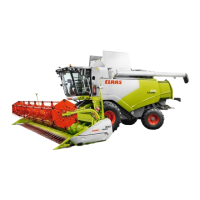
This document is a repair manual for CLAAS ROLLANT 66 and CLAAS ROLLANT 46 round balers. It is designed to assist personnel with the maintenance and service of these machines, ensuring their permanent working order. The manual compiles the experience of CLAAS Service engineers, providing detailed instructions and illustrations for various repairs and adjustments.
Function Description:
The CLAAS ROLLANT 66 and ROLLANT 46 are round balers, agricultural machines used to compress and bind cut crops (like hay or straw) into compact cylindrical bales. The manual covers the repair and maintenance of all major components involved in this process, including the machine drive systems, pick-up and assister feed rake, baler forming rollers, net wrapping system, twine tying mechanism, and hydraulics. The goal is to facilitate efficient and reliable operation of the balers by providing comprehensive repair guidance.
Important Technical Specifications (for ROLLANT 66, as detailed in the manual):
- PTO Speed: 540 rpm
- Universal Drive Shaft: Features a wide-angle joint on the tractor side and an over-run clutch on the machine side.
- Drawbar: Height adjustable.
- Tightening torque for M20 mounting bolts: 370 Nm (273 ft-lb)
- Tightening torque for M24 mounting bolts: 640 Nm (472 ft-lb)
- Tyres:
- 11.5/80-15.3 6 PR
- 15.0/55-17 10 PR
- Tyre Pressure: 2.0 bar (29 psi) for both tyre types.
- Wheel Tread: 2040 mm (80.3 in.) or 2070 mm (81.5 in.)
- Tightening Torque for Wheel Bolts: 150 Nm (110 ft-lb)
- Angle Drive Gearbox Capacity: 2.5 litres of hypoid transmission oil, SAE 90 to (MIL-L-2105 B) API-GL-5-90.
- Safety Features:
- Setting of pressure relief valve: 240+10 bar
- Shear bolt: M8 x 30 DIN 931-8.8
- Electrical remote control and lighting: 8 A fuse
The manual notes that specifications for the ROLLANT 46 are also included, but only the ROLLANT 66 details are visible in the provided excerpt.
Usage Features:
The manual is structured to be user-friendly, with repairs broken down into manageable steps. It uses a system of symbols (e.g., Remove/Dismantle, Grease, Prevent Damage, Disassemble, Oil, Special Tool, Assemble, Adjust/Set, Drain, Install/Mount, Visually Check, Fill, Mark, Unlock/Release/Secure, Overflow, Balance, Lock/Bound/Seal using adhesives, Bleed, Possibly Reusable, Block Up/Support/Hold, Renew on Each Assembly, Note Direction of Installation) to quickly convey information and simplify recurring service procedures. This visual aid helps users quickly understand the required actions. The manual is designed to be kept in a folder, allowing for easy insertion of supplementary pages as they are issued, ensuring it remains updated. Users are advised to always compare settings and filling capacities with the specifications in the Operator's Manual for the specific Round Baler.
Maintenance Features:
The manual provides general recommendations for repairs to ensure reliable service and durability of parts. Key maintenance features and recommendations include:
- Troubleshooting: Identify the cause of trouble, note defective parts, and take precautions to prevent accidents.
- Safety First: Always shut off the tractor engine and remove the ignition key before any repairs.
- Genuine Parts and Tools: Use only genuine CLAAS spare parts and suitable CLAAS special service tools.
- Oil Drainage: Always drain oil before removing transmission cases.
- Part Separation: Use plastic or soft metal hammers for tight-fitting parts.
- Tensioning Steel Roller Chains: Chains should be tensioned so the slack span can be deflected by approx. 2% of the distance between sprocket shaft centres. New chains require more frequent checks.
- Self-locking Bolts: Renew self-locking bolts (e.g., Verbus-Plus/Imbus-Plus) whenever they have been loosened. They can be reused up to three times in exceptional cases. Always tighten them quickly to the specified torque and ensure they do not contact sealing compounds. Regular bolts with locking compound can be used if the connection can be heated to 200°C (392°F) for removal. Self-locking bolts with adhesive-filled micro capsules should not be used where operating temperatures exceed +90°C (194°F). Full load can be applied after 24 hours of curing at 20°C (68°F), or 15 minutes at 70°C (158°F) with heating.
- Liquid Locking Compound: Use only when expressly recommended. Surfaces must be grease-free, cleaned with "Aktivator," and allowed to dry. Apply compound sparingly to the inside thread of nuts or the bottom end of threads in blind holes to prevent excessive breakaway torque. Connections can be loosened by heating to approx. 200°C (392°F).
- Lock Collar Bearings: Tighten by pushing the eccentric locking collar over the inner ring in the direction of shaft rotation, then tapping with a punch and hammer for a moderate lock, and finally tightening the set screw. Lubricate the inner ring and shaft with semi-fluid lubricant NLGI grade 00 (e.g., Shell Retinax G) before mounting to facilitate future removal.
- Olive-type Connectors on Hydraulic Lines: For preassembled fittings, tighten the union nut 1/2 turn beyond the point of noticeable effort. When preassembling, saw pipes at right angles (no pipe cutters), deburr ends, push union nut and olive onto the pipe, then push the pipe into the female connector and tighten the union nut until the olive contacts the pipe (pipe must not turn), then tighten 1/2 turn further. A noticeable collar must form in front of the olive. For subsequent reassembly, retighten the union nut without great force. If leaks occur, loosen the nut until a little oil escapes, then retighten.
- General Repair Advice:
- Mark parts before removal/disassembly for correct reinstallation and balance.
- Fit roll (expansion) pins with their gap pointing to the load side.
- Always renew cotter pins, split pins, locking wires, locking plates, tab washers, and lock washers.
- Fit lubricated ball and sleeve bearings coated with high-quality grease.
- Ensure chain sprockets and V-belt pulleys are correctly aligned.
- Maintain utmost cleanliness when working on the hydraulic system.
- Do not mix different types and grades of oil.
- After repairs, run the machine or assemblies at low speed initially.
- Inform the machine owner about the cause of damage, consequential damage, and parts involved.
The manual is divided into main groups (e.g., Specifications, Basic Components, Machine Drive Systems, Pick-Up and Assister Feed Rake, Baler Forming Rollers, Net Wrapping System, Twine Tying Mechanism, Hydraulics), with pages and illustrations numbered consecutively within each group. Differences between machine models are indicated by sub-titles or text headings.

 Need help?
 General

 To Next Page