EasyManua.ls Logo

Clark GCS 25 - Page 24

Clark GCS 25
128 pages
Print Icon
To Next Page IconTo Next Page
To Previous Page IconTo Previous Page
Loading...
General
Safety Rules
Fork
safety
*
-
I
•—
Planned
Maintenance
and
Lubrication
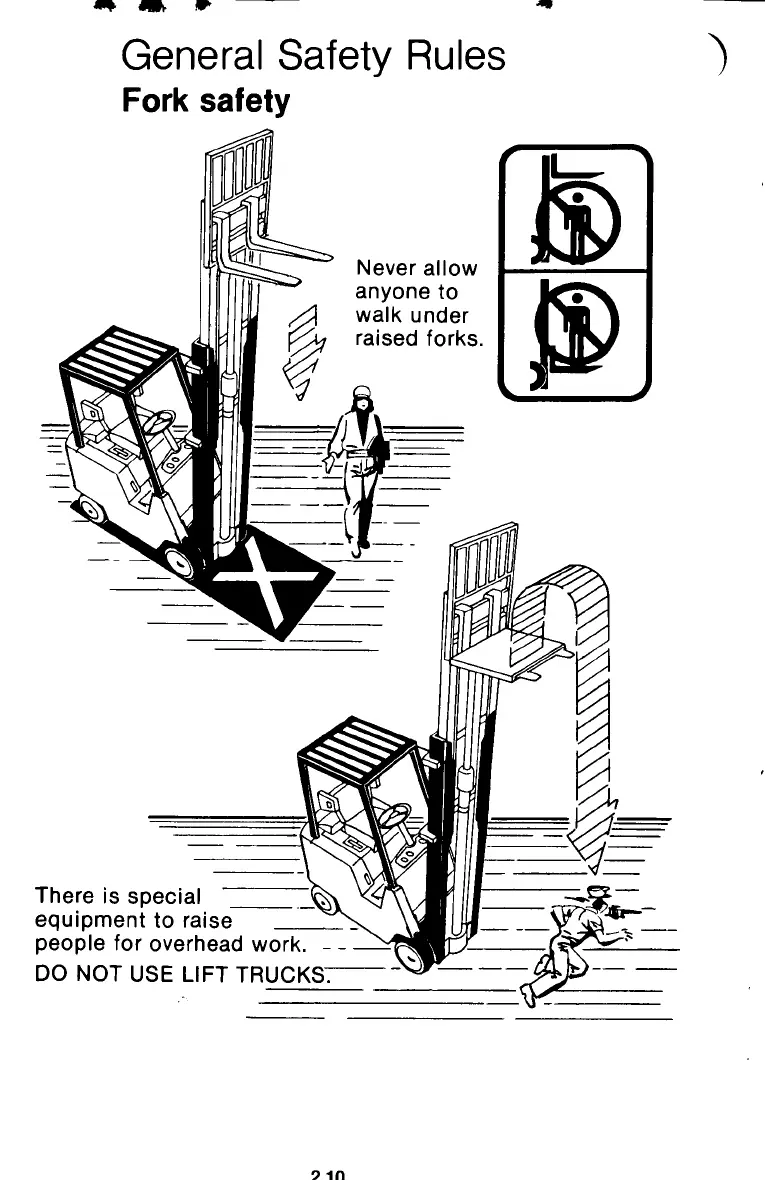
Never
allow
anyone
to
walk
under
raised
forks.
There
is
special
equipment
to
raise
people
for
overhead work.
- -
DO
NOT USE
LIFT
TRUCKST"
Transaxle
Fluid
&
Filter
Change
It is
recommended
to:
•
Drain
and
replace
the
trans-
axle
fluid
every 1000 operating
hours.
* •
Replace
the
transmission
oil
filter every
500
operating hours.
*When
the
transaxle
is new or
rebuilt,
it is
recommended
to
change
the oil
filter
after
the
first
50
hours
and
again
after
100
operating
hours.
The
reason
for
this
is to be
sure
that
the oil is
cleaned
of all
harmful
par-
ticles
of
material
which
may be
loosened
or
flushed
off new
parts
as
they
wear
in.
To
change
oil in the
transaxle:
1.
The oil
should
be
drained
when
it is
warmed
to
operating
temperature.
2.
Put the
truck
in a
level posi-
tion.
3.
Apply
the
parking brake
and
block
the
wheels
to
prevent
the
truck from moving.
NOTICE: When suitable equip-
ment
is
available,
the
truck
may
be
raised
or
hoisted
up and
placed
in a
level
position
on
wheel cradles
to
allow access
under
the
axle. Otherwise, raise
the
fork
carriage
only
high
enough
to
provide access
to the
axle. Please refer
to
procedure
described
above
in
"Access
to
the
Drive
Axle".
NOTICE
Frequent changes
of
lubricant
and
filters
is an
inexpensive
way to
pro-
tect
and
prolong
the
safe opera-
ting
life
of an
essential
and
rela-
tively
more valuable major compon-
ent
such
as the
transaxle.
Extending
the
recommended inter-
vals
at
which
transaxle
fluid
and
filters
are
changed
should
be
con-
sidered only after careful evalua-
tion
of
your
operating
conditions
and/or analysis
of the
condition
of
the
oil. Because
the oil is
heated
to
very
high
temperatures
when
a
troque converter
and
transmission
are
operated under heavy
or
sus-
tained
working
conditions,
it
will
"wear
put" (break down)
and
lose
its
lubricating
ability
due to
oxida-
tion.
When this happens,
it
will cause
rapid
wear
and
damage
to
seals,
bearings,
and
clutch
plates,
result-
ing in the
need
for a
much more
costly transmission
rebuild.
2.10
0-11

Related product manuals