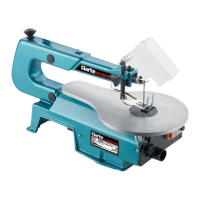
This document is the operating and maintenance manual for the Clarke 400mm (16") Scroll Saw, Model No. CSS 400, Part No. 6460100. It provides comprehensive instructions for safe operation, assembly, installation, and upkeep of the scroll saw, designed for both professional and DIY enthusiasts.
Function Description:
The Clarke 400mm (16") Scroll Saw is a woodworking machine primarily designed for cutting intricate curves and patterns that other saws cannot achieve. It can also perform straight line cuts, cross cuts, ripping, and bevels. The saw operates by moving a small, thin blade up and down, allowing the user to guide a workpiece into the blade to create precise cuts. Its unique capability lies in its ability to cut intricate patterns inside a workpiece by drilling a pilot hole and threading the blade through it. The machine is intended for indoor use only and requires secure mounting to a stand or workbench for stable operation.
Important Technical Specifications:
- Motor Voltage: 230V, 50Hz, 1 phase
- Motor Rating: 90 Watts
- Maximum Thickness of Cut: 50mm (2")
- Throat: 400mm (16")
- Blade Length: 125mm (5")
- Strokes per Minute: 1400
- Stroke Length: 20mm (3/4")
- Table Size: 375 x 200mm
- Machine Dimensions: 540 x 265 x 360mm
- Table Tilt: 0° - 45° left
- Base Size: 400 x 215mm
- Blade Type: Pin (plain type optional)
- Gross / Net Weight: 22 / 20kg
- Fuse Rating: 5 amps (ASTA approved to BS1362)
Usage Features:
The scroll saw offers several features to enhance its usability and versatility:
- Blade Holder Alignment: The manual emphasizes the importance of checking and adjusting blade holder alignment to prevent blade wandering and extend blade life. A metal strip is provided to aid in this alignment.
- Bevel Alignment: The table can be tilted from 0° to 45° left, allowing for bevel cuts. The bevel indicator can be aligned using a small square to ensure accuracy.
- Blade Installation/Renewal: The saw supports both standard blades with end pins and plain blades using a pair of provided holders. Instructions detail how to install blades, ensuring teeth point downwards and tension is correct. Side cutting is possible when the bevel is set at 0°, useful for workpieces over 16" long.
- Blade Selection: The manual provides a guide for selecting the appropriate blade based on TPI, width, thickness, and material type. Narrower blades are recommended for intricate curves, while wider blades are for straight and large curve operations.
- Operating Characteristics: Users are advised to feed the workpiece slowly, especially with thicker materials (over 1" thick), as the blade cuts only on the down stroke. The blade's tendency to follow wood grain requires careful guidance. Blades wear out and need frequent replacement (approximately 1.5 to 2 hours of continuous running).
- Straight Line Cutting: Achieving straight cuts requires practice due to the blade's fragility and influences like blade tension, condition, and holder alignment.
- Cutting Intricate Patterns: For internal cuts, a pilot hole is drilled, the blade is removed, threaded through the hole, and then reinstalled and re-tensioned.
- Safety Precautions: The manual includes general safety rules for operating machinery and specific precautions for scroll saws. These include wearing safety goggles and dust masks, securing the machine, keeping the work area clear, ensuring correct blade tension, and disconnecting power during adjustments or blade changes. It warns against forcing the machine, operating under the influence, leaving the machine unattended, overreaching, and standing on the machine.
Maintenance Features:
Regular maintenance is crucial for the longevity and performance of the scroll saw:
- Work Table Lubrication: Apply a thin coat of paste wax to the work table periodically to ensure smooth gliding of wood.
- Arm Bush Lubrication: After every 50 hours of use, lubricate the upper and lower arm bushes with SAE 20 oil.
- Motor Maintenance: The motor is permanently lubricated, and users are advised not to attempt to oil its bearings or service internal parts.
- Power Cord Inspection: Regularly check the power cord for wear, fraying, cuts, or damage, and replace it if necessary. Do not attempt to patch it with electrical tape.
- Troubleshooting Guide: A comprehensive troubleshooting section helps diagnose and resolve common issues such as breaking blades (due to incorrect tension, overuse, wrong blade type, or twisting), motor not running (defective cord/plug or motor), excessive vibration (improper mounting, unsuitable surface, loose table/motor mount), and blade runout (misaligned blade holders, insufficient tension, dull blade).
The manual emphasizes the importance of using only approved replacement saw blades and contacting Clarke International for spare parts and service.

 Need help?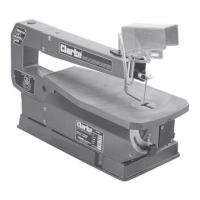

 To Next Page
 General