Need help?
Do you have a question about the Clarke PC60 and is the answer not in the manual?
Details the obligation for WEEE disposal according to regulations.
Explains connecting the converter to the supply and motor, detailing cable requirements.
Details wiring the output plug and socket for the 3-phase motor.
Provides a table for setting switches based on motor HP for correct output.
Covers motor reversal procedures and the use of pilot motors for specific applications.
Discusses power losses, control circuit feeds, and multispeed machine operation.
The CLARKE Single to 3 Phase Converter, Model PC60, is a robust electrical device designed to enable the operation of 3-phase asynchronous motors from a 230V single-phase supply. This converter is primarily intended for use with motors that run continuously, making it less suitable for applications requiring frequent stop-start operations due to its inherent characteristics. Its core function is to transform a single-phase input into a three-phase output, thereby allowing industrial machinery designed for three-phase power to be used in environments where only single-phase power is readily available.
The phase converter works by generating a third phase from a single-phase input, effectively creating a three-phase power supply suitable for asynchronous motors. The unit takes a 230V AC, 50-60Hz single-phase input and converts it to a 3-phase 400VAC output, capable of delivering up to 5.5 HP. This conversion process involves a combination of capacitors and an auto-transformer to synthesize the missing phase, ensuring a balanced three-phase output for the connected motor.
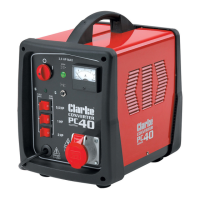
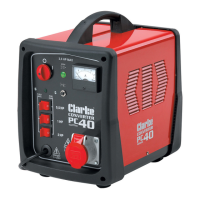
The front panel of the converter features an ON/OFF switch (A) to power the unit, an ammeter (C) to monitor current, and a series of three switches (G) (SW1, SW2, SW3) that allow the user to select the appropriate output horsepower (HP) to match the driven motor. An indicator lamp (B) illuminates when the converter is switched ON, and another indicator lamp (F) lights up when the output switches (G) are correctly set. The output socket (E) is a 4-pin, 16A, 400V (3-pin + earth) connection, designed to interface with the motor's plug.
A critical safety feature is the thermal overload protection. Should the unit overheat, this mechanism will trip, cutting off the supply to the motor/machine. A reset button (D) is provided to restart the unit after it has cooled down. The internal components, such as capacitors (MKM 8mf, 16mf, 25mf, 50mf 450V), a relay (LY2 24VDC), and a circuit breaker (32A), work in concert to manage the power conversion and ensure safe operation. The auto-transformer (22) plays a central role in the voltage transformation and phase generation.
Operating the PC60 phase converter requires careful attention to the setup and selection of output settings. Before connecting any motor, all three output switches (G) must be set to OFF. The converter is then switched ON using the main ON/OFF switch (A), which will illuminate the main indicator lamp (B) and the rocker switch. At this point, the ammeter (C) should be checked and adjusted to read zero if necessary, using the small adjustment screw located at its bottom centre.
Once the initial power-on checks are complete, the converter should be switched OFF before connecting the motor's plug to the output socket (E). The next crucial step is to set the output HP using the three switches (G) to match the HP rating of the motor to be driven, as found on the motor's data plate. A chart is provided in the manual to guide the user in selecting the correct switch combination for various HP outputs, ranging from 1 HP to 5.5 HP. It is imperative that these switches are not adjusted while the phase converter is switched ON, as this could lead to damage. Once the switches are set, the indicator lamp (F) will illuminate, confirming the selected output.
After setting the output, the converter can be switched ON again, and the motor/machine can then be started. The converter is designed to provide a 3-phase, 3-line load as standard. If a neutral connection is required for specific applications, users are advised to contact their dealer or Clarke Service for guidance.
When connecting the output, it is important to ensure that pins L1 and L3 of the 4-pin plug are used for the connections across the motor windings, as these are considered the 'hot phases'. The manual provides a diagram of the socket configuration to aid in correct wiring. For those unsure about wiring, consulting a qualified electrician is recommended.
The converter's design emphasizes safety, with warnings against opening or removing covers while connected to the mains, and against operating with panels open. Repairs should only be attempted by qualified electricians. The unit is not suitable for use in wet or damp environments.
The CLARKE PC60 phase converter is designed for reliable operation, but proper installation and adherence to operating guidelines are key to its longevity and performance. While the manual does not detail routine user maintenance tasks beyond initial setup and troubleshooting, it emphasizes several critical aspects related to its care and use.
One significant maintenance-related feature is the thermal overload protection. In the event of an overload, the unit will shut down automatically. The user's role here is to switch the unit OFF, allow it to cool for at least 5 minutes, and then press the Reset button (D) to restart. Crucially, the user is also advised to investigate the cause of the overheating to prevent recurrence, which might involve consulting a qualified engineer. This proactive approach helps in identifying and rectifying underlying issues that could lead to repeated thermal trips and potential damage to the converter or the connected motor.
The manual also highlights the importance of correct electrical installation. It recommends that installation be carried out by a qualified electrician with a thorough understanding of industrial switching applications. This ensures that the supply and cabling are of sufficient capacity to start the motor without causing undue voltage drops, which can impact the converter's performance and lifespan. The provided 2M (minimum) 3-core input cable requires proper connection to the power supply, following the specified colour codes for Earth, Neutral, and Live.
For machines with a contactor starter, it is noted that the control circuit should be fed from the two live phases (L1 and L3 in the socket). If the contactor chatters or fails to operate, it indicates an incorrect control circuit feed, requiring attention. If the control circuit is designed for 230 volts AC, a separate feed must be provided, and a qualified technician should be consulted if there is any doubt.
When using the converter with multispeed machines, a specific procedure must be followed: allow the machine to slow down before switching from high to low speeds. Failure to do so can generate excess motor back E.M.F., potentially damaging both the converter and the motor. Similarly, when reversing a motor, it must be ensured that the motor has fully stopped before initiating the reversal.
The manual also touches upon potential issues with small motors or motors with unusual magnetic characteristics, suggesting that a pilot motor might be necessary to achieve phase balance. This indicates that while the converter is versatile, some applications may require additional components or expert consultation to optimize performance and prevent issues.
Overall, the maintenance philosophy for the CLARKE PC60 revolves around correct installation, vigilant operation, prompt troubleshooting of issues like overheating, and seeking professional assistance when necessary, all of which contribute to the long-term reliability and safety of the device.
 General
| Type | Media Converter |
|---|---|
| Model | PC60 |
| Data Rate | 10/100 Mbps |
| Operating Temperature | 0°C to 50°C |
| Connector Type | RJ45 |

 To Next Page