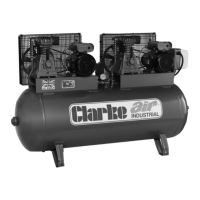
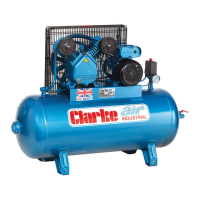
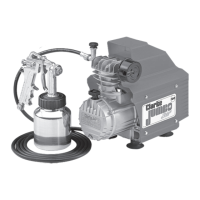
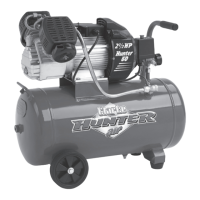
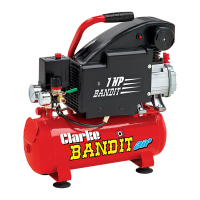
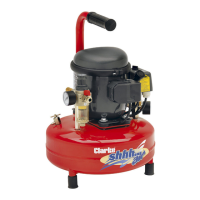
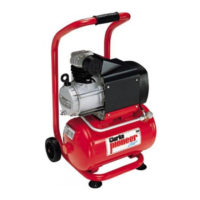
This document is an operation and maintenance manual for Clarke XE Range Electric Motor Driven Air Compressors.
Function Description:
The Clarke XE Range Air Compressors are designed to supply compressed air for a wide range of applications, including spraying, sanding, drilling, and cutting. These compressors are electric motor-driven and are intended for indoor use.
Important Technical Specifications:
The manual provides a table of models covered, along with their sound power level (dB(LWA)) and sound pressure level (dB(LAEQ)). For example:
- XEV11/100: Sound Power level 98 dB(LWA), Sound Pressure level 81 dB(LAEQ)
- XEP15/50: Sound Power level 101 dB(LWA), Sound Pressure level 78 dB(LAEQ)
- XE18/200: Sound Power level 104 dB(LWA), Sound Pressure level 87 dB(LAEQ)
- XE37/270: Sound Power level 106 dB(LWA), Sound Pressure level 88 dB(LAEQ)
Electrical connection details include suggested fuse ratings for single-phase and three-phase motors (415V).
- Single Phase Motor D.O.L.:
- 0.75 KW (1.0 HP): 13 amp
- 1.1 KW (1.5 HP): 13/15 amp
- 1.5 KW (2.0 HP): 20 amp
- 1.9 KW (2.5 HP): 20 amp
- 2.2 KW (3.0 HP): 30 amp
- 3.0 KW (4.0 HP): 40 amp
- Three Phase Motors 415V D.O.L.:
- 0.75 KW (1.0 HP): 10 amp
- 1.1 KW (1.5 HP): 10 amp
- 1.5 KW (2.0 HP): 10 amp
- 2.2 KW (3.0 HP): 16 amp
- 3.0 KW (4.0 HP): 20 amp
- 4.0 KW (5.5 HP): 25 amp
- 5.5 KW (7.5 HP): 30 amp
- Three Phase Motors 415V Star Delta:
The maximum working pressure of the compressor is stated on the machine plate.
Usage Features:
The manual outlines detailed instructions for installation, starting, and stopping the compressor, along with safety precautions.
Installation:
- Compressors should be placed on a firm, level surface, ideally with anti-vibration pads for stationary models. Direct bolting to the floor is not recommended.
- A dust and damp-free environment with adequate ventilation for the compressor pump and electric motor is crucial.
- A minimum clearance of 500mm around the machine is required for servicing.
- The power cable must be appropriately sized for the motor's starting and running load, especially if the compressor is far from the power source.
- Electrical installations should be performed by a qualified electrician, using a suitably fused approved plug or isolator. Motor-rated circuit breakers of sufficient size are recommended.
- Connection to the mains electricity supply should be via an earth leakage protection device (RCD).
- Moving the compressor should be done carefully, using slings beneath the receiver near the domed ends with a forklift truck or wheeled gantry crane, being mindful of off-centre loads.
Before Starting:
- Check the compressor pump oil level using the dipstick or sight glass.
- Ensure the pressure switch ON/OFF switch is in the OFF position.
- Crucially, all outlet valves must be open before starting the compressor.
- The manual emphasizes following start and stop instructions precisely to avoid damage.
Starting the Compressor:
- Switch on the mains isolator.
- Switch on the pressure switch (lift knob or twist switch).
- Check the rotation: the flywheel/fan should blow air over the pump.
- Verify that the pressure does not exceed the maximum working pressure stated on the machine plate. If it does, stop the machine, vent the system, and contact Clarke Service Department.
- For compressors up to 3HP, an auto bleed valve will operate, venting air for a few seconds, which is normal.
Stopping the Compressor:
- Switch off the pressure switch (push knob down or turn switch).
- Isolate from the mains supply.
- Drain the air receiver by releasing the drain tap.
- Warning: Compressor pumps and delivery pipes will remain hot for some time after use.
Outlet Pressure Adjustments (Portable Compressors):
- Portable compressors feature a pressure adjusting knob, outlet taps, and a pressure gauge.
- To increase pressure, turn the knob clockwise; to decrease, turn anticlockwise.
- Outlet taps are opened by sliding the knurled section away from the body and closed by pushing it towards the body.
- Note that the pressure gauge reading may differ by approximately 1 bar depending on whether outlets are open or closed.
Outlet Pressure Adjustments (Stationary Compressors):
- Stationary machines do not have a facility to adjust outlet pressure. Airline accessories are available from Clarke stockists.
- The electric motor is equipped with an automatic overload detector. If an overload is detected:
- Switch off the pressure switch.
- Allow the compressor to cool for 5-10 minutes.
- Press the Reset button.
- Switch on the pressure switch.
- Repeated tripping may indicate a fault, requiring contact with the Clarke service department.
Maintenance Features:
The manual includes a comprehensive troubleshooting chart and a maintenance chart.
Lubrication:
- Use Clarke compressor oil as indicated on the machine plate.
Troubleshooting Chart (Key issues and remedies):
- Compressor will not start automatically: Fault in electrical installation, current supply failure, voltage drop, faulty motor starter, incorrectly connected/faulty motor, tripped starter overload, defective pressure switch, blown fuse.
- Remedies: Electrician check, reset overload button, replace pressure switch/fuse, contact Clarke Service.
- Compressor unit will not stop automatically: Defective pressure switch.
- Remedy: Contact Clarke Service.
- Fuses keep blowing: Inadequate fuse size, fault in motor.
- Remedies: Replace fuse with correct rating (refer to page 6), contact Clarke Service.
- Bleed valve under pressure switch blows whilst compressor is not running: Non-return valve leaking.
- Remedy: Clean non-return valve or replace.
- Bleed valve under pressure switch blows whilst compressor is running: Non-return valve stuck open.
- Remedy: Drain tank, remove inspection nut, clean non-return valve.
- Compressor unit starts, but stops again after only a few revolutions: Non-return valve leaking/blocked/frozen, solenoid valve leaking/defective (10 HP+ machines).
- Remedies: Clean/replace non-return valve, thaw valve, contact Clarke Service.
- Unusual noise from compressor: Loose bolts, V-Belt/cooling coil touching guard, loose flywheel, unsuitable base, worn bearings/piston rings/cylinder, broken valve, worn electric motor bearings.
- Remedies: Tighten bolts/flywheel, find/remedy contact point, move unit to solid base, contact Clarke Service.
- Compressor unit starts and stops more frequently than usual: Large condensation in air receiver, leaks in control unit/inspection cover, too little pressure differential.
- Remedies: Drain condensation weekly, locate/repair leaks, contact Clarke Service.
- Compressor's oil consumption rising: Too much oil, leaks around crank case, high working temperature (insufficient cooling), unit too small, semi-automatic unit load too small, worn cylinder, blocked intake air filter.
- Remedies: Check oil level, contact Clarke Service, increase ventilation, connect supplementary, convert to fully automatic, clean/change air filter.
- Compressor runs continuously and can't attain working pressure: V-belt too slack, leak between compressor block/air receiver, low RPM (incorrectly connected motor), blocked valves, leaking inspection cover/plug, difficult suction/warm intake air, defective pressure gauge, unit too small, worn compressor.
- Remedies: Tighten V-Belt, tighten connections/repair leaks, contact Clarke Service, clean valves, ensure unobstructed airflow, install larger compressor, overhaul/replace compressor.
- Compressor unit starts when no air is being used: Leaks in pipework system.
- Remedy: Locate and repair leaks.
- Machine running but not pumping air into receiver (10HP only): Air exhausting from solenoid after starter changed direction.
- Remedy: Check solenoid valve, contact Clarke Service.
- Compressor becomes too hot: Insufficient ventilation, low oil level, faulty valves, blown head gasket, dirt on cooling fins/suction filter, unit working at too high pressure, non-return valve partly blocked, compressor overworked.
- Remedies: Ensure sufficient air supply/ventilation, fill oil, clean cooling fins/suction filter, clean/thaw non-return valve, use larger compressor.
- Oil in the air delivered: Sump over full, worn cylinder, blocked intake air filter.
- Remedies: Reduce oil, contact Clarke Service, change air filter.
- Condensation in crank case (especially 2-stage): Compressor over-dimensioned (short operational periods).
- Remedy: Frequent oil changes, reduce cooling of crank case.
- Condensation at outlet points: Incorrect piping installation, compressor taking in warm air, high delivery air temperature.
- Remedies: Consult local dealer, obtain better fresh air supply, use larger air receiver.
- Electric motor too hot (max 90°C/194°F): Low operational voltage, electrical installation faults, cooling fins blocked by dirt.
- Remedies: Call electrician, contact Clarke Service, clean cooling fins.
Maintenance Chart (Scheduled checks):
- Daily: Oil level check, air receiver drain.
- Weekly: Intake filter check/clean, oil breather check/clean, fan and cooling fins clean.
- 6 Monthly: Oil change, non-return valve replace if worn, belt tension check/adjust/replace if worn, big end bearings check, main bearings check, piston rings check, cylinder head bolts check torque settings.
- Notes: Intake filter replacement if necessary. If inlet/outlet valves, big end bearings, main bearings, or piston rings are worn, contact Clarke Service. Belt tension does not apply to direct drive models.
The manual concludes with a Declaration of Conformity, stating compliance with various EU directives including Electromagnetic Compatibility, Machinery, Restriction of Hazardous Substances, Simple Pressure Vessel, and Noise Emissions. The CE mark was first applied in 2016.

 To Next Page

 General