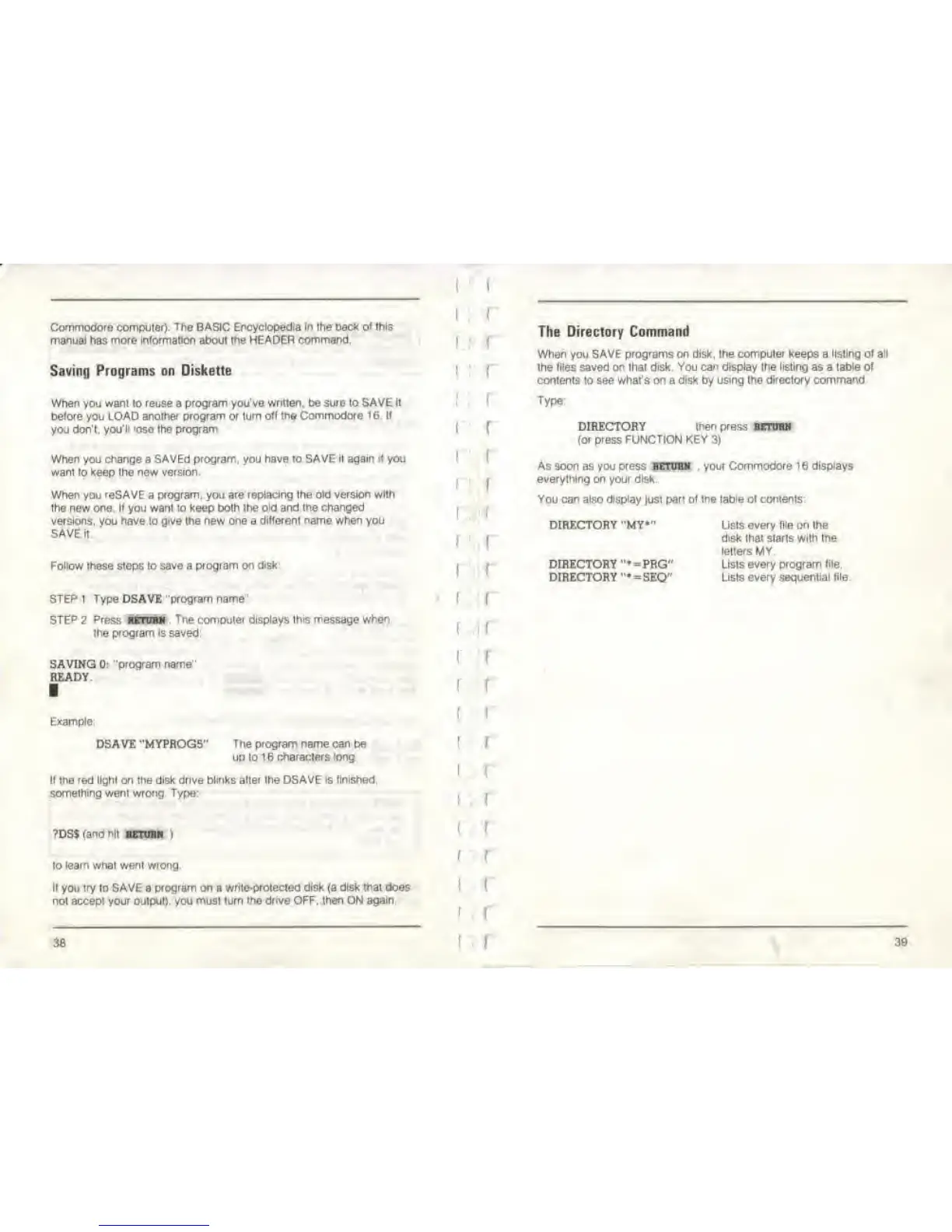
Commodore
computer). The BASIC Encyclopedia
In
the back
of
Ihls
manual has more Information about the HEADER command.
Saving
Programs on Diskette
When you want lo reuse a
program
you've
written, be sure to SAVE it
before
you
LOAD anolher program or turn otl the
Commodore 16.
K
you
don't,
you'll lose
the
program
When
you
change
a
SAVEd program, you have to SAVE it again
it
you
want to
keep
the new version
When
you
reSAVE
a
program, you are replacing the
old
version with
the new one. If you want to keep both the
old
and
the changed
versions, you have lo
give the
new one a
different name when you
SAVE
it.
Follow
these steps to save a
program on disk:
STEP 1 Type DSAVE
"program name
'
STEP 2 Press return
Tne computer
displays
this message when
the
program is
saved:
SAVING
0: "program name"
READY.
I
Example
DSAVE
"MYPROGS"
The program name can be
up lo
1
6
characters long
It the red light
on
the
disk
drive blinks after the DSAVE is finished,
something went wrong Type-
?DSS
(and "it BBTUHN
to learn what went wrong.
If you try lo SAVE a program on a
write-protected disk
(a
disk thai does
not accept
your
output} you
must turn the drive OFF, then ON
again
i
I
1 1
1
1
1
1
1
1
(
1
1
I
I
I
I
I
I
(
(
(
I 1
1
( 1
1
(
1
f
1
'
1 1
1
(
1
(
(
1
The
Directory
Command
When you SAVE
programs
on disk, the
computer
keeps a
listing of all
the
flies
saved
on
ihat
disk.
You
can display the listing
as a
table
of
contents to see what's
on
a disk by
using the directory command
Type;
DIRECTORY
then press HETUHH
(or ptess FUNCTION KEY
3)
As soon as you press return your Commodore 1 6
displays
everything
on
your
disk.
You can
also
display
just part of
the table of contents:
DIRECTORY
"MY""
DIRECTORY
"'^PRG"
DIRECTORY "«=SEQ"
Lists every
tile
on Ihe
disk
that starts with
the
tetters MY.
Lists every program file.
Lists every
sequential file.
I 98


 To Next Page