11
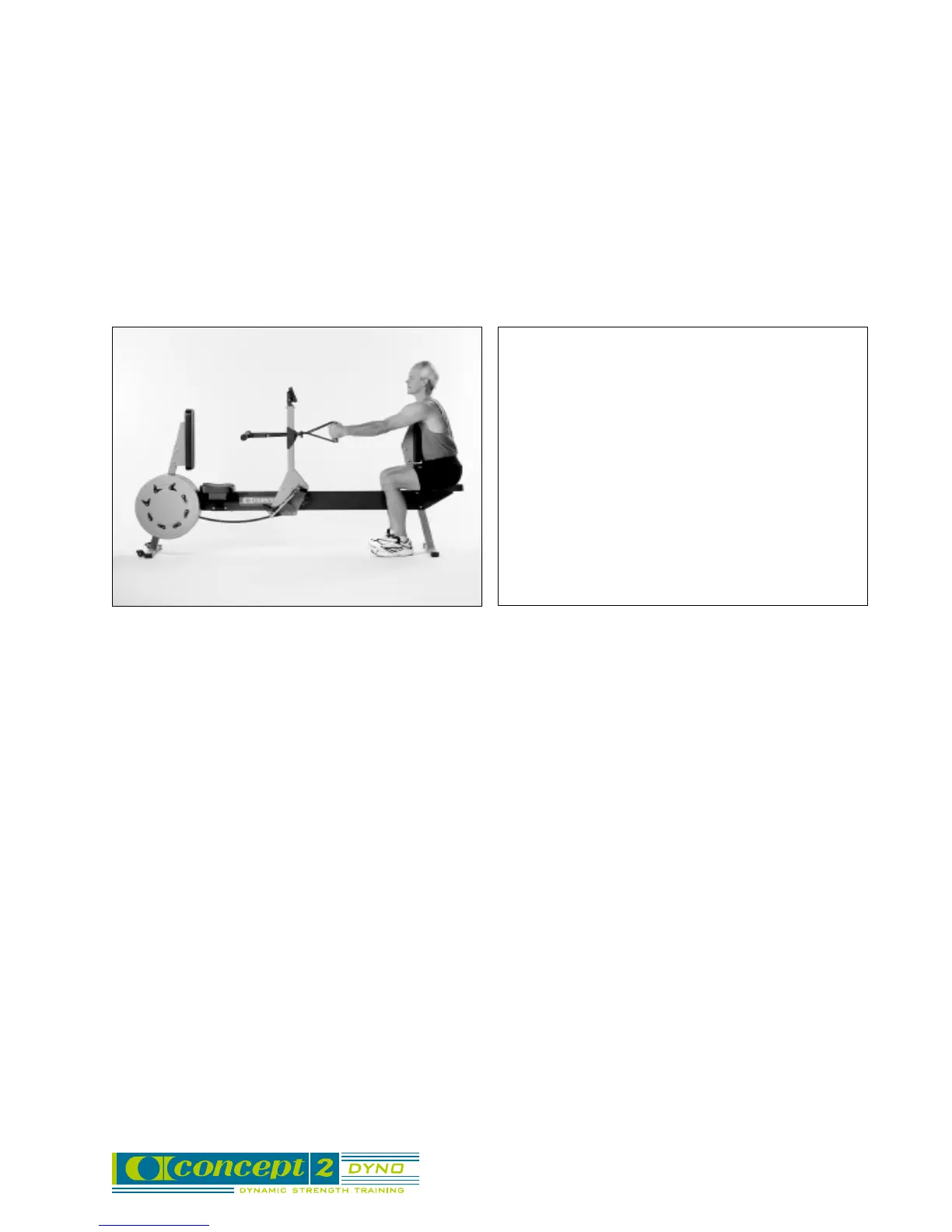
3) Seated Bench Pull
a) Handle height: Loosen the knob that holds the handles on the vertical post. Set the bar
height so that the handles are about five inches below your bench press setting. Tighten
the knob.
b) Damper levers: Start in the range of 1-2 dampers open.
c) Sit with your knees far enough apart to allow the carriage to travel all the way to the chest
support.
d) Start position: Start the pull with arms fully extended.
e) Finish position: The pull is complete when you have pulled the handles all the way to your
body or just past the seat back.
Your First Session:
• Be sure to do 5-10 minutes of cardiovascular activity as a warm-up.
• Stretch.
• Order of “Lifts”: Start with one of the upper body “lifts” (Seated Bench Press or Seated Bench
Pull), then do the Leg Press, and finish with the remaining upper body lift.
• Protocol: A typical protocol for general strength improvement is three sets of eight reps. (In
other words: 8 reps, rest, 8 reps, rest, 8 reps.) If this feels like too much, just do one or two
sets. If you are accustomed to another protocol from standard weight lifting, you may wish to
apply it to the
DYNO
as well.
• Work gently at first, applying only as much pressure as is comfortable. Remember, the harder
you push, the harder it will feel. Watch the monitor and get used to how it feels at different
force numbers.
• Watch your compression on the Leg Press to see what amount of compression is natural and
comfortable for you. Record this in your log.
• Use your first session to get comfortable. If you feel that a “lift” would be more comfortable if
you adjusted your settings, go ahead and change them. When you are comfortable, record all
settings so you can duplicate them for your next
DYNO
session.
By the end of the first workout, you should have established your settings and compression tar-
gets. For subsequent workouts, it will be important to keep these variables consistent in order to
be able to accurately monitor your progress. You will also have an idea of how much force you can
apply and what the set average means.
Start
Finish



 To Next Page