STROBOCONN
"PIANO TUNING" MANUAL
INTRODUCTION
The
Stroboconn is
an
electronic device
for
instanta-
neous
and
accurate visual measurement
(or
comparison)
of
sound frequencies. Its frequency range is from 31,772
to 4,066.8 cycles
per
second-essentially
covering the
range
of
the piano keyboard.
The
Stroboconn is
now
widely
known
and is rapidly
becoming a daily byword among piano tuners
and
tech-
nicians
throughout
the world.
It
is a highly scientific
addition to the traditional
"tools
of
the trade," which
enables
the
tuner
to
carryon
his skilled
work
more
rapidly
and
with
more
confidence
than
ever before.
Here
are some
of
the most practical
and
helpful
ways
in which the
STROBOCONN
saves
time
and
increases
the
earni11gs
of
the tuner!
1.
Time
consuming
and
difficult "setting
of
tempera-
ment"
is speeded
up
to
require
no
more time than
other
octaves. Each note is tuned visual1y, quickly,
and
the temperament is automatically set.
2.
Time
required
to
"beat"
(count
beats) is elimin-
ated-visual
pattern
appears immediately.
3.
Time
required for total
tuning
job may be greatly
reduced with this advanced method.
4. A permanent, visual record
of
each
tuning
can be
kept
which enables
an
exact duplication
of
the
tuning
job
at
any time.
5.
Piano can be tuned to standard
of
A-440-or
any
other
standard
of
frequency,
with
equal ease.
6.
Piano can be tuned
with
ease to mean-tone scale,
Pythagorean Scale,
Just
Scale,
or
any
odler
scale.
7.
The
amount
of
octave stretching required by each
piano can be measured
with
the Stroboconn, en-
abling the technician
to
achieve the best sound
the piano is capable
of
producing.
8.
Enables the technician to use more
of
his percep-
tion powers by using
both
eyes and ears
to
give
less chance
for
error
and means for quick checks
to see
if
any accidental change has ,occurred.
9. Many tuners are getting
higher
prices
for
Strobo-
conn tunings.
10.
Although
this is a simplification and extension
of
a technique already used by some technicians, it
provides,
for
the first time,
an
accurate and de-
pendable visual guide.
11,
Proof
of
the accuracy
of
the
tuning
job
can be
given
the
customer by showing him the visual
reading
on
the Stroboconn.
This
creates customer
confidence and satisfaction.
12.
Makes possible "identical" tunings for two
or
more pianos to be used together
or
for
piano and
organ.
13.
Makes accurate
tuning
possible in noisy sur-
tOundings.
The
information which follows will
help
darify
many
questions which may occur to you in connection with the
use
of
the Stroboconn in piano tuning!
In
addition,
it
is also urgently suggested
that
the operator's manual be
studied carefully before using the instrument.
..-
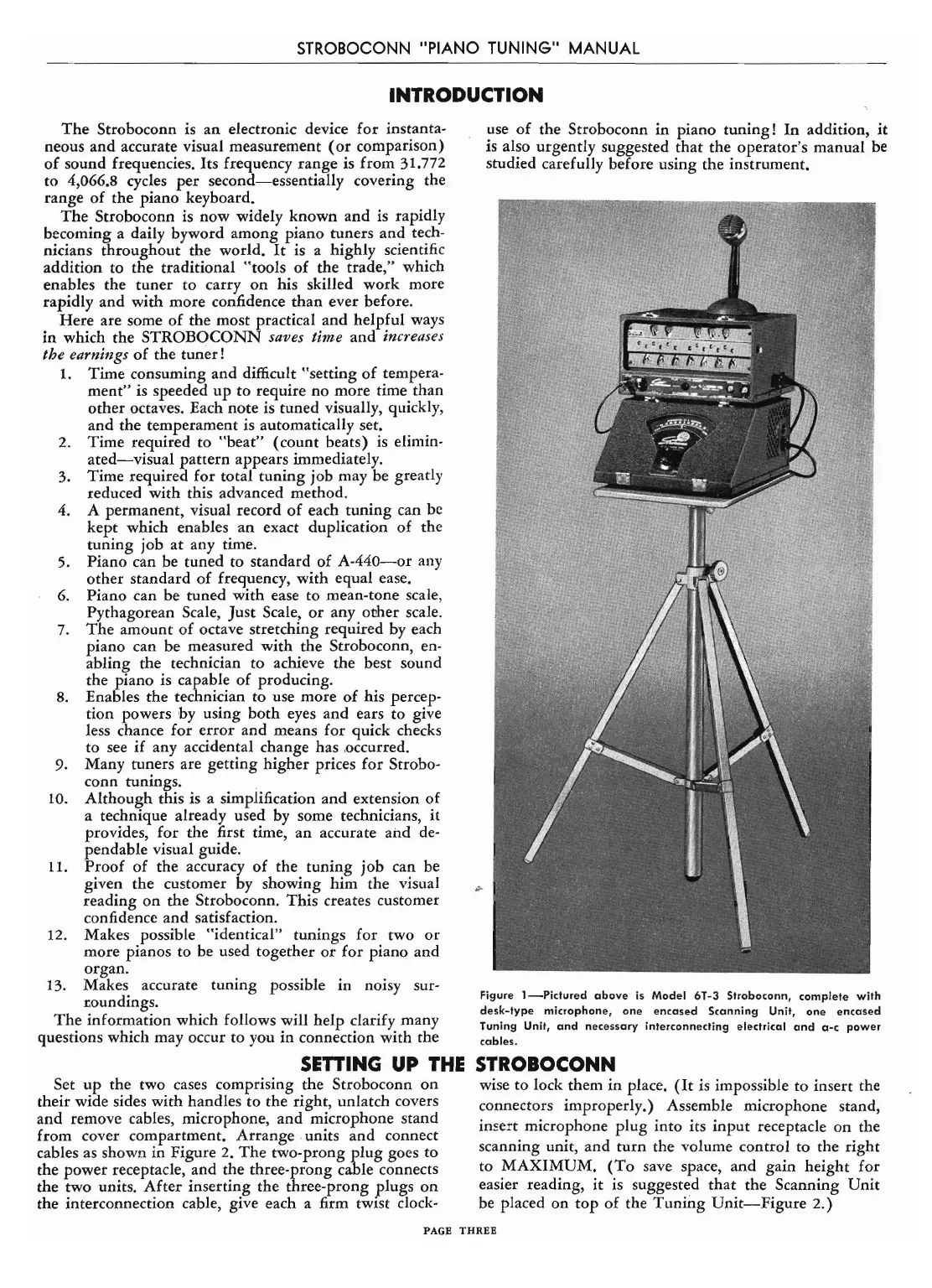
Figure
I-Pictured
above
is
Model
6T-3
Stroboconn,
complete
with
desk·type
microphone,
one
encased
Scanning
Unit,
one
encased
Tuning Unit,
and
necessary
interconnecting
electrical
and
a-c
power
cables.
SEnlNG
UP
THE
STROBOCONN
Set
up
the two cases comprising the Stroboconn
on
wise
to
lock them
in
place.
(It
is impossible
to
insert the
their wide sides with handles to the right, unlatch covers connectors improperly.) Assemble microphone stand
afnd
remove cables, microphAone, and
m~crophdone
stand insert microphone
plug
into its
input
receptacle on
th~
rom cover compartment. rrange .
umts
an connect
..
.
cables as shown in Figure
2.
The
two-prong
plug
goes
to
scannmg umt, and
turn
the volume control to the rIght
the power receptacle, and the three-prong cable connects
to
~AXIMUM.
(To
save space, and gain
height
for
the two units.
After
inserting the three-prong 'plugs
on
eaSler reading,
it
is suggested
that
the Scanning
Unit
the interconnection cable, give each a firm
tWlSt
clock- be placed on
top
of
the
Tuning
Unit-Figure
2.)
PAGE
THREE



 To Next Page
 Loading...